
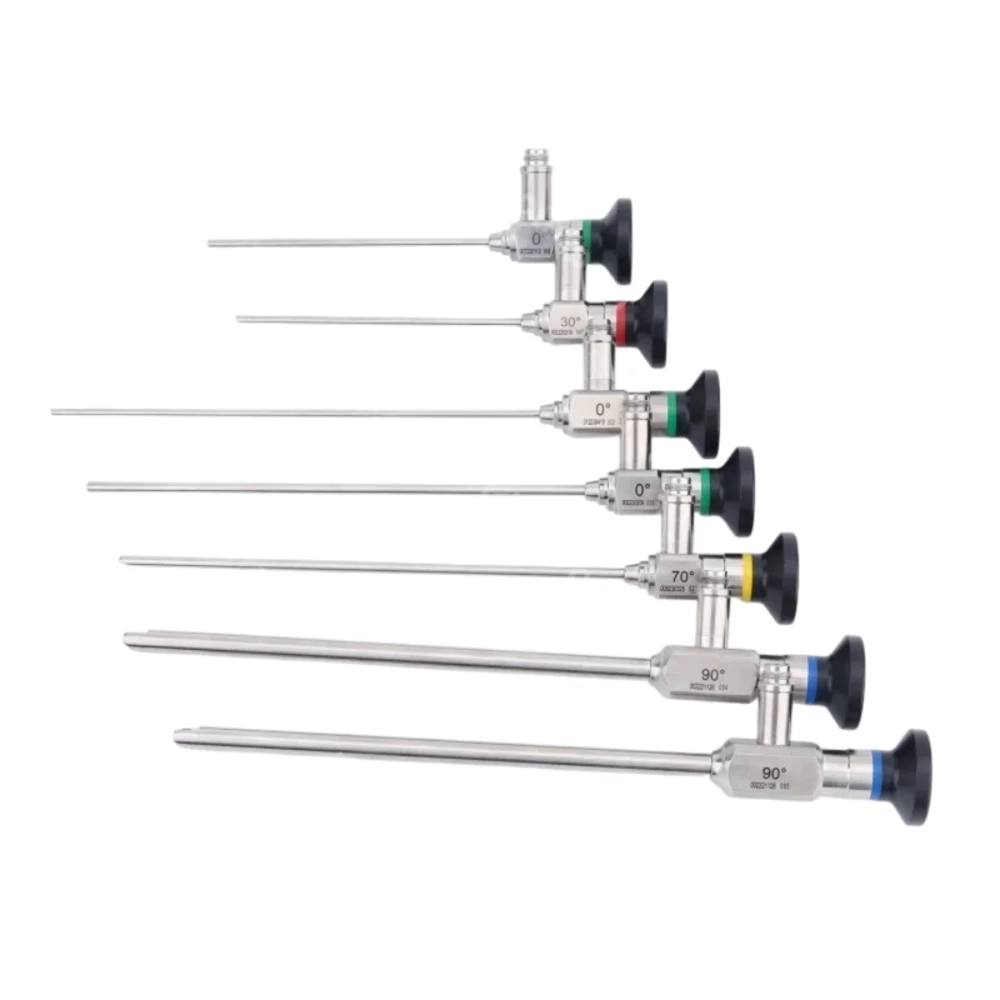

The Surgical ENT Rigid Endoscope – 0° / 30° / 70° / 90° Sinuscope, Otoscope, Laryngoscope is designed to provide direct and angled visualization during otolaryngology procedures. A rigid endoscope uses an optical telescope to transmit an enlarged view from the distal end of the instrument to the eyepiece or connected imaging system, allowing clinicians to examine anatomical structures through a relatively small access pathway.
The availability of 0°, 30°, 70°, and 90° viewing configurations provides different lines of sight for ENT examination and surgery. A 0° telescope provides a forward view along the longitudinal axis, while angled telescopes redirect the viewing direction to help visualize anatomy that may not be directly visible with a straight telescope. Commercial rigid ENT telescope systems are available in multiple angled configurations, including 30° and 70° designs.
In sinus surgery, rigid endoscopes are used to visualize the nasal cavity and paranasal sinus anatomy during diagnostic examination and procedures such as functional endoscopic sinus surgery. Different viewing angles can assist the surgeon in examining structures from alternative directions, which is useful when working around anatomical recesses and narrow passages.
The endoscope can also support otologic examination and surgery when the diameter, working length, and optical configuration are appropriate for ear applications. Rigid otoscopes are available in compact diameters and working lengths designed for access to the external auditory canal and middle-ear surgical field. Exact suitability depends on the specific telescope dimensions and the intended clinical application.
For laryngoscopy and rhino-laryngoscopy, endoscopic optics provide visualization of the nasal passages, pharynx, and laryngeal structures when the particular endoscope is designed for that application. Rigid and flexible endoscopic systems differ in their mechanical design and clinical applications, so the specific scope should be selected according to the procedure and anatomical access required.
The rigid construction provides a stable optical path and consistent shaft geometry. Compared with flexible endoscopes, rigid telescopes maintain a fixed shape and viewing direction, making them suitable for procedures where the surgeon requires a predictable optical axis and precise instrument placement.
A typical rigid ENT telescope incorporates an optical system and a connection for external illumination. Professional telescope systems may use fiber-optic light transmission to deliver illumination from a compatible light source to the distal end of the instrument. Modern systems may also connect to cameras and video equipment for larger-screen visualization and documentation.
The 0°, 30°, 70°, and 90° configurations should not be considered interchangeable for every procedure. The appropriate viewing angle depends on the anatomy being examined, the surgical approach, the available working space, and the clinician’s preferred technique. Likewise, outer diameter and working length are important specifications when selecting a telescope for sinus, ear, or laryngeal applications.
The optical surfaces and distal tip require careful handling. Scratches, contamination, impact, or improper cleaning can reduce image quality and may interfere with visualization. The telescope should be inspected before each procedure for optical clarity, structural damage, secure connections, and proper illumination.
Reusable rigid endoscopes must be processed according to their validated instructions. Commercial rigid telescope systems are available as reusable and autoclavable devices, but processing requirements vary by model and manufacturer.
Cleaning should remove biological material from the distal end, shaft, optical surfaces, and connection areas without using methods that can damage the telescope. The approved sterilization or high-level disinfection process should be determined from the specific manufacturer’s instructions rather than assumed from the general appearance of the instrument.
The Surgical ENT Rigid Endoscope Set is suitable for ENT departments, otolaryngology operating rooms, sinus surgery centers, otology units, hospitals, and specialty clinics requiring rigid visualization equipment for nasal, sinus, ear, and upper-airway procedures. Its multiple viewing-angle configuration provides flexibility for different endoscopic visualization requirements.
Key Features
- Rigid ENT endoscope system
- 0°, 30°, 70°, and 90° viewing configurations
- Suitable for selected sinusoscopic applications
- Useful for otoscopic and otologic visualization
- Suitable for selected laryngoscopic applications
- Multiple viewing angles provide alternative lines of sight
- Rigid shaft provides stable optical orientation
- Designed for narrow ENT anatomical passages
- Can be connected to compatible illumination systems
- May support camera and video integration depending on configuration
- Optical components require careful handling and cleaning
- Reprocessing must follow validated manufacturer instructions
Product Specifications
| Specification | Details |
|---|---|
| Product Name | Surgical ENT Rigid Endoscope |
| Product Type | Rigid ENT Telescope / Endoscope |
| Primary Specialty | ENT / Otolaryngology |
| Viewing Angles | 0°, 30°, 70°, 90° |
| Primary Applications | Sinuscopy, Otoscopy, Selected Laryngoscopy |
| Optical Configuration | Rigid Telescope |
| Viewing Direction | Straight and Angled, Configuration Dependent |
| Illumination | Fiber-Optic / Compatible Light Source |
| Outer Diameter | Model / Configuration Dependent |
| Working Length | Model / Configuration Dependent |
| Imaging | Optical Telescope / Camera-Compatible, Configuration Dependent |
| Shaft Type | Rigid |
| Material | Medical-Grade Construction, Configuration Dependent |
| Reusable | Depending on Product Configuration |
| Sterilization | Follow Validated Manufacturer Instructions |
| Compatibility | Verify Light Cable, Camera, and Accessory Compatibility |
FAQs
What is a rigid ENT endoscope used for?
A rigid ENT endoscope is used to provide illuminated, magnified visualization of anatomical structures during ENT examination and selected endoscopic procedures.
What is the difference between 0°, 30°, 70°, and 90° endoscopes?
The different angles provide different viewing directions. A 0° scope looks forward along the shaft, while angled scopes redirect the optical view to provide alternative perspectives of anatomical structures.
What is a 0° sinuscope used for?
A 0° sinuscope provides a direct forward view and can be useful for examining the nasal cavity and sinus anatomy when a straight line of sight is appropriate.
Why are angled endoscopes useful in sinus surgery?
Angled telescopes can provide visualization around anatomical structures and into areas that may not be directly visible with a straight telescope.
Can this endoscope be used for otoscopy?
A suitably sized rigid telescope can be used for otologic visualization, but outer diameter, working length, and optical configuration must be appropriate for the intended ear procedure.
Can rigid endoscopes be used for laryngoscopy?
Certain rigid endoscopes are designed for upper-airway and laryngeal visualization. The specific instrument must be appropriate for the intended laryngoscopic technique.
Does a rigid endoscope require a light source?
Rigid endoscopes generally require compatible illumination to adequately visualize the operative field. Fiber-optic systems can transmit light from an external source to the distal end.
Can the endoscope be connected to a camera?
Many rigid telescope systems can be coupled to compatible camera systems for video visualization and documentation. The exact camera adapter and system interface depend on the telescope configuration.
Are rigid ENT endoscopes reusable?
Some rigid endoscopes are designed for repeated clinical use, while others may have different processing requirements. Reusability should be confirmed from the specific product labeling.
Can these endoscopes be autoclaved?
Some reusable rigid telescope systems are autoclavable, but sterilization compatibility is model-specific. For example, certain rigid telescope products are expressly documented as autoclavable.
What should be inspected before using an ENT endoscope?
Check the optical image, distal lens, shaft, eyepiece, light connection, camera interface where applicable, and overall structural integrity before clinical use.
How should a rigid ENT endoscope be cleaned?
Cleaning and sterilization should follow the validated instructions for the exact model. Optical surfaces and distal components should be handled carefully to prevent scratches, residue, or other damage.

Reviews
There are no reviews yet.