


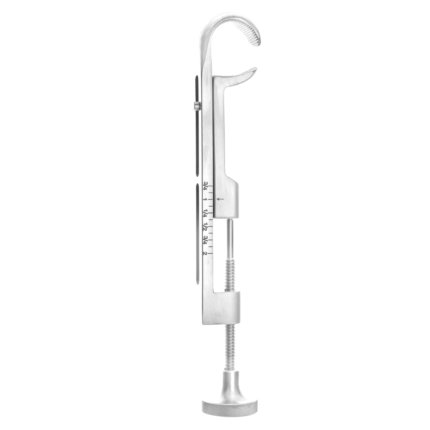
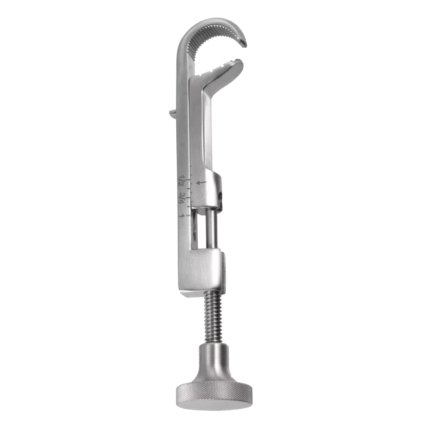
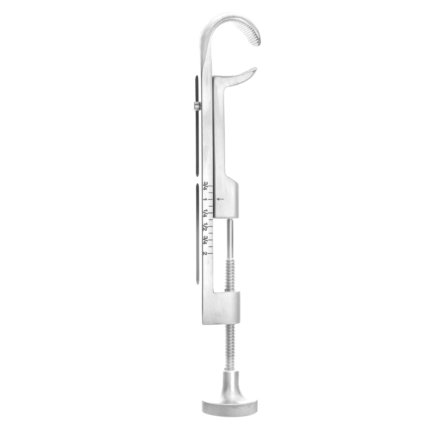
The Freeman Areola Marker 50mm Diameter is a high-quality surgical marking instrument specifically designed to provide precise areola sizing and consistent preoperative skin marking during breast surgery. Its accurately machined 50mm circular profile enables surgeons to create uniform reference markings for procedures such as breast reduction, mastopexy (breast lift), breast reconstruction, and cosmetic breast surgery. The instrument helps improve procedural planning while supporting symmetry and aesthetic accuracy.
Manufactured from premium surgical-grade stainless steel, the Freeman Areola Marker offers exceptional durability, corrosion resistance, and long-lasting clinical performance. The precisely engineered 50mm diameter ensures consistent measurements and repeatable marking throughout surgical planning. Its smooth, highly polished surface allows comfortable handling while enabling quick cleaning and repeated sterilization without compromising accuracy.
The ergonomic design provides excellent balance and precise control during preoperative marking. The circular marker creates clear, uniform outlines that assist surgeons in achieving symmetrical areolar positioning and consistent surgical results. Its robust construction ensures dependable performance in demanding operating room environments and outpatient surgical facilities.
Designed for repeated professional use, the Freeman Areola Marker 50mm Diameter is fully reusable and compatible with standard autoclave sterilization protocols. It maintains its dimensional accuracy, polished finish, and structural integrity through repeated sterilization cycles, making it a trusted instrument for plastic surgeons, reconstructive surgeons, cosmetic surgery clinics, hospitals, and specialized breast surgery centers.
Key Features
- Freeman areola marker with 50mm diameter.
- Designed for accurate preoperative areola marking.
- Produces precise and uniform circular reference markings.
- Supports breast reduction, mastopexy, and reconstruction procedures.
- Promotes symmetrical surgical planning.
- Manufactured from premium surgical-grade stainless steel.
- Smooth polished surface for comfortable handling.
- Corrosion-resistant and rust-resistant construction.
- Highly durable for long-term professional use.
- Fully reusable and autoclavable.
- Maintains dimensional accuracy after repeated sterilization.
- Ideal for plastic surgery, cosmetic surgery, and reconstructive procedures.
Product Specifications
| Specification | Details |
|---|---|
| Product Name | Freeman Areola Marker 50mm Diameter |
| Instrument Type | Areola Marker |
| Marker Diameter | 50mm |
| Design | Circular Surgical Marker |
| Material | Surgical Grade Stainless Steel |
| Finish | Satin / Mirror Polish |
| Reusable | Yes |
| Sterilization | Autoclavable |
| Corrosion Resistant | Yes |
| Specialty | Plastic & Reconstructive Surgery |
| Application | Areola Measurement & Preoperative Skin Marking |
| Usage | Professional Medical Use |
FAQs
Q1: What is the Freeman Areola Marker 50mm Diameter used for?
It is used to create accurate circular markings for areola sizing during breast reduction, breast lift, breast reconstruction, and cosmetic breast surgery.
Q2: Why is the 50mm diameter important?
The 50mm diameter provides a standardized reference size for creating consistent and symmetrical areolar markings during surgical planning.
Q3: What material is the Freeman Areola Marker made from?
It is manufactured from premium surgical-grade stainless steel for exceptional durability, corrosion resistance, and long-term clinical performance.
Q4: Is the Freeman Areola Marker reusable?
Yes. It is fully reusable and intended for repeated professional medical use.
Q5: Can it be autoclaved?
Yes, the instrument is fully autoclavable and compatible with standard hospital sterilization procedures.
Q6: Which procedures commonly use this marker?
It is commonly used for breast reduction, mastopexy (breast lift), breast reconstruction, nipple-areola complex repositioning, and other cosmetic or reconstructive breast procedures.
Q7: Where is this instrument commonly used?
It is widely used in hospitals, plastic surgery clinics, cosmetic surgery centers, reconstructive surgery units, and specialized breast surgery practices by qualified healthcare professionals.
Reviews
There are no reviews yet.