

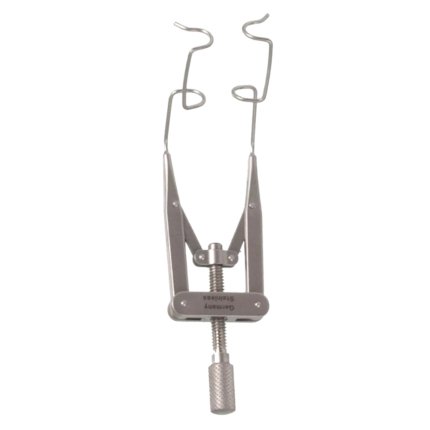

The Lieberman Speculum Closed 45° is a specialized ophthalmic surgical instrument designed to provide controlled eyelid retraction during eye surgery and other delicate ophthalmic procedures. Its closed-blade configuration and 45° angled design provide a specialized working geometry intended to support stable eyelid positioning while maintaining access to the operative field.
Controlled eyelid retraction is essential in many ophthalmic procedures because the eyelids can obstruct access to the eye and interfere with surgical visualization. The Lieberman Closed Speculum provides a practical method for maintaining the eyelids in a controlled position, allowing the surgeon to work with improved access to the ocular structures. The appropriate amount of retraction and instrument positioning should always be determined by the operating ophthalmologist according to patient anatomy and procedural requirements.
The 45-degree angle is an important design characteristic of this model. An angled working configuration can allow the surgeon to position the instrument according to the orientation of the operative field and preferred surgical technique. The specific angle may provide useful access and positioning in procedures where a straight speculum configuration is less convenient.
The closed-blade design provides a defined contact surface for engaging the eyelids. This can help maintain consistent retraction throughout the procedure when the instrument is appropriately positioned. The working surfaces should be placed carefully to achieve the required exposure while avoiding excessive pressure on the eyelids or surrounding tissues.
The Lieberman Speculum Closed 45° can be incorporated into professional ophthalmic instrument sets for a variety of eye surgery applications. Potential uses include selected anterior segment procedures, cataract-related surgery, ocular surface procedures, and other ophthalmic operations where controlled eyelid retraction is required. The exact clinical application depends on the surgeon’s technique, patient anatomy, and procedural requirements.
The instrument is designed for precise handling and controlled positioning. Its angled configuration can assist the surgeon in maintaining a practical working relationship between the instrument and the operative site. This can be particularly useful in microsurgical environments where small changes in instrument orientation may influence access and visualization.
Professional reusable versions are commonly manufactured from surgical-grade stainless steel or other suitable medical-grade materials. Stainless steel is widely used in ophthalmic instrumentation because of its strength, durability, and corrosion resistance when properly cleaned and maintained. It also supports validated cleaning and sterilization processes appropriate for reusable surgical instruments.
After use, the Lieberman 45-degree eye speculum should be cleaned promptly according to the manufacturer’s validated instructions. Blood, tissue, and other biological material should be removed before sterilization. The closed blades and angled working areas should be inspected carefully to ensure that no debris remains after cleaning.
The instrument should be inspected before reuse for corrosion, surface damage, deformation, or other abnormalities that could affect its function. Particular attention should be given to the alignment of the blades and the 45° working configuration, as deformation may alter the intended positioning characteristics.
If supplied as a reusable surgical instrument, sterilization should be performed using a validated method specified by the manufacturer. Healthcare facilities should follow established ophthalmic instrument-processing and infection-control protocols.
Proper storage is also important for maintaining the instrument’s working geometry. The speculum should be protected from unnecessary impact, bending, or contact with heavier instruments that could damage the blades or alter the angle.
The Lieberman Speculum Closed 45° combines a closed-blade design with a specialized 45-degree configuration to provide controlled eyelid retraction and practical surgical positioning. Its precision construction makes it a useful addition to professional ophthalmic instrument sets for procedures requiring reliable exposure and controlled access to the eye.
Key Features
- Lieberman-style ophthalmic eye speculum
- Closed-blade configuration for controlled eyelid retraction
- 45° angled working design
- Designed for stable exposure of the ocular surgical field
- Suitable for delicate ophthalmic procedures
- Angled configuration supports controlled instrument positioning
- Useful for anterior segment and selected eye surgery applications
- Surgical-grade construction for professional clinical environments
- Designed for precise handling and controlled retraction
- Suitable for ophthalmic surgical instrument sets
- Reusable when supplied as a reusable surgical instrument
- Supports validated cleaning and sterilization procedures
Product Specifications
| Specification | Details |
|---|---|
| Product Name | Lieberman Speculum Closed 45° |
| Instrument Type | Ophthalmic Eye Speculum |
| Design | Lieberman Style |
| Blade Configuration | Closed Blades |
| Working Angle | 45° |
| Primary Function | Eyelid Retraction |
| Specialty | Ophthalmology |
| Application | Eye Surgery and Ophthalmic Procedures |
| Construction | Surgical-Grade / Medical-Grade Material |
| Use | Professional Ophthalmic Surgery |
| Reusability | Depends on product configuration |
| Cleaning | Follow manufacturer-approved instructions |
| Sterilization | According to validated manufacturer protocol |
FAQs
1. What is the Lieberman Speculum Closed 45° used for?
The Lieberman Speculum Closed 45° is designed to provide controlled eyelid retraction during ophthalmic procedures, helping maintain access and visibility of the ocular surgical field.
2. What is the purpose of the 45° angle?
The 45° configuration provides an angled working orientation that can assist with positioning and access according to the surgeon’s technique and the requirements of the ophthalmic procedure.
3. What is the advantage of closed blades?
The closed-blade configuration provides defined contact surfaces for controlled eyelid engagement and retraction, helping maintain stable surgical exposure.
4. Can the Lieberman 45° Speculum be used for cataract surgery?
It may be used in cataract and other ophthalmic procedures when its configuration is appropriate for the surgeon’s technique and the patient’s anatomy.
5. What material is the Lieberman Speculum made from?
Professional reusable versions are commonly manufactured from surgical-grade stainless steel or another appropriate medical-grade material selected for strength, durability, and resistance to corrosion.
6. How should a 45° ophthalmic speculum be maintained?
The instrument should be cleaned, inspected, sterilized, and stored according to the manufacturer’s validated instructions. Care should be taken to preserve the blade alignment and 45° working configuration.
7. Is the Lieberman Speculum Closed 45° reusable?
If supplied as a reusable ophthalmic instrument, it can be cleaned, inspected, sterilized, and reused according to the manufacturer’s validated processing instructions and applicable infection-control requirements.

Reviews
There are no reviews yet.