
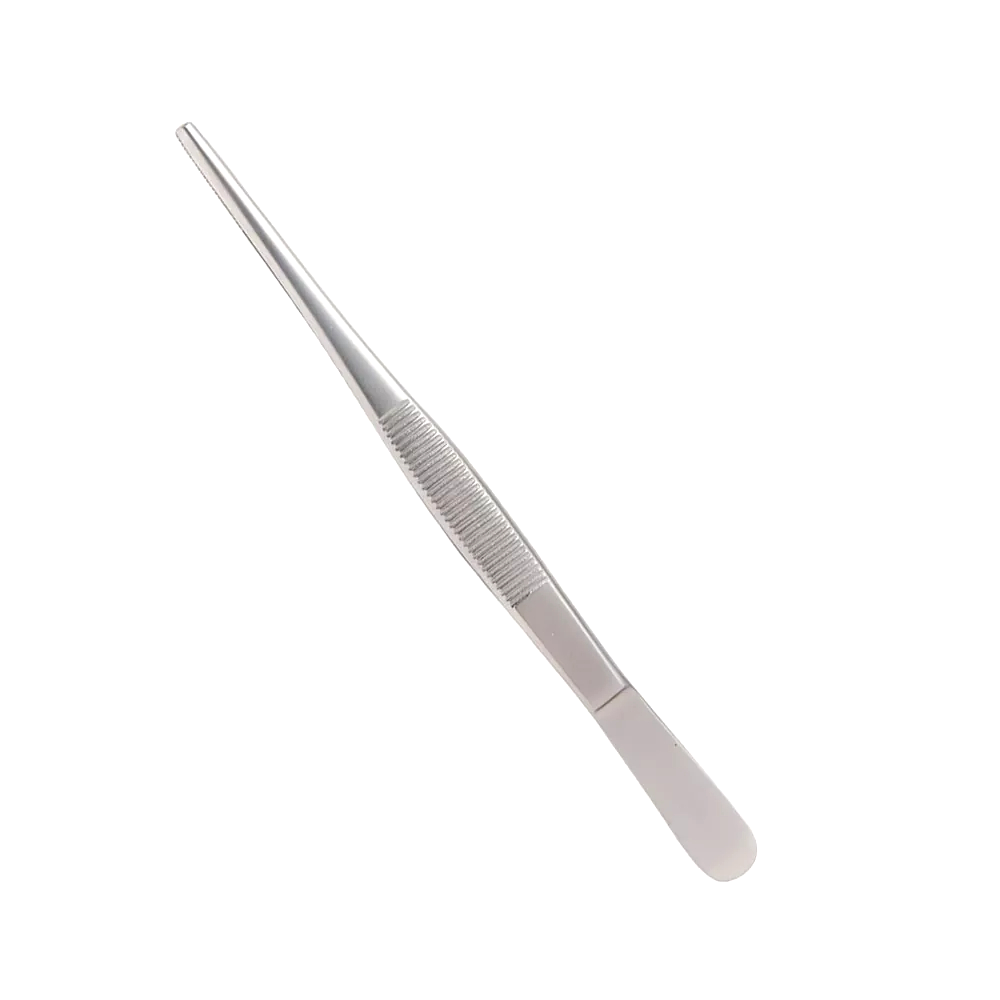
The Round Point Dissecting Forceps Serrated Jaws, Stainless Steel Premium Quality are precision surgical instruments engineered for gentle tissue handling, dissection, and manipulation during a wide range of surgical and clinical procedures. Their rounded tips and finely serrated jaws provide a secure, non-traumatic grip on delicate tissues, making them ideal for procedures where precision and tissue preservation are essential.
Manufactured from premium surgical-grade stainless steel, these dissecting forceps offer exceptional durability, corrosion resistance, and dependable long-term performance. The precision-machined serrated jaws increase friction for improved tissue control while helping minimize slippage during delicate surgical maneuvers.
The rounded tip design allows surgeons to manipulate tissues safely without the penetrating action of toothed forceps, making the instrument suitable for handling delicate anatomical structures. The lightweight spring handle provides smooth operation, excellent balance, and enhanced tactile feedback for precise instrument control.
The ergonomic design reduces hand fatigue during prolonged procedures, while the polished finish improves resistance to corrosion and staining and simplifies cleaning and sterilization. Designed for repeated professional use, the Round Point Dissecting Forceps maintain their alignment, spring tension, and gripping performance through frequent autoclave sterilization cycles.
Suitable for hospitals, surgical centers, outpatient clinics, laboratories, and specialty healthcare facilities, the Round Point Dissecting Forceps Serrated Jaws combine premium stainless steel construction, precision craftsmanship, and reliable tissue handling for general surgery and numerous specialized procedures.
Key Features
- Premium surgical-grade stainless steel construction
- Round point tips for atraumatic tissue handling
- Finely serrated jaws for secure tissue grip
- Precision-aligned jaws for consistent performance
- Lightweight spring handle for excellent control
- Smooth and accurate tissue manipulation
- Ergonomic design reduces hand fatigue
- Excellent tactile feedback and balance
- Polished finish for easy cleaning and maintenance
- Corrosion and stain resistant
- Fully autoclavable and reusable
- Suitable for general and specialty surgical procedures
Product Specifications
| Specification | Details |
|---|---|
| Product Name | Round Point Dissecting Forceps Serrated Jaws |
| Category | Surgical Dissecting Forceps |
| Instrument Type | Tissue Forceps |
| Tip Style | Round Point |
| Jaw Type | Fine Serrated |
| Handle Type | Spring Handle |
| Material | Premium Surgical Grade Stainless Steel |
| Finish | Satin/Polished Finish |
| Reusable | Yes |
| Sterility | Non-Sterile (Autoclavable Before Use) |
| Autoclavable | Yes |
| Corrosion Resistant | Yes |
| Latex Free | Yes |
| Applications | General Surgery, Tissue Dissection, Plastic Surgery, Microsurgery, Laboratory Procedures, Soft Tissue Handling |
| Cleaning Method | Manual and Ultrasonic Cleaning Compatible |
FAQs
1. What are Round Point Dissecting Forceps used for?
They are used to grasp, hold, manipulate, and dissect delicate tissues during surgical and clinical procedures.
2. What is the advantage of the round point design?
The rounded tips allow gentle, atraumatic tissue handling, reducing the risk of unnecessary tissue injury during manipulation.
3. Why are the jaws serrated?
The fine serrations provide a secure grip on tissues while minimizing slippage and improving surgical precision.
4. What material are the forceps made from?
They are manufactured from premium surgical-grade stainless steel for excellent durability, corrosion resistance, and long-lasting performance.
5. Are these forceps reusable?
Yes. They are designed for repeated professional use after proper cleaning and sterilization.
6. Can the forceps be autoclaved?
Yes. They are fully autoclavable and compatible with standard steam sterilization procedures.
7. In which medical specialties are these forceps commonly used?
They are widely used in general surgery, plastic surgery, ENT, dermatology, microsurgery, laboratory work, and other procedures requiring precise, atraumatic tissue handling.

Reviews
There are no reviews yet.