

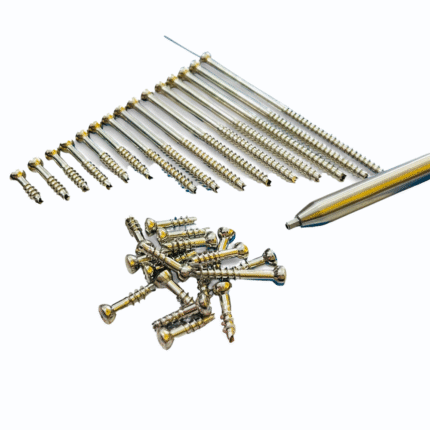
The ACL Interference Screws 7 10mm Titanium Grade 5 49 Pcs is a specialized orthopedic implant system designed for selected anterior cruciate ligament (ACL) reconstruction procedures. Interference screws are commonly used to secure ligament or tendon grafts within appropriately prepared bone tunnels during reconstructive knee surgery. This 49-piece system provides four diameter options and multiple screw lengths, allowing qualified orthopedic surgeons to select a suitable implant according to the graft, tunnel dimensions, bone quality, reconstruction technique, and patient anatomy.
ACL reconstruction is an established surgical procedure used to restore knee stability following an ACL injury. Depending on the selected reconstruction technique, a tendon graft is positioned through prepared bone tunnels and secured using an appropriate fixation method. Interference screw fixation is one commonly used approach for securing the graft within the tunnel. The precise implant selection should be determined by the surgeon based on the patient’s anatomy, graft characteristics, tunnel preparation, and applicable surgical technique.
This system includes 7 mm, 8 mm, 9 mm, and 10 mm diameter options, providing a useful range for different graft and bone-tunnel requirements. The availability of multiple diameters allows the surgical team to select an appropriate screw size rather than relying on a single standardized dimension. Screw selection should always correspond with the prepared tunnel and graft dimensions and should follow the manufacturer’s validated sizing recommendations.
The screws are available in 20 mm through 35 mm lengths, providing multiple fixation-depth options. Different lengths may be selected according to tunnel dimensions, graft positioning, bone stock, and the intended reconstruction technique. Diameter and length should be considered together when selecting the implant, rather than using either measurement independently.
Manufactured from Titanium Grade 5, these ACL interference screws use a titanium alloy widely recognized in orthopedic implant applications. Titanium Grade 5 provides high mechanical strength, a favorable strength-to-weight ratio, and corrosion resistance. Titanium materials are also well established in orthopedic implant applications. Actual implant performance depends on the specific screw geometry, thread design, dimensions, manufacturing quality, surface characteristics, and intended clinical application.
The threaded interference screw design is intended to engage with the surrounding bone and secure the graft within an appropriately prepared tunnel when used according to the applicable surgical technique. Proper screw positioning and insertion are essential to the intended fixation construct. Surgeons should use compatible insertion instruments and follow the manufacturer’s recommendations to help avoid implant damage or improper fixation.
The 49-piece system provides multiple ACL interference screw configurations within a consolidated orthopedic implant set. This can be useful for orthopedic hospitals, sports medicine centers, arthroscopy facilities, and surgical departments performing ACL reconstruction procedures. Maintaining multiple diameters and lengths in one organized set can assist with intraoperative implant selection and surgical inventory management.
Before use, every implant should be inspected for visible damage, deformation, contamination, compromised threads, or other abnormalities. Screws should be handled with appropriate surgical instruments to protect the implant surface and thread profile. Only compatible instruments and accessories should be used for insertion.
Patient-specific factors should guide implant selection. These include the patient’s bone anatomy and quality, graft type and dimensions, bone tunnel diameter and length, reconstruction technique, and the surgeon’s preferred fixation strategy. The availability of multiple sizes does not replace appropriate clinical assessment or surgical planning.
Cleaning and sterilization requirements depend on whether the implants are supplied sterile or intended for processing before use. Healthcare facilities should follow the manufacturer’s validated instructions for use (IFU) for implant handling, storage, cleaning, and sterilization where applicable. Titanium Grade 5 alone should not be used to determine a sterilization cycle.
With 7–10 mm diameter options, 20–35 mm length options, Titanium Grade 5 construction, and a 49-piece configuration, this ACL Interference Screw System provides orthopedic professionals with a versatile selection of fixation implants for selected ACL reconstruction and ligament graft fixation procedures.
Key Features
- ACL interference screw system designed for selected anterior cruciate ligament reconstruction procedures.
- Available in 7 mm, 8 mm, 9 mm, and 10 mm diameters.
- Multiple screw lengths from 20 mm to 35 mm.
- Manufactured from Titanium Grade 5 for orthopedic implant applications.
- Threaded design intended for graft fixation within an appropriately prepared bone tunnel.
- Multiple diameter options support selection according to graft and tunnel dimensions.
- Multiple length options provide flexibility for different fixation requirements.
- 49-piece system provides a comprehensive selection of ACL interference screws.
- Suitable for professional orthopedic, arthroscopic, and sports medicine applications.
- Designed for use with compatible insertion instrumentation.
- Screw dimensions should be selected according to patient anatomy, graft characteristics, tunnel dimensions, and surgical technique.
- Components should be inspected for integrity before implantation.
- Handling, cleaning, and sterilization should follow the manufacturer’s validated instructions.
Product Specifications
| Specification | Details |
|---|---|
| Product Name | ACL Interference Screws |
| Primary Application | ACL Reconstruction |
| Screw Type | Interference Screw |
| Diameter Options | 7 mm, 8 mm, 9 mm & 10 mm |
| Length Range | 20–35 mm |
| Material | Titanium Grade 5 |
| Total Set Quantity | 49 Pieces |
| Fixation Method | Graft / Bone Tunnel Fixation |
| Anatomical Site | Knee |
| Surgical Specialty | Orthopedic Surgery / Sports Medicine |
| Intended Procedure | Anterior Cruciate Ligament Reconstruction |
| Implant Design | Threaded Interference Screw |
| Size Selection | Based on Graft, Tunnel and Patient Anatomy |
| Intended Users | Qualified Orthopedic and Sports Medicine Professionals |
| Instrument Compatibility | Use specified compatible insertion instrumentation |
| Sterilization | Follow manufacturer’s validated instructions |
| Implant Handling | Follow applicable manufacturer IFU |
FAQs
1. What are ACL interference screws used for?
ACL interference screws are orthopedic fixation implants commonly used during ACL reconstruction to secure a tendon or ligament graft within an appropriately prepared bone tunnel.
2. What diameters are available in this ACL interference screw set?
The system includes 7 mm, 8 mm, 9 mm, and 10 mm diameter options, providing multiple choices for different graft and bone-tunnel requirements.
3. What lengths are available?
The screws are available in lengths ranging from 20 mm to 35 mm, allowing selection according to tunnel dimensions, graft positioning, and the surgical technique.
4. What material are these ACL interference screws made from?
The screws are manufactured from Titanium Grade 5, a high-strength titanium alloy widely used in orthopedic implant applications.
5. How many screws are included in the system?
The product is specified as a 49-piece ACL interference screw system containing multiple diameter and length configurations.
6. How does an ACL interference screw secure a graft?
An interference screw is inserted into an appropriately prepared bone tunnel alongside or against the graft according to the selected reconstruction technique. The screw engages the surrounding bone and helps secure the graft within the tunnel.

Reviews
There are no reviews yet.