
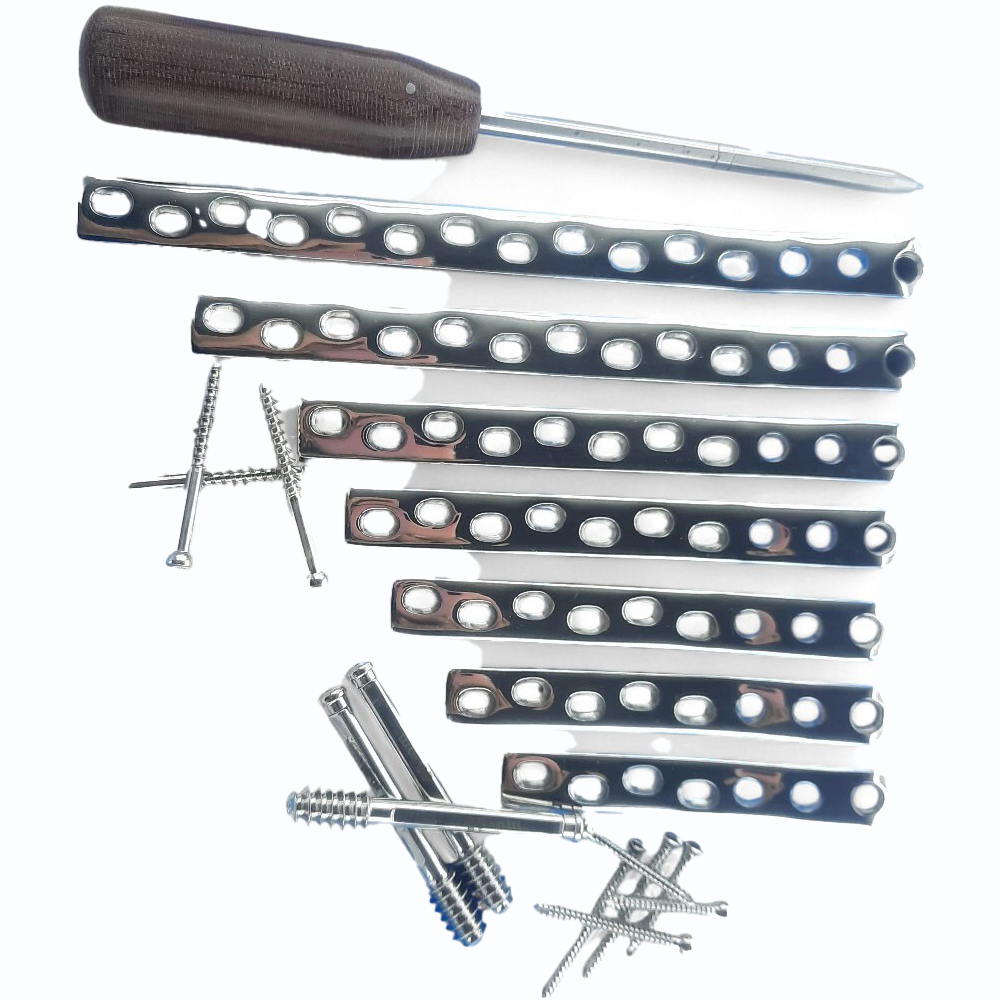


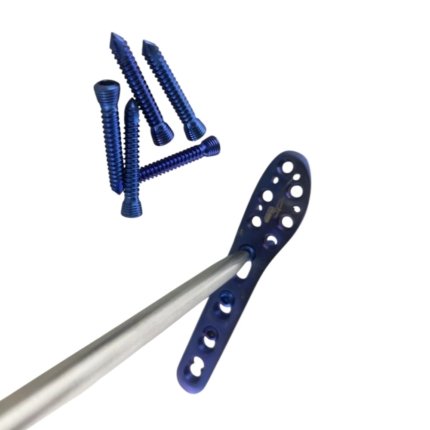
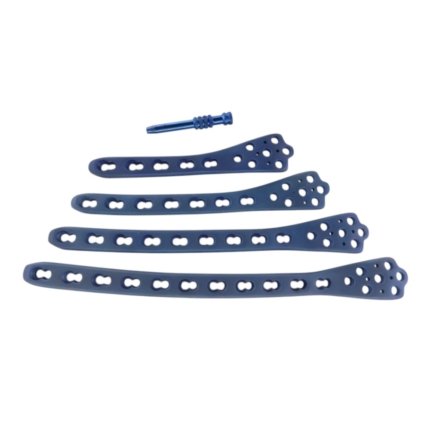
The DCS 95° Plate Set with Screws SS 316L Orthopedic Set is a comprehensive orthopedic trauma fixation set intended for appropriately selected femoral fracture procedures. DCS refers to the Dynamic Condylar Screw system, an angled fixation construct designed to provide stable fixation around the distal femur and selected complex femoral fracture patterns.
The 95° DCS plate incorporates an angled barrel designed to accept the corresponding Dynamic Condylar Screw. This configuration creates a fixed-angle relationship between the main screw and plate, helping establish a stable construct when correctly positioned. The DCS concept is particularly associated with distal femoral fracture fixation and may be considered in selected extra-articular and certain complex fracture patterns according to the specific implant design and surgical technique.
The set includes a combination of DCS screws, 4.5 mm DCP screws, and 6.5 mm cancellous screws, providing different fixation options for the primary plate construct and associated bone fragments. Each screw type has a specific role within the fixation system, and the surgeon should select screw diameter, length, trajectory, and position according to fracture anatomy, bone quality, and the manufacturer’s surgical technique.
The 4.5 mm DCP component provides conventional dynamic compression plate fixation capability where compatible plate holes and screw configurations are designed for this purpose. DCP refers to a Dynamic Compression Plate concept, where screw placement can generate compression across appropriately selected fracture sites. The exact use depends on the plate geometry and approved system configuration.
The 6.5 mm cancellous screws are intended for fixation in cancellous or metaphyseal bone where their larger thread profile can provide appropriate purchase when used according to the surgical technique. In the distal femur, cancellous bone anatomy and fracture morphology must be carefully assessed before selecting screw type and length.
Manufactured from SS 316L stainless steel, the components offer material characteristics commonly used in orthopedic implant systems. SS 316L is a low-carbon stainless steel recognized for corrosion resistance, durability, and suitability for many medical device applications. Exact implant-grade specifications, dimensions, mechanical properties, and surface finish should be verified from the manufacturer’s technical documentation.
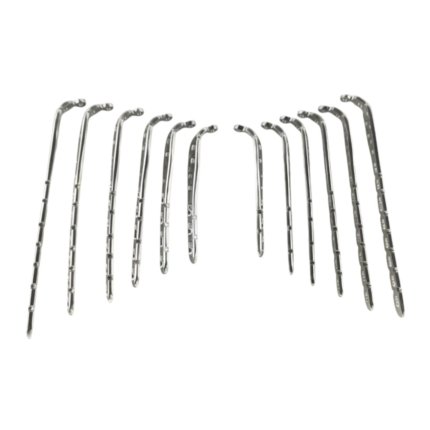
The 55-piece set provides multiple components within one organized fixation system, making it suitable for orthopedic trauma departments, hospitals, surgical centers, and medical implant suppliers that require a range of femoral fracture fixation components. The combination of angled DCS fixation and additional DCP and cancellous screw options can provide flexibility when addressing different fracture configurations.
DCS fixation may be considered for selected distal femoral fractures, supracondylar femoral fractures, and other appropriately selected femoral fracture patterns where an angled condylar screw construct is indicated. Patient-specific factors, fracture classification, articular involvement, bone quality, soft-tissue condition, and surgeon experience should guide implant selection.
Correct positioning of the DCS lag screw is critical. The surgeon must determine the appropriate entry point, trajectory, depth, and position within the femoral condyles according to the applicable surgical technique. Incorrect placement can affect fracture reduction, fixation stability, and joint-related outcomes. Appropriate intraoperative imaging should be used to confirm implant position and alignment.
The plate should be positioned according to the fracture pattern and intended fixation strategy. Reduction may require temporary fixation, clamps, guidewires, or other compatible orthopedic instruments before definitive screw insertion. Screw length should be measured carefully to provide adequate bone purchase without inappropriate penetration.
The components should be handled carefully to prevent contamination, scratching, deformation, or damage to screw threads and plate holes. Implants should not be modified unless such modification is specifically permitted by the manufacturer. Improper bending or alteration may compromise mechanical performance and implant compatibility.
Sterility, packaging, storage, and processing requirements depend on the manufacturer’s product labeling and supplied configuration. Reusable surgical instruments should be cleaned, inspected, packaged, and sterilized using validated healthcare-facility procedures according to applicable manufacturer instructions.
With a 95° DCS plate, DCS screws, 4.5 mm DCP screws, 6.5 mm cancellous screws, SS 316L construction, and a 55-piece configuration, this orthopedic fixation set provides a comprehensive option for appropriately selected femoral fracture stabilization procedures.
Key Features
- 95° Dynamic Condylar Screw (DCS) plate configuration.
- Designed for selected femoral fracture fixation.
- Includes compatible DCS screws.
- Includes 4.5 mm DCP screws.
- Includes 6.5 mm cancellous screws.
- Manufactured from SS 316L stainless steel.
- Provides angled fixed-axis DCS fixation.
- Multiple screw types support different fixation requirements.
- Suitable for selected distal femoral and complex femoral fractures.
- 55-piece set provides a comprehensive implant selection.
- Designed for professional orthopedic trauma applications.
- Requires compatible DCS surgical instrumentation and technique.
Product Specifications
| Specification | Details |
|---|---|
| Product Name | DCS 95° Plate Set |
| Primary Implant | 95° DCS Plate |
| System | Dynamic Condylar Screw System |
| DCS Angle | 95° |
| Additional Components | DCS Screws, 4.5 mm DCP Screws & 6.5 mm Cancellous Screws |
| Material | SS 316L Stainless Steel |
| Quantity | 55 Pieces |
| Primary Application | Femoral Fracture Fixation |
| Common Application | Selected Distal Femur / Supracondylar Fractures |
| Fixation Type | Angled Fixed-Axis / Compression Fixation |
| Screw Options | DCS, 4.5 mm DCP & 6.5 mm Cancellous |
| Surgical Specialty | Orthopedic Trauma |
| Intended Use | Professional orthopedic surgical applications |
| Instrument Compatibility | Use compatible DCS fixation instrumentation |
| Sterilization | Follow product-specific manufacturer instructions and validated protocols |
FAQs
1. What is a DCS 95° Plate?
A DCS 95° Plate is an orthopedic fixation plate designed to work with a Dynamic Condylar Screw. The angled plate-barrel configuration creates a fixed-angle relationship intended for selected femoral fracture fixation procedures.
2. What does DCS stand for?
DCS stands for Dynamic Condylar Screw, an orthopedic fixation system commonly associated with selected distal femoral and complex femoral fracture stabilization.
3. What components are included in this 55-piece set?
The set includes a 95° DCS plate, DCS screws, 4.5 mm DCP screws, and 6.5 mm cancellous screws, with a total specified quantity of 55 pieces.
4. What material is the DCS set made from?
The components are specified as SS 316L stainless steel, a low-carbon stainless steel commonly used in orthopedic implant applications.
5. What fractures can a DCS plate be used for?
DCS systems may be considered for selected distal femoral, supracondylar, and other appropriately selected femoral fracture patterns where an angled condylar screw construct is suitable.
6. What is the purpose of the 4.5 mm DCP screws?
The 4.5 mm DCP screws can provide conventional plate fixation and compression where the corresponding plate and screw configuration is designed to support that technique.
7. What are 6.5 mm cancellous screws used for?
6.5 mm cancellous screws are designed for fixation in cancellous or metaphyseal bone where their larger thread profile can provide appropriate purchase when selected according to the surgical technique.


Reviews
There are no reviews yet.