
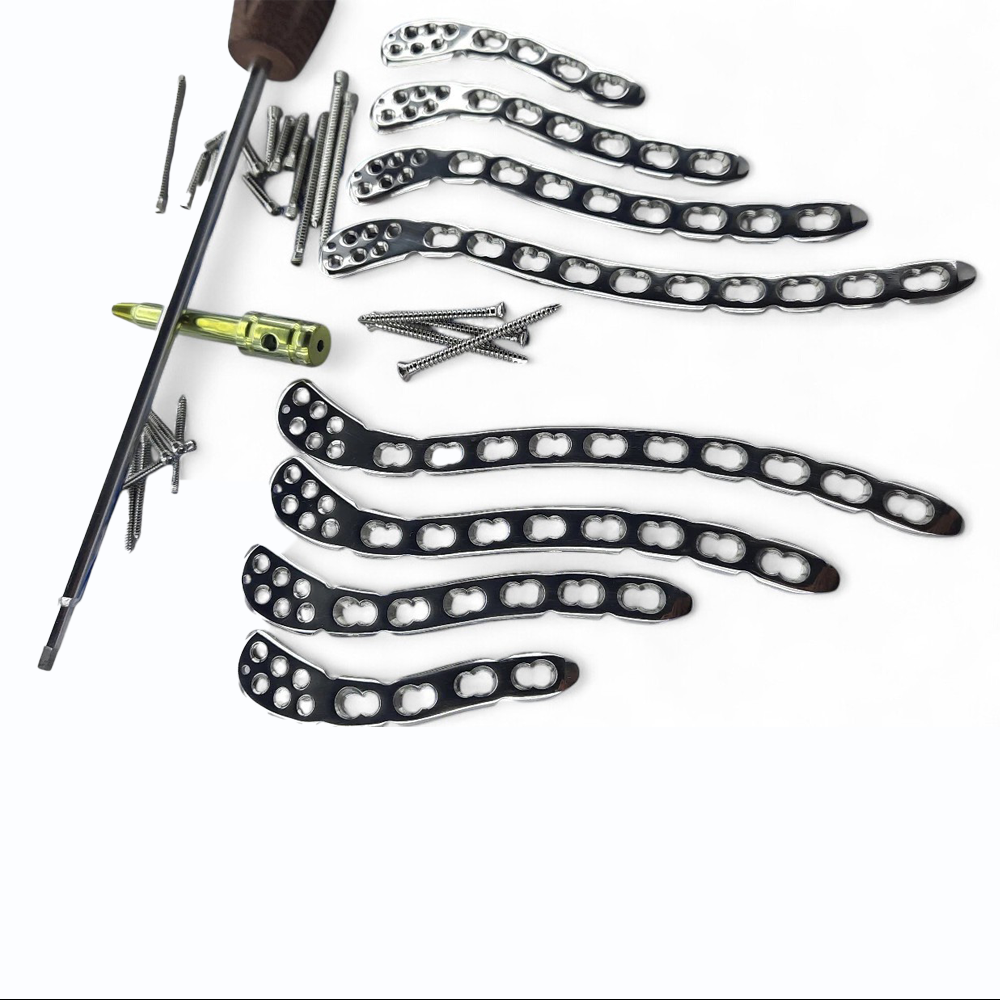
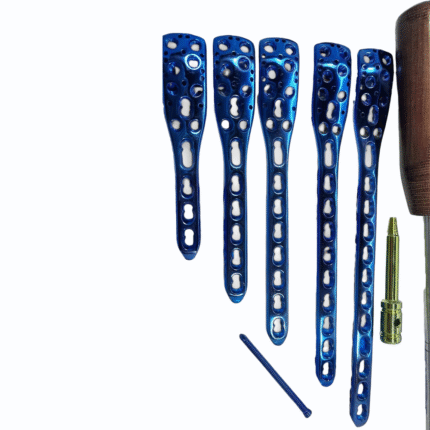
The Locking Superior Anterior Clavicle S Plate SS 316L is an orthopedic fixation implant designed for stabilization of appropriately selected clavicle fractures requiring operative fixation. Its superior anterior “S” shaped anatomical configuration is intended to follow the general contour of the clavicle while providing multiple fixation points through compatible locking screws.
Clavicle fractures are among the most common fractures encountered in orthopedic trauma. Although many clavicle fractures can be managed conservatively, operative fixation may be considered in selected displaced, shortened, unstable, comminuted, or otherwise clinically appropriate fracture patterns. Anatomical plate design can assist with positioning the fixation construct along the clavicle while allowing the surgeon to select screw placement according to fracture morphology and available bone.
The superior anterior “S” plate configuration is designed to accommodate the curved anatomy of the clavicle. The left- and right-sided versions provide options corresponding to the patient’s anatomical side. Proper plate selection and positioning are essential because clavicle morphology varies significantly between individuals and along different portions of the bone.
The locking plate design allows compatible locking screws to engage threaded plate holes, creating an angular-stable relationship between the plate and screw. This can help maintain the intended screw trajectory and provide stable fixation in appropriately selected fracture patterns. The locking mechanism must be used with compatible screws and system-specific instrumentation to achieve the intended function.
The plate is available in 4-, 6-, 8-, and 10-hole configurations, providing different fixation lengths. Shorter plates may be suitable for selected fractures requiring a limited fixation span, while longer plates can provide additional fixation points across a more extensive fracture or comminuted region. The appropriate plate length should be determined according to fracture location, fracture morphology, bone quality, and the surgeon’s fixation strategy.
Manufactured from SS 316L stainless steel, the plate provides material characteristics commonly used in orthopedic implant applications. SS 316L is a low-carbon stainless steel known for corrosion resistance and mechanical durability and is widely used in medical devices. The precise implant-grade specification, mechanical properties, dimensions, and surface finish should be confirmed through the manufacturer’s technical documentation.
The system is intended for use with compatible locking screws. Screw diameter, length, head geometry, and locking interface must correspond with the plate system. Screw length is particularly important in clavicle fixation because the clavicle lies close to important neurovascular and thoracic structures. Appropriate imaging, measurement, and surgical technique are essential for safe screw placement.
The 110-piece selection provides a broad inventory of left- and right-sided plates in multiple hole configurations. This can be useful for orthopedic trauma departments, hospitals, surgical centers, fracture clinics, and medical implant suppliers requiring multiple clavicle fixation options.
Locking superior clavicle plates may be considered for selected displaced, unstable, comminuted, shortened, or nonunion-related clavicle fractures when operative fixation is indicated. They should not be considered universally appropriate for every clavicle fracture. Treatment selection should be based on fracture classification, displacement, patient anatomy, soft-tissue status, bone quality, functional requirements, and surgeon assessment.
Accurate fracture reduction and plate positioning are important for successful clavicle fixation. The surgeon should use compatible drills, drill guides, depth gauges, screwdrivers, and reduction instruments according to the applicable surgical technique. Imaging may be used to verify fracture reduction, implant position, and screw length.
The plate should be handled carefully to prevent contamination, scratching, deformation, or damage to the locking holes. Plate bending or modification should only be performed if specifically permitted by the manufacturer. Improper bending can compromise the locking mechanism or structural integrity of the implant.
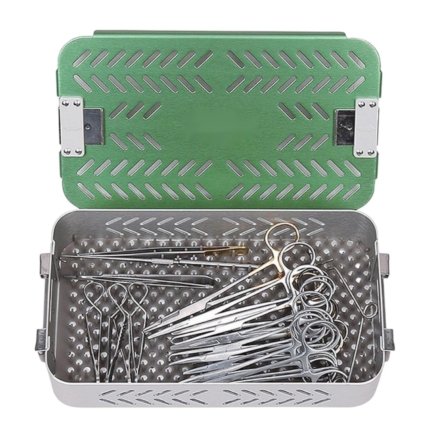
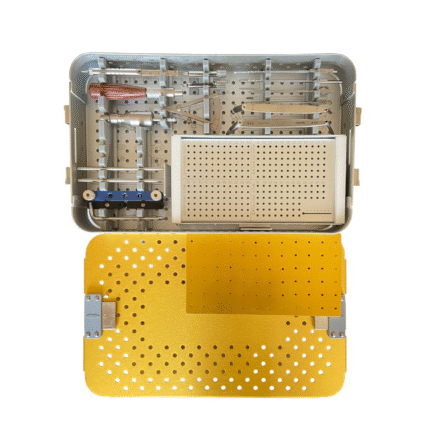
Sterility, packaging, storage, and processing requirements depend on the manufacturer’s labeling and whether the implant is supplied sterile or requires processing before use. Reusable instruments should be cleaned, inspected, packaged, and sterilized using validated healthcare-facility procedures.
With left- and right-sided anatomical options, 4–10 hole configurations, superior anterior “S” geometry, SS 316L construction, and a 110-piece selection, this clavicle locking plate system provides a versatile fixation option for appropriately selected clavicular fracture procedures.
Key Features
- Designed for clavicle fracture fixation.
- Superior anterior “S” shaped anatomical configuration.
- Available for left and right clavicles.
- 4, 6, 8, and 10-hole options.
- Manufactured from SS 316L stainless steel.
- Locking plate design supports angular-stable fixation.
- Compatible locking screws provide fixed-angle fixation when properly engaged.
- Multiple plate lengths accommodate different fracture patterns.
- Suitable for selected displaced and unstable clavicle fractures.
- 110-piece selection provides multiple side and size options.
- Designed for professional orthopedic trauma applications.
- Requires compatible locking plate instrumentation.
Product Specifications
| Specification | Details |
|---|---|
| Product Name | Locking Superior Anterior Clavicle “S” Plate |
| Anatomical Site | Clavicle |
| Plate Position | Superior Anterior |
| Plate Design | Anatomical “S” Plate |
| Side Options | Left & Right |
| Hole Options | 4, 6, 8 & 10 Holes |
| Material | SS 316L Stainless Steel |
| Screws | Compatible Locking Screws |
| Quantity | 110 Pieces |
| Fixation Type | Locking / Angular-Stable Fixation |
| Primary Application | Clavicle Fracture Fixation |
| Surgical Specialty | Orthopedic Trauma |
| Intended Use | Professional orthopedic surgical applications |
| Instrument Compatibility | Use compatible locking plate instrumentation |
| Sterilization | Follow product-specific manufacturer instructions and validated protocols |
FAQs
1. What is a Locking Superior Anterior Clavicle S Plate?
It is an anatomical orthopedic plate designed for selected clavicle fracture fixation. Its superior anterior “S” configuration is intended to follow the general contour of the clavicle while compatible locking screws provide angular-stable fixation.
2. Are left and right clavicle plates available?
Yes. The product includes left and right plate options to accommodate the corresponding anatomical side.
3. What hole configurations are available?
The system includes 4-, 6-, 8-, and 10-hole configurations, providing different plate lengths and fixation options.
4. What material is the clavicle plate made from?
The plates are manufactured from SS 316L stainless steel, a low-carbon stainless steel commonly used in orthopedic implant applications.
5. What is the advantage of a locking clavicle plate?
Locking screws engage threaded plate holes to create an angular-stable plate-screw connection. This can provide stable fixation in appropriately selected clavicle fractures.
6. What types of clavicle fractures can this plate be used for?
It may be considered for selected displaced, unstable, shortened, comminuted, and other clavicle fractures requiring operative fixation. Final implant selection depends on fracture morphology and surgeon assessment.
7. Why is screw length important in clavicle surgery?
The clavicle is anatomically close to important neurovascular and thoracic structures. Screw length and trajectory therefore require careful planning and verification to avoid inappropriate penetration.

Reviews
There are no reviews yet.