
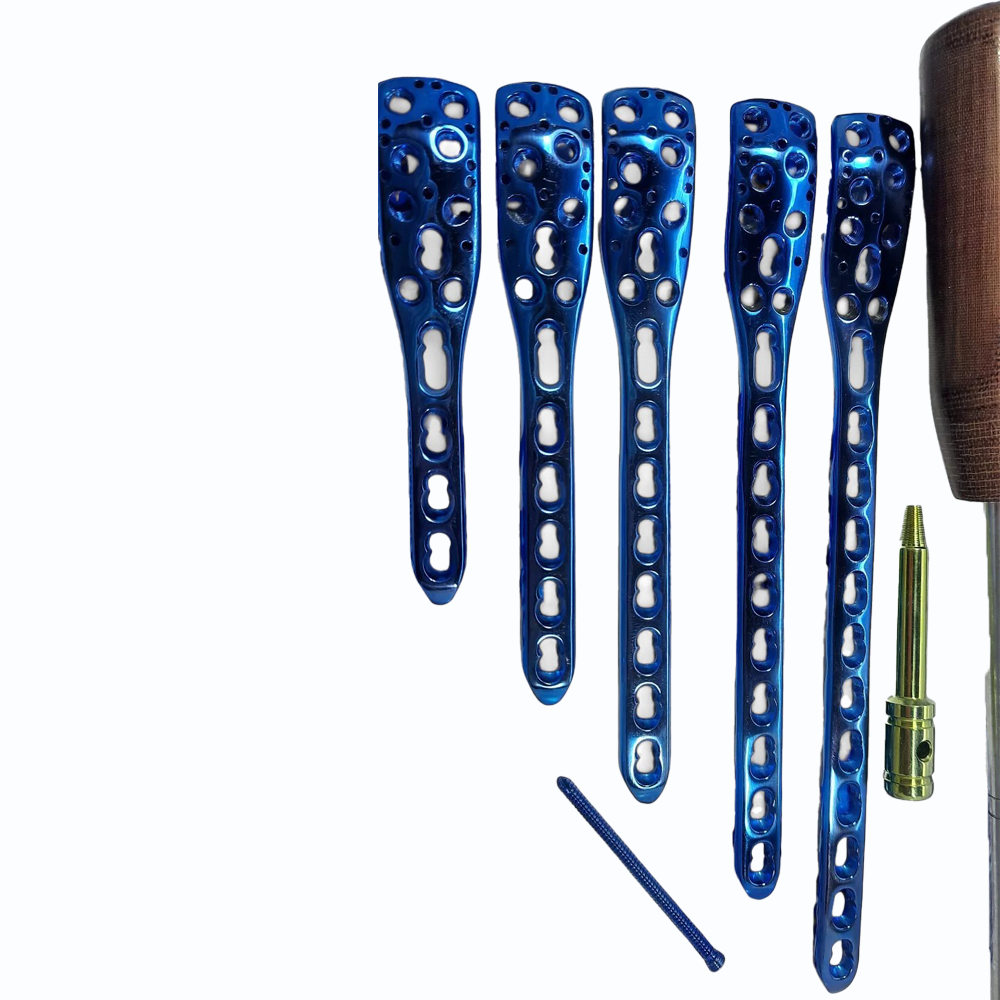
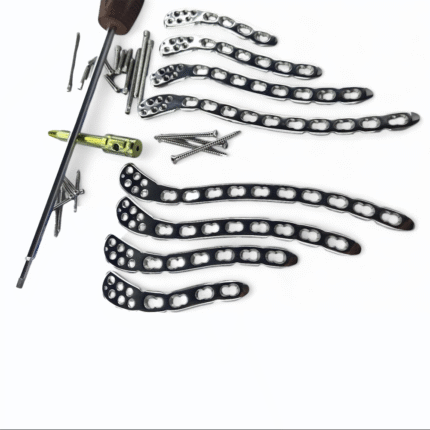

The Proximal Humeral PHILOS Locking Plates Titanium are specialized orthopedic fixation implants designed for stabilization of appropriately selected proximal humerus fractures. Their anatomical proximal humeral configuration is intended to provide fixation around the proximal humerus while compatible multi-angle locking screws allow controlled screw positioning within the plate’s approved locking range.
Proximal humerus fractures can present significant fixation challenges because of the complex three-dimensional anatomy of the shoulder, variable bone quality, and proximity of the humeral head, tuberosities, rotator cuff, and shoulder joint. A dedicated proximal humerus locking plate can provide a stable fixation option for selected displaced, unstable, or complex fractures where operative treatment is clinically indicated.
The PHILOS-style plate configuration is designed for anatomical fixation of the proximal humerus. Multiple fixation points around the proximal portion of the plate can support selected fracture fragments while shaft holes provide additional fixation below the fracture. The exact positioning and number of screws should be determined according to fracture morphology, bone quality, and the manufacturer’s surgical technique.
The multi-angle locking technology allows compatible locking screws to be positioned within a specified angular range rather than requiring every screw to follow one predetermined axis. This can provide greater flexibility for targeting selected fracture fragments and optimizing screw purchase in the proximal humeral head. The permitted angular range and screw compatibility must always be confirmed through the manufacturer’s technical documentation.
The product is available in 6-, 8-, 10-, and 12-hole configurations, providing multiple options for plate length and fixation distribution. Shorter configurations may be appropriate for selected fracture patterns requiring a limited fixation span, while longer configurations can provide additional shaft fixation when clinically required. Plate selection should be based on fracture location, anatomy, bone quality, and the surgeon’s fixation strategy.
The plates are manufactured from titanium, a material widely used in orthopedic implant applications because of its favorable strength-to-weight characteristics, corrosion resistance, and established biocompatibility. Titanium construction can provide a relatively lightweight implant while maintaining the mechanical properties required for appropriate fracture fixation. The exact titanium grade, mechanical specifications, dimensions, and surface treatment should be confirmed through the manufacturer’s technical documentation.
The locking plate system is intended for use with compatible locking screws. Correct screw diameter, length, head configuration, thread design, and locking interface are essential for proper engagement. Screw trajectory and length are particularly important around the proximal humerus because inappropriate positioning may affect the humeral head, articular surface, or surrounding soft tissues.
The 51-piece selection provides multiple proximal humeral plate configurations for orthopedic trauma departments, hospitals, shoulder surgery units, surgical centers, and medical implant suppliers. Multiple hole options allow the surgical team to select an appropriate plate length based on the fracture pattern and required fixation span.
Proximal humeral locking plates may be considered for selected displaced, unstable, comminuted, three-part, four-part, and other complex proximal humerus fractures when surgical fixation is indicated. The suitability of operative fixation depends on patient age, bone quality, fracture morphology, displacement, vascular considerations, soft-tissue condition, and surgeon assessment. The implant should not be considered appropriate for every proximal humerus fracture.
Accurate fracture reduction and implant positioning are essential. The surgeon should use appropriate imaging and system-specific instrumentation to confirm plate placement, fracture reduction, and screw position. Special attention should be given to screw depth and trajectory to reduce the risk of inappropriate penetration into the humeral head or joint.
The implant should be handled carefully to prevent contamination, scratches, deformation, or damage to the locking holes. Plate bending or modification should only be performed if specifically permitted by the manufacturer. The use of compatible drills, guides, depth gauges, screwdrivers, and reduction instruments is recommended according to the applicable surgical technique.
Sterility, packaging, storage, and processing requirements depend on the product configuration and manufacturer labeling. Reusable instruments should be cleaned, inspected, packaged, and sterilized according to validated healthcare-facility procedures and applicable manufacturer instructions.
With 6–12 hole configurations, a proximal humeral PHILOS-style design, multi-angle locking capability, titanium construction, and a 51-piece selection, this system provides a versatile orthopedic fixation option for appropriately selected proximal humerus fracture procedures.
Key Features
- Designed for proximal humerus fracture fixation.
- PHILOS-style anatomical proximal humeral configuration.
- Multi-angle locking technology provides flexible screw trajectories.
- Available in 6, 8, 10, and 12-hole configurations.
- Titanium construction provides a favorable strength-to-weight ratio.
- Designed for use with compatible locking screws.
- Multiple fixation points support selected proximal humeral fracture fragments.
- Multiple plate lengths accommodate different fracture patterns.
- Suitable for selected displaced, unstable, and complex proximal humerus fractures.
- 51-piece selection provides multiple plate configurations.
- Suitable for professional orthopedic trauma and shoulder surgery applications.
- Requires compatible multi-angle locking instrumentation.
Product Specifications
| Specification | Details |
|---|---|
| Product Name | Proximal Humeral Multi-Angle (PHILOS) Locking Plates |
| Anatomical Site | Proximal Humerus / Shoulder |
| Plate Type | Anatomical Multi-Angle Locking Plate |
| Hole Options | 6, 8, 10 & 12 Holes |
| Plate Design | PHILOS-Style Proximal Humeral |
| Locking Technology | Multi-Angle Locking |
| Material | Titanium |
| Screws | Compatible Locking Screws |
| Quantity | 51 Pieces |
| Primary Application | Proximal Humerus Fracture Fixation |
| Fixation Type | Multi-Angle / Angular-Stable Fixation |
| Surgical Specialty | Orthopedic Trauma / Shoulder Surgery |
| Intended Use | Professional orthopedic surgical applications |
| Instrument Compatibility | Use compatible multi-angle locking plate instrumentation |
| Sterilization | Follow product-specific manufacturer instructions and validated protocols |
FAQs
1. What are Proximal Humeral PHILOS Locking Plates used for?
They are orthopedic fixation plates designed for selected proximal humerus fractures requiring surgical stabilization. Their anatomical design and multi-angle locking interface provide flexible fixation options around the proximal humerus.
2. What does PHILOS mean?
PHILOS is commonly used to describe a Proximal Humeral Internal Locking System style of anatomical locking plate. The term generally refers to a proximal humeral plate configuration designed for locking fixation.
3. What hole configurations are available?
The product includes 6-, 8-, 10-, and 12-hole configurations, providing different plate lengths and fixation options.
4. What does multi-angle locking mean?
Multi-angle locking allows compatible screws to be inserted at different permitted trajectories within the manufacturer’s specified angular range. This can provide flexibility when targeting selected fracture fragments.
5. What material are these plates made from?
The plates are manufactured from titanium, a material widely used in orthopedic implants because of its corrosion resistance, biocompatibility, and favorable strength-to-weight characteristics.
6. Are screws included with the 51-piece set?
The title specifies the plate system and its 51-piece quantity but does not explicitly state a screw quantity. Compatible locking screws should be confirmed against the manufacturer’s detailed set configuration before ordering.
7. What types of proximal humerus fractures can these plates be used for?
They may be considered for selected displaced, unstable, comminuted, three-part, four-part, and other complex proximal humerus fractures when operative fixation is clinically indicated.

Reviews
There are no reviews yet.