
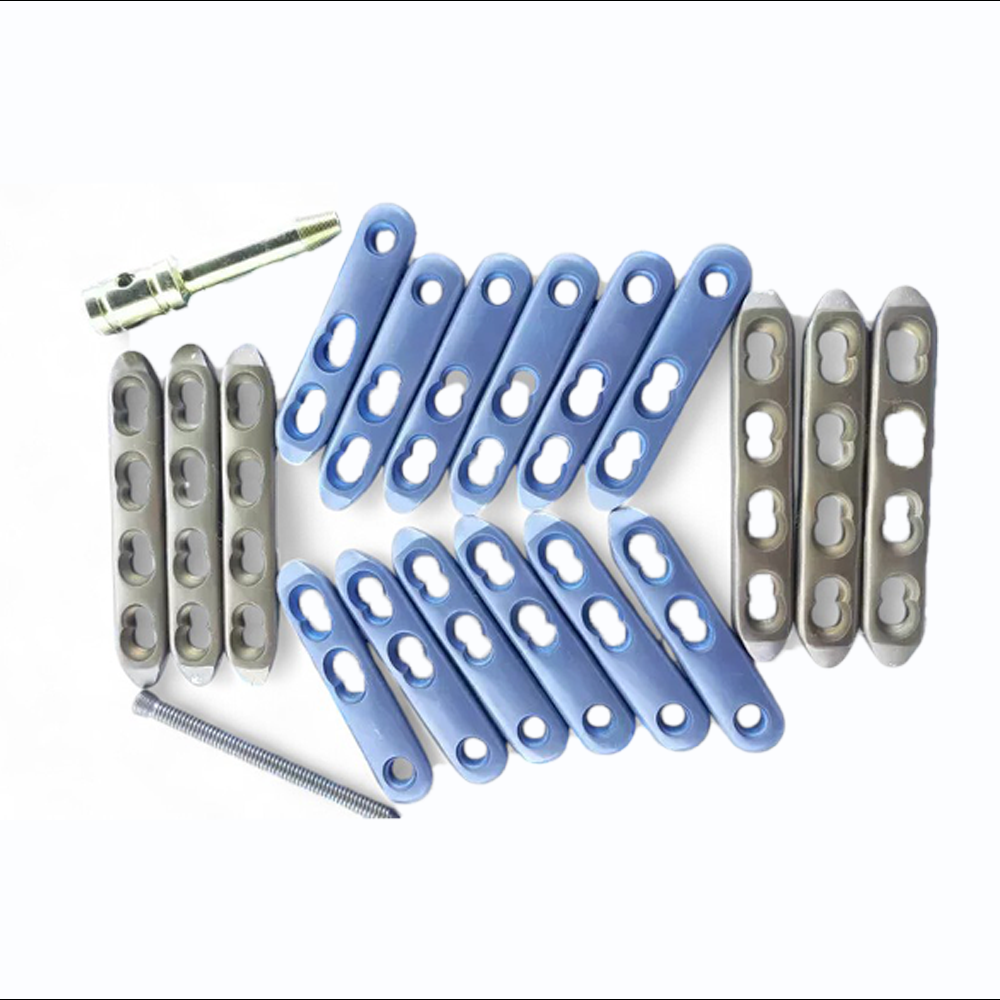
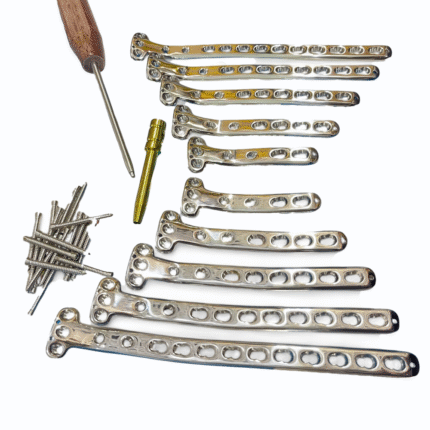
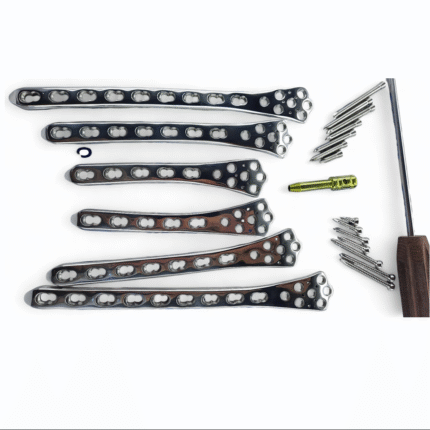
The Locking Narrow 4.5/5mm Plate with Titanium Screws 79 pcs is an orthopedic fixation system designed for stabilization of appropriately selected fractures where a narrow locking plate configuration is indicated. The system combines titanium plates with compatible titanium locking screws to provide an angular-stable fixation construct when used according to the manufacturer’s recommended surgical technique.
The narrow plate configuration provides a more compact implant profile compared with broader plate designs, making it suitable for selected anatomical locations where available bone surface and soft-tissue considerations require a narrower fixation solution. The appropriate plate size and configuration should be selected according to the fracture pattern, anatomical location, bone dimensions, bone quality, and surgeon’s treatment plan.
The 4.5/5 mm designation identifies the screw/plate system size according to the product specification. This type of locking plate system is intended for compatible screws of the corresponding dimensions. Exact screw diameter, thread configuration, locking interface, and plate dimensions should be verified against the manufacturer’s technical documentation before clinical use.
The plate is available in 3-hole and 4-hole configurations, allowing different options for fixation length and screw distribution. A shorter plate configuration may be appropriate when limited fixation length is required, while a longer configuration can provide additional fixation points when clinically indicated. The choice should be based on fracture characteristics and the required fixation construct rather than hole count alone.
Both the plates and screws are manufactured from titanium. Titanium is widely used in orthopedic implant applications because of its favorable strength-to-weight ratio, corrosion resistance, and established biocompatibility characteristics. The exact titanium grade, mechanical properties, surface treatment, and dimensional specifications should be confirmed through the manufacturer’s product documentation.
The locking screw mechanism allows compatible screw heads to engage with threaded plate holes, creating a fixed-angle relationship between the screws and plate. This can provide angular stability and maintain screw positioning within the fixation construct. Locking screws should be inserted using compatible instrumentation and within the manufacturer’s specified insertion parameters.
The included titanium screws provide a convenient plate-and-screw configuration for orthopedic surgical inventory. Appropriate screw length should be selected according to bone thickness, fracture location, plate position, and the desired purchase. Overly long screws may present a risk of unwanted anatomical penetration, while inadequate screw length may compromise fixation.
The 79-piece selection provides multiple plate and screw configurations for hospitals, orthopedic trauma centers, surgical facilities, and medical implant suppliers. A range of plate sizes and screw options can help support implant selection for different fracture patterns and patient anatomies.
Locking narrow plates may be considered for selected long-bone and periarticular fracture fixation applications where the corresponding plate geometry and dimensions are appropriate. The product should not be assumed to be suitable for every anatomical site or fracture pattern. Clinical indications must be determined according to the specific implant design, surgeon judgment, and applicable manufacturer labeling.
Proper plate contouring, positioning, drilling, and screw insertion are important to the performance of the fixation construct. Locking plates should generally not be bent or modified unless the manufacturer specifically permits it, as uncontrolled modification can affect the locking interface or mechanical integrity.
The plates and screws should be handled carefully to avoid contamination, scratching, deformation, or damage to the threaded locking surfaces. Sterility and packaging requirements depend on the product configuration and manufacturer labeling. Reusable surgical instruments should be cleaned, inspected, packaged, and sterilized according to validated healthcare-facility protocols.
With 3- and 4-hole configurations, narrow 4.5/5 mm sizing, titanium plate and screw construction, locking fixation technology, and a 79-piece selection, this system provides a versatile orthopedic fixation option for appropriately selected fracture stabilization procedures.
Key Features
- Locking narrow plate configuration for orthopedic fracture fixation.
- Compatible with the specified 4.5/5 mm fixation system.
- Available in 3-hole and 4-hole configurations.
- Plates manufactured from titanium.
- Supplied with compatible titanium screws.
- Locking screw interface provides an angular-stable connection when properly assembled.
- Narrow plate profile supports selected anatomical fixation applications.
- Multiple hole configurations provide flexibility in fixation length.
- Designed for professional orthopedic trauma and fracture fixation procedures.
- 79-piece selection provides multiple plate and screw options.
- Requires compatible drilling guides and screwdrivers.
- Screw length and plate configuration should be selected according to anatomy and surgical requirements.
Product Specifications
| Specification | Details |
|---|---|
| Product Name | Locking Narrow 4.5/5 mm Plate |
| Plate Type | Narrow Locking Plate |
| System Size | 4.5/5 mm |
| Hole Options | 3 & 4 Holes |
| Plate Material | Titanium |
| Screw Material | Titanium |
| Screws | Included |
| Locking Type | Locking / Angular-Stable Fixation |
| Quantity | 79 Pieces |
| Primary Application | Orthopedic Fracture Fixation |
| Surgical Specialty | Orthopedic Trauma |
| Plate Configuration | Narrow |
| Intended Use | Professional orthopedic surgical applications |
| Instrument Compatibility | Use compatible locking plate instrumentation |
| Sterilization | Follow product-specific manufacturer instructions and validated protocols |
FAQs
1. What is a Locking Narrow 4.5/5 mm Plate?
It is an orthopedic locking plate designed for selected fracture fixation procedures requiring a narrow plate configuration and compatible 4.5/5 mm locking screw system.
2. What hole configurations are available?
The product includes 3-hole and 4-hole plate configurations, providing different fixation lengths and screw-position options.
3. What material are the plates made from?
The plates are manufactured from titanium, a material commonly used in orthopedic implants because of its corrosion resistance, favorable strength-to-weight characteristics, and biocompatibility.
4. Are the screws made from titanium?
Yes. The product specifies titanium plates with titanium screws.
5. What does locking plate mean?
A locking plate contains threaded holes designed to engage compatible locking screw heads. When correctly assembled, the screw and plate form an angular-stable fixation construct.
6. What does 4.5/5 mm refer to?
The 4.5/5 mm designation refers to the specified plate and screw system size. Exact dimensions and compatibility should be verified against the manufacturer’s technical specifications.
7. What is the advantage of a narrow locking plate?
A narrow plate can provide a more compact fixation option where anatomical dimensions or soft-tissue considerations make a narrower implant appropriate. The suitability depends on the specific anatomical site and fracture pattern.
8. How many pieces are included?
The product is supplied as a 79-piece selection consisting of titanium plates and compatible titanium screws.

Reviews
There are no reviews yet.