
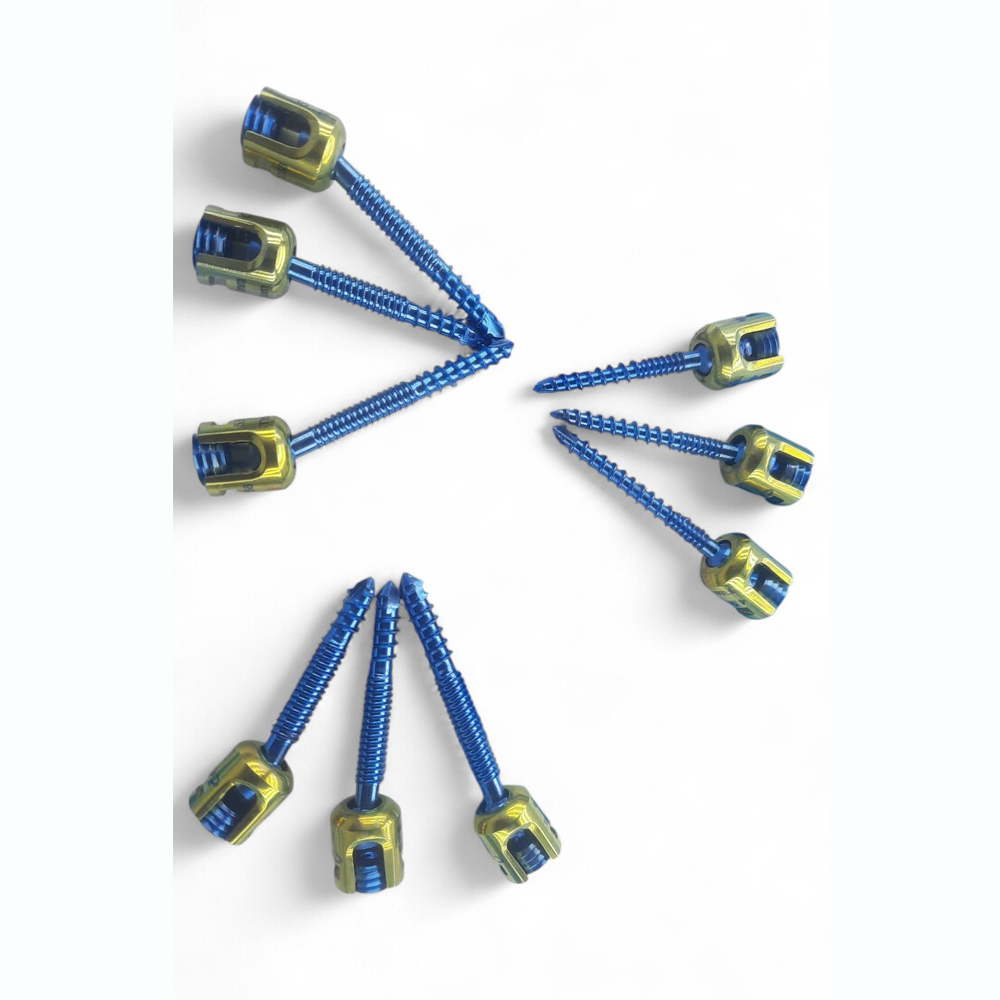

The Polyaxial Pedicle Screw Spine System Double Thread Titanium is a spinal fixation component designed for use in compatible posterior spinal stabilization and fusion systems. The system combines a polyaxial screw-head mechanism with a double-thread screw configuration to provide controlled fixation of the vertebral pedicle and flexibility during rod-based spinal construct assembly.
Polyaxial pedicle screws are designed with a mobile screw head that can articulate relative to the screw shaft within the permitted range. This feature allows the surgeon greater flexibility when aligning the screw heads with a longitudinal rod during spinal instrumentation. Rather than requiring every screw to be positioned along exactly the same trajectory, the polyaxial mechanism can help accommodate variations in vertebral anatomy and screw placement.
The double-thread configuration is designed to provide efficient advancement of the screw during insertion. Thread geometry is an important aspect of pedicle screw performance because it influences insertion characteristics, bone purchase, and the interaction between the screw and vertebral bone. The exact thread pitch, thread profile, core diameter, outer diameter, and insertion specifications should be verified from the manufacturer’s technical documentation.
Manufactured from titanium, the pedicle screws provide material characteristics commonly used in spinal implant applications, including favorable strength-to-weight properties, corrosion resistance, and biocompatibility. Titanium is widely used in spinal instrumentation, although the exact titanium grade and mechanical specifications should always be confirmed according to the manufacturer’s product documentation.
The 9-piece selection provides a focused inventory of pedicle screw components for spinal surgery facilities and implant systems. The appropriate screw size and configuration should be selected based on vertebral level, patient anatomy, pedicle dimensions, bone quality, surgical approach, and the requirements of the compatible spinal fixation system.
Polyaxial pedicle screw systems are commonly incorporated into posterior spinal constructs using connecting rods and compatible locking or set-screw components. Once appropriately positioned within the pedicle, the screw heads can be aligned with the rod, allowing the surgical team to construct a stabilized spinal segment. Correct compatibility between the pedicle screw, rod, set screw, and other system components is essential.
Pedicle screw placement requires careful preoperative planning and precise intraoperative technique because the vertebral pedicle is located near important neural and vascular structures. Screw trajectory, depth, diameter, and placement should be determined using appropriate imaging and surgical guidance according to the surgeon’s technique and the applicable device instructions.
The system should be used only with compatible spinal instrumentation. Appropriate instruments may include pedicle probes, awls, taps, screwdrivers, rod holders, reduction instruments, and set-screw drivers depending on the complete system configuration. Using incompatible instruments or components may compromise screw placement or locking performance.
The screws should be handled carefully to prevent contamination, deformation, thread damage, or damage to the polyaxial mechanism. Sterility and processing requirements depend on the specific product configuration and manufacturer labeling. Reusable spinal instruments should be cleaned, inspected, packaged, and sterilized according to validated healthcare-facility procedures.
With its polyaxial screw-head design, double-thread configuration, titanium construction, and 9-piece selection, this pedicle screw system provides a specialized component for compatible spinal fixation constructs and professional orthopedic spine surgery applications.
Key Features
- Polyaxial pedicle screw design for multidirectional head positioning.
- Double-thread configuration for controlled screw advancement.
- Manufactured from titanium for spinal implant applications.
- Supplied as a 9-piece selection.
- Designed for compatible posterior spinal fixation systems.
- Polyaxial head facilitates rod alignment during construct assembly.
- Suitable for selected spinal stabilization and fusion procedures.
- Designed for fixation within appropriately prepared vertebral pedicles.
- Requires compatible rods, set screws, and spinal instrumentation.
- Screw dimensions should be selected according to vertebral anatomy and surgical requirements.
- Titanium construction provides corrosion resistance and favorable strength-to-weight characteristics.
- Intended for professional orthopedic and spinal surgery applications.
Product Specifications
| Specification | Details |
|---|---|
| Product Name | Double Thread Polyaxial Pedicle Screw Spine System |
| Screw Type | Polyaxial Pedicle Screw |
| Thread Design | Double Thread |
| Material | Titanium |
| Quantity | 9 Pieces |
| Application | Spinal Fixation |
| Primary Use | Posterior Spinal Stabilization |
| Head Type | Polyaxial |
| Implant Category | Spinal Fixation Implant |
| Surgical Specialty | Orthopedic Spine Surgery / Neurosurgery |
| Compatible Components | Rods, Set Screws & System-Specific Instruments |
| Intended Use | Professional spinal fixation procedures |
| Screw Dimensions | Select according to system and anatomy |
| Sterilization | Follow product-specific manufacturer instructions and validated protocols |
FAQs
1. What is a Polyaxial Pedicle Screw?
A polyaxial pedicle screw is a spinal fixation implant with a mobile screw head that can articulate relative to the screw shaft. This allows the head to be positioned for alignment with a connecting rod during spinal instrumentation.
2. What does double thread mean on a pedicle screw?
A double-thread configuration uses two thread starts to allow the screw to advance more efficiently during insertion. The exact insertion characteristics depend on the screw’s thread geometry and manufacturer specifications.
3. What material are these pedicle screws made from?
The screws are manufactured from titanium, a material widely used in spinal implant systems due to its favorable mechanical, corrosion-resistant, and biocompatibility characteristics.
4. How many pedicle screws are included?
The product is supplied as a 9-piece selection. Exact screw sizes and configurations should be confirmed from the applicable product specification.
5. What are polyaxial pedicle screws used for?
Polyaxial pedicle screws are used as components of compatible spinal fixation constructs for selected spinal stabilization and fusion procedures. They are commonly connected to rods using compatible locking or set-screw components.
6. What is the advantage of a polyaxial screw head?
The mobile screw head provides flexibility when aligning multiple screws with a connecting rod. This can help accommodate variations in screw trajectories and vertebral anatomy during construct assembly.
7. Where are pedicle screws placed?
Pedicle screws are inserted through the pedicles into the vertebral body or appropriate vertebral fixation region according to the specific spinal procedure. Precise placement requires careful planning and appropriate surgical guidance.
8. Can these pedicle screws be used with any spinal rod?
No. Pedicle screws should only be used with compatible rods, set screws, and other components specified for the corresponding spinal fixation system. Component compatibility must be verified before use.
9. What procedures may use polyaxial pedicle screw systems?
Compatible polyaxial pedicle screw systems may be used in selected spinal stabilization and fusion procedures. Specific indications depend on the complete implant system, anatomical region, patient condition, and applicable regulatory labeling.
Reviews
There are no reviews yet.