
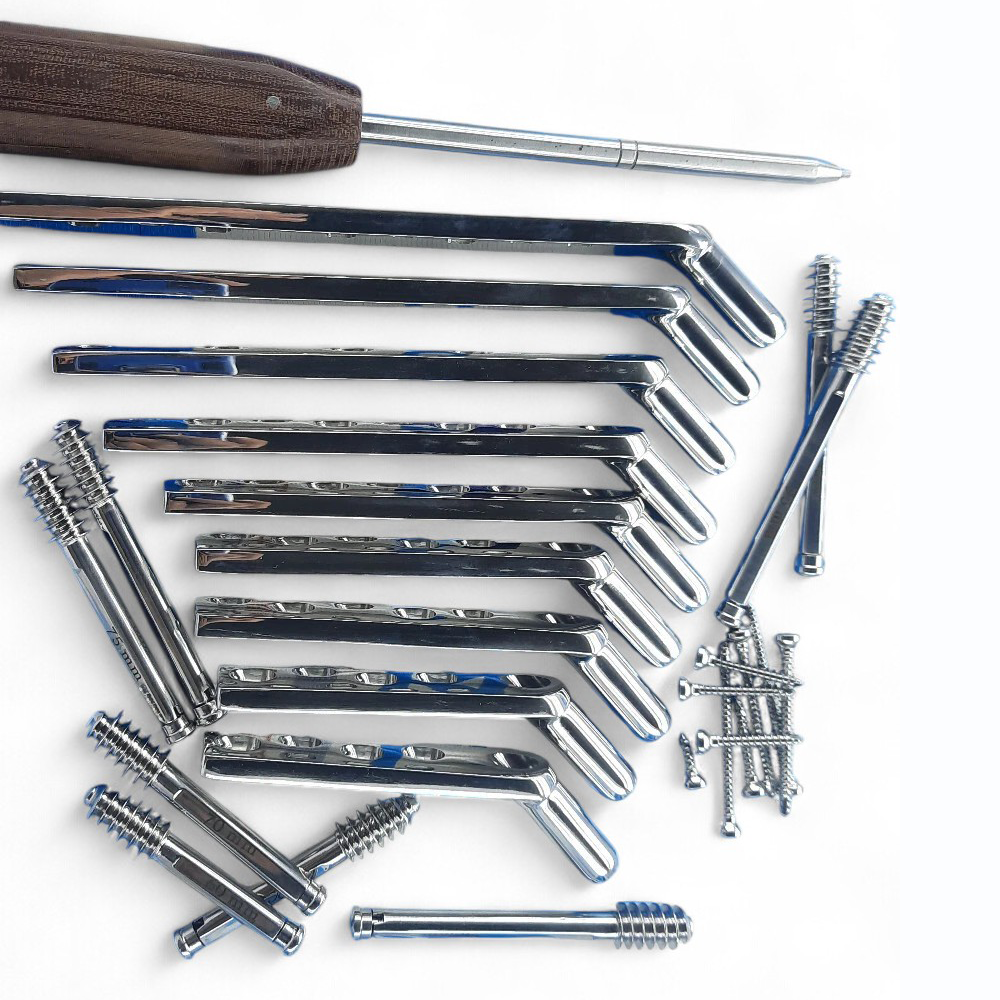
The Non Locked DHS 135° Plate 4 5 Hole SS 316L 33 pcs is an orthopedic fracture fixation component designed for use with compatible Dynamic Hip Screw (DHS) systems. The 135° plate configuration provides a standardized angular relationship between the barrel portion of the plate and the plate body, supporting fixation of appropriately selected proximal femoral fractures according to the surgeon’s preferred fixation technique and the applicable implant system.
Dynamic hip screw fixation is an established orthopedic technique in which a lag screw or compatible DHS component is positioned across the femoral neck and head and engages with a side plate attached to the femoral shaft. The design permits controlled sliding of the lag screw within the barrel in compatible systems, allowing compression at the fracture site under appropriate loading conditions. The suitability of this fixation method depends on fracture morphology, bone quality, reduction, implant positioning, and surgical judgment.
This product features a 135° plate angle, a commonly used configuration for proximal femoral fixation. The angular geometry is intended to assist appropriate positioning of the DHS component relative to the femoral neck and shaft. Accurate preoperative planning and intraoperative imaging are important for determining the appropriate implant size, entry point, trajectory, and plate position.
The plates are available in 4-hole and 5-hole configurations, providing different options for fixation along the femoral shaft. The number of plate holes can influence the available fixation length and number of cortical screw positions. Selection should be based on the fracture pattern, bone anatomy, bone quality, and the fixation strategy recommended by the operating orthopedic surgeon.
The system is specified for a 12.5 mm DHS component and 4.5 mm cortex screws. The DHS component provides the principal cephalocervical fixation element, while the cortex screws secure the side plate to the femoral shaft. Compatibility between the plate, DHS component, screws, insertion instruments, and other system components should always be confirmed before clinical use.
Manufactured from SS 316L stainless steel, the plate provides corrosion resistance and mechanical durability characteristics appropriate for orthopedic implant applications. SS 316L is a low-carbon stainless steel commonly used in medical devices where resistance to corrosion and reliable mechanical performance are required. The precise implant-grade material specifications should be confirmed through the manufacturer’s technical documentation.
The 33-piece selection provides a practical range of DHS plates and compatible fixation components for orthopedic trauma facilities. Having both 4-hole and 5-hole plate configurations available can support implant selection according to the patient’s anatomy and fracture characteristics.
Non-locked DHS plates rely on conventional screw fixation rather than threaded locking between the screw head and plate. This conventional fixation approach requires appropriate plate-to-bone contact and correct screw placement. The surgical technique should follow the applicable DHS system instructions, including appropriate guide-wire placement, drilling, lag-screw insertion, plate positioning, and cortical screw fixation.
All implant components should be handled carefully to prevent contamination, scratching, bending, or other damage. Compatible DHS instrumentation should be used for preparation and insertion. Sterility, packaging integrity, storage, and processing requirements must follow the manufacturer’s labeling and applicable healthcare-facility protocols.
The Non-Locked DHS 135° Plate provides a conventional dynamic hip screw fixation option combining 4- and 5-hole plate configurations, 12.5 mm DHS compatibility, 4.5 mm cortex screw fixation, and SS 316L stainless-steel construction for appropriately selected orthopedic trauma procedures.
Key Features
- 135° DHS plate angle for compatible proximal femoral fixation systems.
- Non-locked plate design using conventional cortical screw fixation.
- Available in 4-hole and 5-hole configurations.
- Designed for use with 12.5 mm DHS components.
- Compatible with 4.5 mm cortex screws as specified.
- Manufactured from SS 316L stainless steel.
- Designed for selected proximal femoral fracture fixation procedures.
- Provides multiple plate-hole configurations for different fixation requirements.
- Compatible with conventional Dynamic Hip Screw fixation techniques.
- Supplied as a 33-piece selection.
- Requires appropriate DHS-compatible surgical instrumentation.
- Suitable for professional orthopedic trauma applications.
Product Specifications
| Specification | Details |
|---|---|
| Product Name | Non-Locked DHS 135° Plate |
| Plate Type | Dynamic Hip Screw (DHS) Plate |
| Locking Type | Non-Locked |
| Plate Angle | 135° |
| Hole Options | 4 & 5 Holes |
| DHS Size | 12.5 mm |
| Cortex Screw Size | 4.5 mm |
| Material | SS 316L Stainless Steel |
| Quantity | 33 Pieces |
| Fixation Method | Conventional DHS Fixation |
| Primary Application | Proximal Femoral Fracture Fixation |
| Surgical Specialty | Orthopedic Trauma |
| Implant System | Compatible DHS System |
| Intended Use | Professional orthopedic surgical applications |
| Instrument Compatibility | Use compatible DHS instrumentation |
| Sterilization | Follow product-specific manufacturer instructions and validated protocols |
FAQs
1. What is a Non-Locked DHS 135° Plate?
A Non-Locked DHS 135° Plate is an orthopedic side plate designed for use with compatible Dynamic Hip Screw systems in selected proximal femoral fracture fixation procedures. It uses conventional, non-locking screw fixation to secure the plate to the femoral shaft.
2. What does the 135° angle mean?
The 135° angle refers to the fixed angular relationship between the plate barrel and the plate body. This geometry is designed to accommodate the appropriate trajectory of the DHS component toward the femoral head and neck.
3. What hole configurations are available?
This product includes 4-hole and 5-hole plate configurations. The appropriate option depends on the fracture pattern, required fixation length, bone anatomy, and surgeon’s treatment plan.
4. What size DHS component is compatible with this plate?
The product is specified for a 12.5 mm DHS component. Compatibility should be confirmed with the corresponding DHS system and manufacturer specifications before use.
5. What size cortex screws are used?
The product is specified for 4.5 mm cortex screws for securing the plate to the femoral shaft. Screw length should be selected according to bone anatomy and the applicable surgical technique.
6. What material is the DHS plate made from?
The plate is manufactured from SS 316L stainless steel, a low-carbon stainless steel known for corrosion resistance and mechanical durability in appropriate medical applications.
7. What fractures can a DHS plate be used for?
DHS fixation may be considered for appropriately selected proximal femoral fractures, depending on fracture morphology, reduction, bone quality, and other clinical factors. The final fixation method should be selected by a qualified orthopedic surgeon.
8. What is the difference between a locked and non-locked DHS plate?
A non-locked DHS plate uses conventional screws that compress the plate against the bone. A locking plate uses screws that engage threaded plate holes to create a fixed-angle construct. The appropriate system depends on the surgical indication and fixation strategy.
9. How many pieces are included in the set?
The product is supplied as a 33-piece selection consisting of the specified DHS plates and associated fixation components.
10. Are special DHS instruments required?
Yes. DHS fixation generally requires compatible instrumentation for guide-wire placement, preparation of the femoral neck and head, DHS component insertion, plate placement, and cortical screw fixation. The appropriate instruments should be used according to the manufacturer’s surgical technique.

Reviews
There are no reviews yet.