
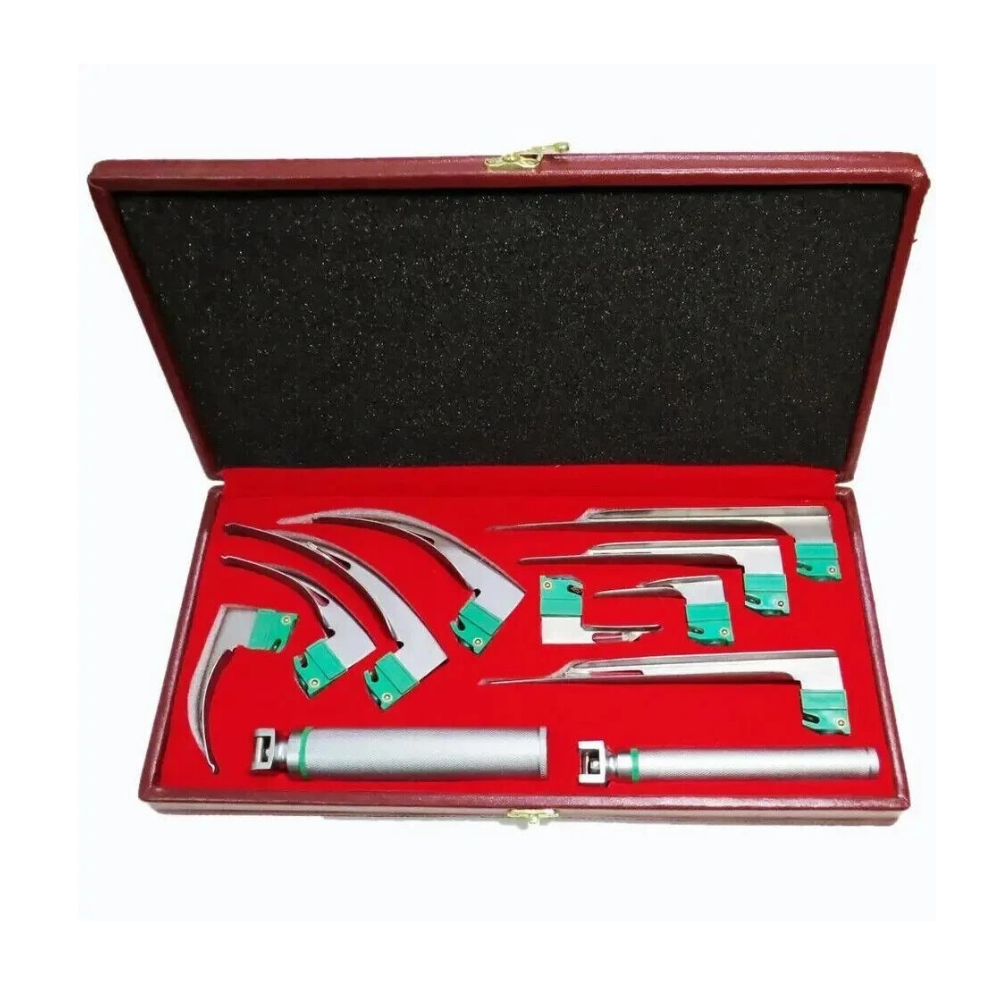
The EMT Fiber optic Laryngoscope Kit – 9 Blades, 2 Handles is a professional airway management set designed to assist clinicians with direct visualization of the laryngeal structures during laryngoscopy and endotracheal intubation. Its combination of two handles and nine interchangeable blades provides a versatile configuration for use across different patient populations and clinical situations.
A fiber optic laryngoscope uses an integrated light-conducting system to illuminate the airway and provide visualization of the oral cavity, pharyngeal structures, and laryngeal area during examination and intubation. Clear illumination is particularly important during airway management, where appropriate visualization can help clinicians identify the relevant anatomical landmarks.
The 9-blade configuration provides multiple options for airway management. Depending on the exact set contents, the blades may include different curved or straight designs and sizes intended for adult, pediatric, or other patient applications. Exact blade styles, lengths, and size distribution should be verified against the supplied kit configuration.
Two handles allow the surgical or emergency team to maintain a second functional handle within the kit or prepare different configurations according to clinical requirements. Handle and blade compatibility should be confirmed before use, particularly when replacement components or accessories from different systems are involved.
Fiber optic laryngoscopes are commonly used in anesthesia, emergency medicine, intensive care, operating rooms, airway management, and prehospital or clinical transport environments where direct laryngoscopy may be required. The instrument can be used for endotracheal intubation and airway visualization by appropriately trained healthcare professionals.
Blade design is an important part of laryngoscope performance. Curved blades are commonly used to engage the vallecula and facilitate visualization of the glottic opening, while straight blade designs may provide a different approach to the epiglottis. The appropriate blade selection depends on patient anatomy, age, clinical circumstances, and the clinician’s established airway technique.
The fiber optic light pathway helps direct illumination toward the distal end of the blade. Compared with older bulb-at-tip configurations, fiber optic designs can provide a low-profile distal working area and facilitate light transmission along the blade. The exact optical system and illumination performance depend on the particular handle and blade design.
The two-handle, nine-blade format also supports operating-room and emergency equipment organization. Keeping compatible blades together in one kit makes it easier for clinicians to select a suitable size before airway management begins. A dedicated case or storage arrangement can also help protect the blades and handles from damage between uses.
Because laryngoscope blades are inserted into the patient’s oral cavity, appropriate infection-control procedures are essential. Reusable blades and handles must be cleaned, disinfected, sterilized, or otherwise processed according to the manufacturer’s validated instructions. Single-use blades, when supplied as disposable products, should not be reused.
Before use, the illumination system should be checked to ensure that the handle powers the fiber optic pathway and that the distal light output is functioning correctly. Blades should be inspected for structural damage, surface defects, secure attachment, and smooth locking. Fiber optic components should also be examined for damage or contamination that could reduce illumination.
The EMT Fiber Optic Laryngoscope Kit is suitable for anesthesia departments, emergency rooms, intensive care units, operating theaters, ambulances, medical training facilities, and other professional healthcare environments requiring a multi-blade laryngoscopy system. Its nine blades and two handles provide flexibility for airway visualization and intubation across different clinical requirements.
Key Features
- Fiber optic laryngoscope kit
- Includes 9 interchangeable blades
- Includes 2 laryngoscope handles
- Designed for airway visualization and intubation
- Suitable for professional anesthesia and emergency settings
- Multiple blade sizes support different patient requirements
- May include curved and/or straight blade configurations
- Fiber optic illumination provides distal airway lighting
- Suitable for operating rooms, emergency departments, and critical care
- Handle and blade compatibility should be verified before use
- Reusable components require validated reprocessing
- Suitable for professional airway management equipment inventories
Product Specifications
| Specification | Details |
|---|---|
| Product Name | EMT Fiber Optic Laryngoscope Kit |
| Product Type | Fiber Optic Airway Management Set |
| Number of Blades | 9 |
| Number of Handles | 2 |
| Primary Function | Laryngoscopy and Airway Visualization |
| Clinical Application | Endotracheal Intubation / Airway Management |
| Illumination | Fiber Optic |
| Blade Configuration | Multiple Sizes / Styles, Set Dependent |
| Blade Design | Curved and/or Straight, Configuration Dependent |
| Patient Range | Adult / Pediatric, Configuration Dependent |
| Handle Type | Fiber Optic Compatible |
| Power Source | Model Dependent |
| Material | Medical-Grade Construction, Configuration Dependent |
| Reusable | Component Specific |
| Cleaning / Sterilization | Follow Validated Manufacturer Instructions |
| Contents | 9 Blades + 2 Handles |
FAQs
What is the EMT Fiber Optic Laryngoscope Kit used for?
The kit is used for direct visualization of the airway and laryngeal structures during laryngoscopy and endotracheal intubation by appropriately trained healthcare professionals.
How many blades are included in the kit?
The kit contains 9 laryngoscope blades in different configurations and sizes, providing options for various airway management requirements.
How many handles are included?
The set includes 2 fiber optic laryngoscope handles.
What is the advantage of fiber optic illumination?
Fiber optic technology transmits light toward the distal end of the blade, providing illumination of the airway while keeping the distal profile relatively compact.
Can this kit be used for endotracheal intubation?
Yes. Fiber optic laryngoscopes are commonly used during direct laryngoscopy for endotracheal intubation by trained clinicians.
Why are multiple laryngoscope blades included?
Different blade sizes and designs can accommodate variations in patient age, anatomy, airway characteristics, and clinician preference.
What is the difference between curved and straight laryngoscope blades?
Curved and straight blades provide different approaches to visualizing the laryngeal structures. The appropriate blade depends on patient anatomy and the clinician’s airway management technique.
Can the laryngoscope be used for pediatric patients?
A laryngoscope kit may include pediatric-compatible blade sizes, but the exact patient range depends on the nine blades supplied with the specific configuration.
Are the blades reusable?
Some laryngoscope blades are designed for reuse, while others are single-use. Reusability must be determined from the specific product labeling and manufacturer’s instructions.
How should the laryngoscope blades and handles be cleaned?
Reusable components should be cleaned and disinfected or sterilized according to validated manufacturer instructions. Not all handles, blades, or accessories necessarily use the same processing method.
What should be checked before using the laryngoscope?
Check the handle power source, fiber optic illumination, blade attachment and locking mechanism, blade integrity, and cleanliness before use.
Why does a laryngoscope kit have two handles?
Two handles provide an additional compatible handle within the set, supporting equipment readiness and allowing the clinical team to maintain more than one assembled configuration when appropriate.



Reviews
There are no reviews yet.