
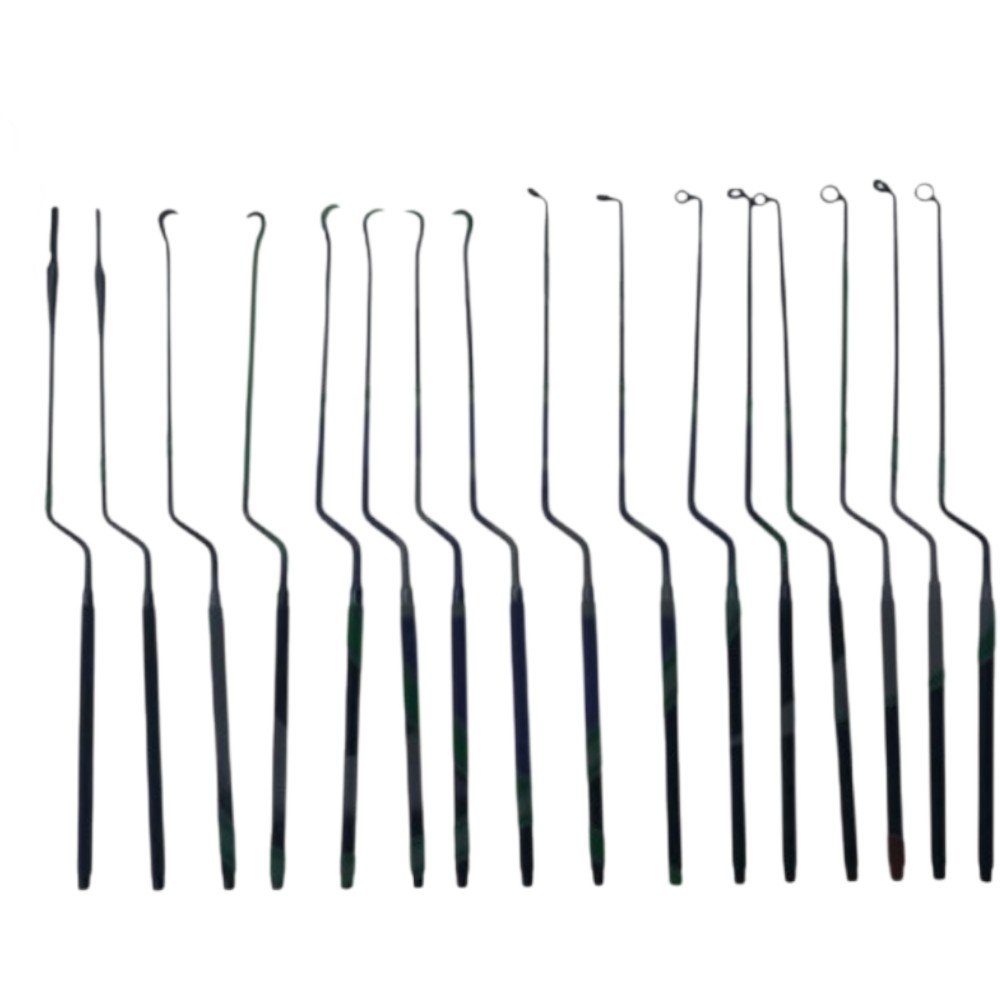
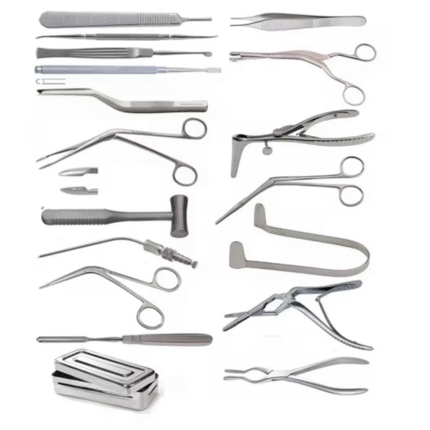

The Hardy Pituitary Neuro Curettes Surgery Set – 16 Pcs Surgical Instruments is designed for specialized neurosurgical procedures involving the pituitary gland and surrounding skull-base anatomy. Pituitary surgery requires instruments that can provide controlled access and precise manipulation within a restricted operative corridor. A dedicated curette set allows the surgeon to select different working-end configurations according to the anatomy, surgical approach, and operative task.
Hardy-style pituitary curettes are commonly associated with transsphenoidal and other skull-base procedures where careful manipulation of tissue is required. Their elongated shafts and specialized curette tips are intended to facilitate controlled removal or mobilization of tissue within a confined surgical field. The exact shape, angle, and size of each curette determine its suitability for particular parts of the operative procedure.
This 16-piece pituitary curette set provides multiple instrument options within a single coordinated configuration. Different curette sizes and working-end geometries can help the surgical team adapt the instrument to different anatomical locations and stages of the procedure. Exact dimensions, tip shapes, shaft lengths, and individual instrument contents should be verified against the supplied set specification.
Pituitary curettes may be used in procedures involving pituitary adenomas, sellar lesions, transsphenoidal approaches, skull-base surgery, and microsurgical removal of selected intracranial tissue. Their use is determined by the operating neurosurgeon and the specific operative technique. The instruments are intended for controlled manipulation rather than forceful or inappropriate tissue traction.
The elongated design of a pituitary curette can help extend the working reach through a narrow surgical corridor while keeping the handle outside the immediate operative field. This can be particularly useful during endonasal or transsphenoidal approaches, where access to the sellar region is limited and precise instrument control is important.
The curette working ends are designed to provide controlled contact with soft tissue. Depending on the configuration, curettes can assist with scooping, separating, manipulating, or removing tissue from the operative area. Selection of a particular curette should be based on the working-end profile and the intended surgical maneuver rather than using one instrument for every stage of the procedure.
The 16-piece configuration can also improve operating-room organization by keeping a range of commonly required pituitary curettes together in a dedicated neurosurgical set. This can simplify instrument preparation and help the surgical team quickly identify an appropriate instrument during a procedure. It also allows sterile processing personnel to check the set for completeness and inspect individual instruments after use.
Because pituitary curettes have fine working ends, careful handling is essential. Tips should be protected from bending, impact, or contact with heavier instruments during transport and sterilization. Each curette should be inspected for alignment, tip integrity, surface condition, corrosion, and other signs of damage before being returned to service.
For reusable surgical instruments, cleaning and sterilization should follow the validated instructions applicable to the exact instrument materials and configuration. Particular attention should be paid to the curette tips, shaft transitions, handles, and other areas where tissue residue can remain. Proper inspection after processing is important for maintaining the intended performance of delicate neurosurgical instruments.
The Hardy Pituitary Neuro Curettes Surgery Set 16 Pcs is appropriate for neurosurgical departments, skull-base surgery units, hospitals, specialty surgical centers, and professional medical facilities requiring a dedicated collection of pituitary curettes. Its range of configurations supports controlled microsurgical manipulation during procedures where precision and access are important.
Key Features
- 16-piece pituitary neurosurgical curette set
- Designed for specialized neurosurgical applications
- Suitable for pituitary and skull-base procedures
- Useful for transsphenoidal surgical approaches
- Multiple curette configurations for procedural flexibility
- Elongated shafts designed for access through confined operative corridors
- Fine working ends for controlled tissue manipulation
- Supports delicate microsurgical handling
- Suitable for selected pituitary tumor procedures
- Coordinated set simplifies operating-room instrument organization
- Fine tips require careful handling and inspection
- Reusable when supplied as reusable instruments and processed according to validated instructions
Product Specifications
| Specification | Details |
|---|---|
| Product Name | Hardy Pituitary Neuro Curettes Surgery Set |
| Set Quantity | 16 Pieces |
| Instrument Type | Pituitary / Neurosurgical Curettes |
| Primary Specialty | Neurosurgery |
| Surgical Focus | Pituitary and Skull-Base Surgery |
| Common Approach | Transsphenoidal, Technique Dependent |
| Primary Function | Controlled Tissue Manipulation and Curettage |
| Shaft Design | Elongated, Configuration Dependent |
| Working Ends | Multiple Curette Profiles |
| Tip Sizes | Multiple Sizes, Configuration Dependent |
| Applications | Pituitary, Sellar, Skull-Base Procedures |
| Material | Surgical Instrument Material, Configuration Dependent |
| Reusable | Depending on Instrument Configuration |
| Sterilization | Follow Validated Manufacturer Instructions |
| Contents | Verify Exact 16-Piece Set Configuration |
FAQs
What is a Hardy pituitary curette used for?
A Hardy pituitary curette is a specialized neurosurgical instrument used for controlled manipulation and removal of tissue during pituitary and skull-base procedures.
How many instruments are included in this Hardy curette set?
This configuration contains 16 surgical instruments. The exact curette sizes, tip profiles, and individual components should be confirmed against the supplied set specification.
What procedures use pituitary curettes?
Pituitary curettes may be used during selected transsphenoidal, skull-base, sellar, and pituitary tumor procedures where controlled tissue manipulation is required.
Why are Hardy curettes elongated?
The elongated shaft allows the working end to reach deeper operative areas through a relatively narrow surgical corridor while the surgeon maintains control from outside the immediate field.
Can this curette set be used for transsphenoidal surgery?
Appropriately configured pituitary curettes are commonly used in transsphenoidal techniques. Exact instrument selection depends on the surgical approach and the surgeon’s established technique.
What makes pituitary curettes different from general curettes?
Pituitary curettes are designed with working-end profiles, dimensions, and shaft lengths intended for delicate neurosurgical access to the sellar and surrounding skull-base region.
Are these curettes suitable for pituitary tumor surgery?
They may be used for selected pituitary tumor procedures as part of a complete neurosurgical instrument system. The specific curette used depends on the anatomy and operative technique.
Are Hardy pituitary curettes reusable?
Reusable status depends on the exact instrument construction and manufacturer instructions. Reusable instruments must be appropriately cleaned, inspected, sterilized, and maintained.
How should pituitary curettes be sterilized?
Cleaning and sterilization should follow validated instructions for the specific instruments and materials. Fine curette tips should be protected during cleaning, transport, and sterilization.
What should be checked before using a pituitary curette?
Inspect each instrument for tip deformation, cracks, corrosion, alignment problems, surface damage, and other signs of wear. Fine working ends should be intact and properly aligned before use.


Reviews
There are no reviews yet.