

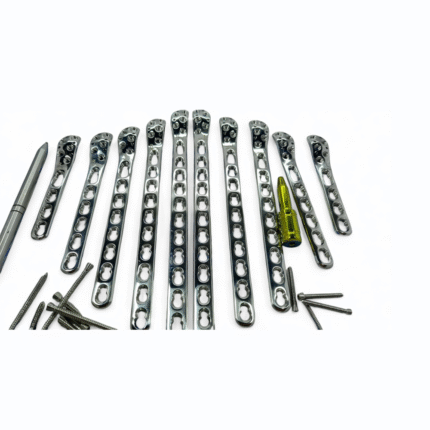
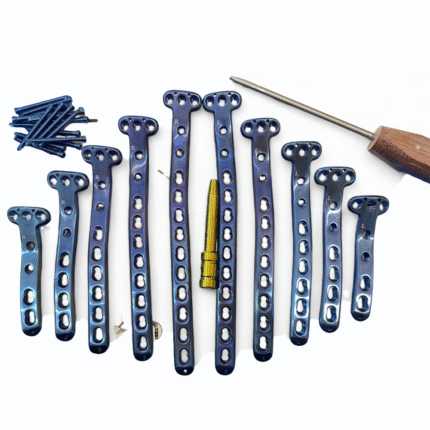
The Locking One Third Tubular Plates 3.5mm Titanium is a specialized orthopedic fixation system designed for selected internal fixation procedures where a narrow, contoured plate profile and locking screw technology are appropriate. The system provides multiple 4-hole through 12-hole one-third tubular plate configurations, together with compatible LCP screws, giving orthopedic surgical teams a range of fixation options for different anatomical and operative requirements.
One-third tubular plates are characterized by a narrow tubular-style profile designed for applications where a relatively low-profile fixation plate is desirable. Their geometry can make them suitable for selected areas of the upper and lower extremities where the available bone surface and soft-tissue envelope require a more compact plate design. The precise anatomical indications depend on the individual plate dimensions, contour, hole configuration, and manufacturer’s approved applications.
The system includes 4, 5, 6, 7, 8, 9, 10, 11 and 12-hole configurations, providing multiple plate-length options. Shorter configurations may be selected when a compact fixation construct is appropriate, while longer plates provide additional fixation points and greater longitudinal coverage when clinically required. Hole count should not be considered independently when selecting an implant; patient anatomy, fracture pattern, bone quality, reduction requirements, and the intended fixation strategy should all be evaluated.
The plates are designed for use with compatible LCP screws. LCP, or Locking Compression Plate, technology uses screw-to-plate locking interfaces that allow compatible screws to engage with the plate. When correctly assembled, the screw can establish a fixed-angle relationship with the plate according to the implant system’s design. This locking construct can provide a stable fixation option while allowing the surgeon to determine appropriate screw positioning based on the anatomy and fracture configuration.
The 3.5 mm specification identifies the stated plate and compatible fixation system size. Appropriate screw selection should take into account plate compatibility, bone dimensions, available bone stock, fracture morphology, and the intended fixation construct. Screw length and trajectory should be carefully selected to achieve the intended fixation without compromising surrounding anatomical structures.
Manufactured from Titanium Grade 5, the plates provide a material platform widely used in orthopedic implant applications. Titanium Grade 5 is known for its favorable strength-to-weight ratio, high mechanical strength, corrosion resistance, and established use in surgical implant systems. The actual performance of an orthopedic plate depends on its complete design, dimensions, manufacturing process, surface characteristics, and intended application.
The 90-piece configuration provides a consolidated selection of one-third tubular locking plates and compatible LCP screws. This can be useful for orthopedic trauma departments, hospitals, surgical centers, and specialized orthopedic facilities requiring several plate lengths for different surgical cases. A multi-size system can also simplify implant inventory organization and assist surgical teams in preparing appropriate fixation options before a procedure.
The narrow plate profile may be beneficial in selected anatomical locations where a bulky implant could be undesirable. However, plate profile alone should not determine suitability. The surgeon should assess the fracture location, available bone surface, soft-tissue considerations, bone quality, and required mechanical stability before selecting a one-third tubular locking plate.
Before implantation, all plates and screws should be inspected for damage, deformation, contamination, corrosion, compromised threads, or other abnormalities. Particular attention should be given to the locking interfaces and screw threads. Components should be handled using appropriate surgical technique, and only compatible plates, screws, and approved instrumentation should be used together.
Correct implant selection and surgical technique are essential to the intended performance of the fixation construct. The surgeon should verify plate dimensions, screw compatibility, screw length, and fixation trajectory before implantation. The manufacturer’s surgical technique and applicable orthopedic fixation principles should be followed throughout the procedure.
Cleaning and sterilization should be performed according to the manufacturer’s validated instructions for use (IFU). Although Titanium Grade 5 is commonly used in orthopedic implant systems, the material designation alone does not establish a universal sterilization cycle. Healthcare facilities should use validated processing procedures and follow the manufacturer’s specified instructions.
With 3.5 mm compatibility, 4–12 hole configurations, LCP screws, Titanium Grade 5 construction, and a 90-piece system, these Locking One-Third Tubular Plates provide qualified orthopedic professionals with a versatile fixation option for selected fracture stabilization procedures.
Key Features
- Locking one-third tubular plate system for selected orthopedic fracture fixation applications.
- 3.5 mm system size with compatible LCP screws.
- Available in 4–12 hole configurations for different plate-length requirements.
- Includes multiple plate lengths to accommodate varying fixation needs.
- Manufactured from Titanium Grade 5.
- Locking interfaces are designed for compatible LCP screw engagement.
- Fixed-angle screw-to-plate fixation is supported when components are correctly assembled.
- Narrow tubular-style profile provides a compact plate configuration for selected anatomical sites.
- 90-piece orthopedic fixation system provides multiple plate and screw options.
- Suitable for selected orthopedic trauma and fracture fixation procedures.
- Components should be inspected for integrity and compatibility before implantation.
- Screw length and trajectory should be selected according to anatomy and surgical technique.
- Cleaning and sterilization should follow the manufacturer’s validated instructions.
Product Specifications
| Specification | Details |
|---|---|
| Product Name | Locking One-Third Tubular Plates |
| Plate Type | Locking One-Third Tubular Plate |
| System Size | 3.5 mm |
| Hole Configurations | 4–12 Holes |
| Screw Type | LCP Screws |
| Screws | Included |
| Total System Quantity | 90 Pieces |
| Material | Titanium Grade 5 |
| Fixation Technology | Locking Plate and Screw System |
| Plate Profile | One-Third Tubular / Narrow Profile |
| Primary Application | Orthopedic Fracture Fixation |
| Surgical Specialty | Orthopedic Surgery / Orthopedic Trauma |
| Plate Options | Multiple Hole Configurations |
| Intended Users | Qualified Orthopedic Professionals |
| Component Compatibility | Use specified compatible LCP screws and instrumentation |
| Sterilization | Follow manufacturer’s validated sterilization instructions |
| Implant Selection | Based on anatomy, fracture pattern and surgeon assessment |
FAQs
1. What are locking one-third tubular plates used for?
Locking one-third tubular plates are orthopedic fixation implants used for selected fracture stabilization procedures where a narrow or low-profile plate configuration is appropriate. Specific applications depend on the plate design, anatomy, and manufacturer’s approved indications.
2. What size are these one-third tubular locking plates?
The system is specified as a 3.5 mm locking plate system with compatible LCP screws.
3. What hole configurations are available?
The system includes 4-hole through 12-hole configurations, providing multiple plate-length and fixation-point options.
4. What type of screws are included?
The plates are supplied with compatible LCP screws, designed to engage with the corresponding locking interfaces of the plate system.
5. What material are these plates made from?
The plates are manufactured from Titanium Grade 5, a high-strength titanium alloy widely used in orthopedic implant applications.
6. What is the purpose of the one-third tubular plate design?
The one-third tubular design provides a relatively narrow plate profile that may be useful for selected anatomical locations where a compact fixation plate is appropriate. The exact clinical suitability depends on the implant dimensions and surgical application.

Reviews
There are no reviews yet.