

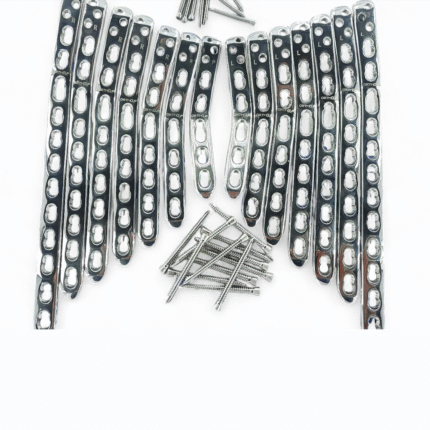
The Locking Distal Fibula Plates L&R 4 12 Holes SS 316L is a versatile orthopedic implant system designed for internal fixation of selected fractures involving the distal fibula and lateral aspect of the ankle. The system combines multiple plate lengths, bilateral left- and right-sided configurations, and compatible LCP screws to provide orthopedic surgical teams with a broad selection of fixation components for different fracture patterns and anatomical requirements.
Distal fibula fractures are common ankle injuries and can present with varying degrees of displacement, comminution, bone quality, and soft-tissue involvement. The anatomy around the lateral malleolus requires careful implant selection and positioning. Providing multiple plate configurations allows the surgeon to select an implant according to the patient’s anatomy, fracture morphology, available bone stock, and planned surgical approach.
This system includes 4-hole, 6-hole, 8-hole, 10-hole, and 12-hole configurations, providing multiple plate-length options and fixation-point distributions. Shorter plates may be appropriate for selected fracture patterns requiring a more compact construct, while longer plates can provide additional fixation points and greater longitudinal coverage when clinically indicated. Plate selection should be based on the complete clinical and radiographic assessment rather than hole count alone.
The availability of left and right plates provides side-specific options corresponding to the affected ankle. Correct laterality can assist with anatomical positioning and surgical handling. The final implant configuration should be selected according to patient-specific anatomy, fracture characteristics, bone quality, imaging findings, soft-tissue considerations, and the manufacturer’s approved indications.
The system uses compatible LCP screws. LCP, or Locking Compression Plate, technology incorporates locking interfaces that allow compatible screws to engage with the plate. When correctly assembled according to the manufacturer’s specifications, locking screws can establish a fixed-angle relationship between the screw and plate. This provides an option for stable plate-and-screw fixation while allowing the surgeon to determine appropriate screw placement according to the fracture and available bone.
The 4–12 hole range provides flexibility in plate length and fixation coverage. Longer configurations may provide additional fixation points when required, while shorter configurations may be useful where a smaller plate footprint is desirable. The surgeon should consider fracture location, bone quality, fragment size, reduction requirements, soft-tissue condition, and fixation strategy when selecting the appropriate plate.
The plates are manufactured from SS 316L stainless steel, a low-carbon stainless-steel alloy widely used in medical and surgical implant applications. SS 316L is recognized for its corrosion-resistant characteristics and suitability for various surgical environments. The mechanical performance of the implant depends on the complete plate design, dimensions, manufacturing process, surface finish, and intended application.
The 127-piece system provides an extensive selection of distal fibula plates and compatible LCP screws within one organized fixation set. This configuration can support orthopedic trauma departments, hospitals, surgical centers, and specialized orthopedic facilities where multiple distal fibula fixation options may be required. A consolidated set can also assist with surgical planning, implant availability, and orthopedic inventory management.
Distal fibula fixation requires careful consideration of the lateral ankle anatomy and surrounding soft tissues. Appropriate plate positioning and screw placement should be determined using preoperative imaging and intraoperative assessment. Accurate fracture reduction, appropriate implant selection, and proper fixation technique remain essential to the surgical procedure.
Before implantation, each plate and screw should be inspected for visible damage, deformation, contamination, corrosion, compromised threads, or other abnormalities. The locking interfaces and screw threads should be protected during handling. Only compatible plates, screws, and approved surgical instrumentation should be used together.
Correct screw length and trajectory are important to the intended fixation construct, particularly around the ankle where surrounding anatomical structures must be considered. The surgeon should verify implant dimensions, screw compatibility, and available bone stock before insertion and follow the manufacturer’s surgical technique.
Cleaning and sterilization should be performed according to the manufacturer’s validated instructions for use (IFU). Although SS 316L is widely used in surgical implant systems, the material specification alone does not define a universal sterilization cycle. Healthcare facilities should follow validated processing procedures and the manufacturer’s applicable instructions.
With 4, 6, 8, 10 and 12-hole configurations, left- and right-sided options, compatible LCP screws, SS 316L construction, and a 127-piece system, these Locking Distal Fibula Plates provide qualified orthopedic professionals with a versatile selection for selected distal fibula and ankle fracture fixation procedures.
Key Features
- Locking distal fibula plate system designed for selected lateral ankle fracture fixation applications.
- Available in 4, 6, 8, 10 and 12-hole configurations.
- Includes left and right side-specific plate options.
- Supplied with compatible LCP screws.
- Manufactured from SS 316L stainless steel.
- Multiple plate lengths provide flexibility for different fracture patterns and fixation requirements.
- Locking interfaces support compatible fixed-angle screw fixation when properly assembled.
- Designed for selected distal fibula and lateral malleolus fracture procedures.
- 127-piece system provides a comprehensive selection of plates and screws.
- Bilateral configurations accommodate left- and right-sided anatomy.
- Suitable for professional orthopedic trauma and fracture fixation applications.
- Components should be inspected for integrity and compatibility before implantation.
- Cleaning and sterilization should follow the manufacturer’s validated instructions.
Product Specifications
| Specification | Details |
|---|---|
| Product Name | Locking Distal Fibula Plates |
| Anatomical Site | Distal Fibula / Lateral Ankle |
| Plate Type | Locking Distal Fibula Plate |
| Hole Configurations | 4, 6, 8, 10 & 12 Holes |
| Laterality | Left & Right |
| Screw Type | LCP Screws |
| Screws | Included |
| Total System Quantity | 127 Pieces |
| Material | SS 316L Stainless Steel |
| Fixation Technology | Locking Plate and Screw System |
| Primary Application | Distal Fibula Fracture Fixation |
| Surgical Specialty | Orthopedic Surgery / Orthopedic Trauma |
| Plate Options | Multiple Length Configurations |
| Intended Users | Qualified Orthopedic Professionals |
| Component Compatibility | Use specified compatible plates, screws and instrumentation |
| Sterilization | Follow manufacturer’s validated sterilization instructions |
| Implant Selection | Based on anatomy, fracture pattern and surgeon assessment |
FAQs
1. What are locking distal fibula plates used for?
Locking distal fibula plates are orthopedic implants used for internal fixation and stabilization of selected fractures involving the distal fibula and lateral ankle. The appropriate implant depends on the patient’s anatomy, fracture pattern, bone quality, and surgical approach.
2. What hole configurations are available?
The system includes 4-hole, 6-hole, 8-hole, 10-hole, and 12-hole configurations, providing multiple plate-length and fixation-point options.
3. Are left and right distal fibula plates included?
Yes. The system includes left and right plate configurations to accommodate the corresponding side of the ankle.
4. Are LCP screws included with these plates?
Yes. The product is specified with compatible LCP screws. Exact screw sizes and quantities should be confirmed against the manufacturer’s component inventory.
5. What does LCP mean in orthopedic plates?
LCP stands for Locking Compression Plate. Compatible locking screws engage with designated plate interfaces to create a fixed-angle screw-to-plate relationship when properly assembled.
6. What material are these distal fibula plates made from?
The plates are manufactured from SS 316L stainless steel, a low-carbon stainless-steel alloy widely used in medical and surgical implant applications.
7. Why are multiple hole configurations available?
Different hole counts provide different plate lengths and potential fixation points. This allows the surgeon to select a configuration appropriate to the fracture pattern, available bone stock, and required fixation construct.
8. How many pieces are included in the system?
The product is specified as a 127-piece distal fibula locking plate and LCP screw system.

Reviews
There are no reviews yet.