
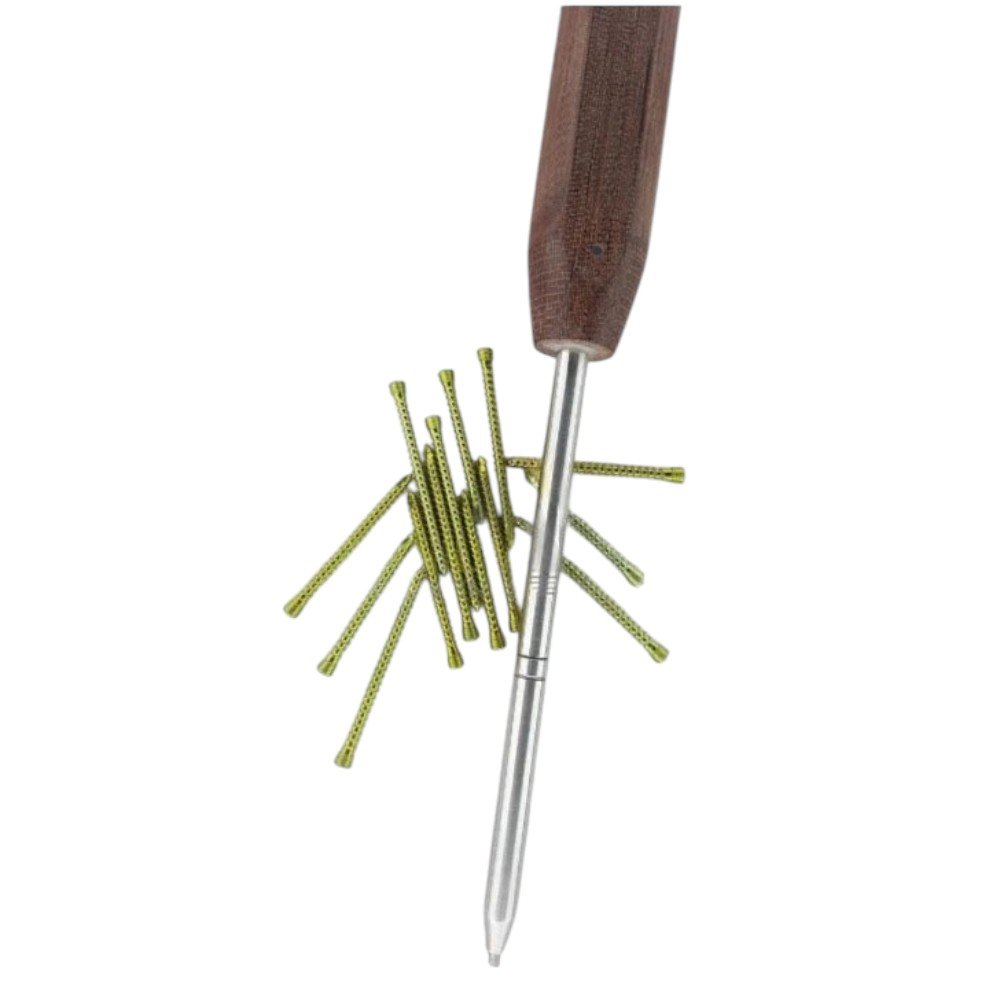
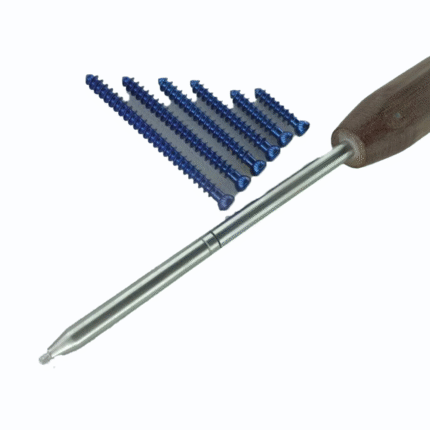

The Safety Locking Screws 3.5mm Self Tapping Titanium 150 pcs are orthopedic fixation components designed for use with compatible locking plate systems in appropriately selected fracture fixation procedures. These screws combine a 3.5 mm diameter, self-tapping thread design, and titanium construction to provide a dedicated fixation option for orthopedic trauma and reconstructive applications.
Locking screws are designed to engage with the threaded holes of compatible locking plates, creating a fixed-angle relationship between the screw and plate. Unlike conventional cortical screws that primarily rely on compression between the plate and bone, a locking screw forms a mechanically locked connection with the plate when correctly inserted into a compatible locking hole. This can provide angular stability within the fixation construct.
The 3.5 mm size is commonly associated with compact orthopedic locking plate systems used in selected fracture fixation applications. The appropriate screw diameter and length must always correspond to the specific plate system. Compatibility should be confirmed by matching the screw’s diameter, thread design, head geometry, and locking interface with the manufacturer’s approved plate components.
The self-tapping design allows the screw threads to form their own thread within appropriately prepared bone during insertion, depending on the specific system and surgical technique. This can simplify screw insertion and may reduce the number of procedural steps compared with systems requiring separate tapping. Whether pre-drilling or other preparation is required depends on the specific implant system and manufacturer instructions.
Manufactured from titanium, these screws provide material characteristics widely valued in orthopedic implant applications. Titanium offers a favorable strength-to-weight ratio, corrosion resistance, and established biocompatibility. The precise titanium grade, mechanical properties, thread geometry, surface treatment, and dimensional tolerances should be confirmed through the manufacturer’s technical documentation.
The locking head is designed to engage with the corresponding threaded plate hole. Correct insertion technique is important because cross-threading, incorrect screw trajectory, excessive insertion torque, or use with an incompatible plate can compromise the intended locking mechanism. The screw should be inserted using the appropriate system-specific screwdriver and instrumentation.
The 150-piece quantity provides an extensive screw inventory for orthopedic trauma departments, hospitals, surgical centers, implant suppliers, and orthopedic instrument sets. Multiple screws can be selected according to the fixation requirements of compatible plate systems. Exact screw lengths within the 150-piece configuration should be verified against the manufacturer’s set composition.
These screws may be used with compatible locking compression plates, anatomical locking plates, and other orthopedic plating systems where 3.5 mm locking screws are specified. They may be suitable for selected upper- and lower-extremity fracture fixation applications depending on the corresponding plate system. The screws should not be assumed to be universally compatible with all 3.5 mm plates.
Proper screw selection is essential to achieve appropriate fixation. Screw length should provide adequate purchase within the intended bone while avoiding excessive penetration beyond the bone or interference with adjacent anatomical structures. The surgeon should use appropriate imaging, measurement instruments, and manufacturer-recommended surgical techniques.
The screws should be stored and handled in a manner that protects the threads and locking head from contamination or damage. The threaded head is a critical component of the locking interface and should remain free from deformation or foreign material. Damaged or compromised implants should not be used.
Sterility and packaging requirements depend on whether the product is supplied sterile or non-sterile and on the applicable manufacturer labeling. Where reusable surgical instrumentation is used, instruments should be cleaned, inspected, packaged, and sterilized according to validated healthcare-facility procedures.
With a 3.5 mm self-tapping design, titanium construction, locking screw head, and 150-piece quantity, these Safety Locking Screws provide a practical inventory solution for compatible orthopedic locking plate systems and appropriately selected fracture fixation procedures.
Key Features
- 3.5 mm orthopedic locking screws.
- Self-tapping thread design for efficient insertion.
- Manufactured from titanium.
- Designed for use with compatible locking plates.
- Locking screw head creates an angular-stable plate-screw connection.
- Suitable for selected orthopedic fracture fixation applications.
- Supports fixed-angle fixation when correctly engaged with a compatible plate.
- Available in a 150-piece quantity.
- Titanium construction provides a favorable strength-to-weight ratio.
- Designed for professional orthopedic trauma applications.
- Requires compatible plate holes and system-specific instrumentation.
- Screw length must be selected according to anatomy and fixation requirements.
Product Specifications
| Specification | Details |
|---|---|
| Product Name | Safety Locking Screws |
| Screw Type | Locking Screw |
| Diameter | 3.5 mm |
| Thread Design | Self-Tapping |
| Material | Titanium |
| Quantity | 150 Pieces |
| Locking Mechanism | Threaded Locking Head |
| Primary Application | Orthopedic Fracture Fixation |
| Plate Compatibility | Compatible 3.5 mm Locking Plate Systems |
| Fixation Type | Angular-Stable Locking Fixation |
| Surgical Specialty | Orthopedic Trauma |
| Intended Use | Professional orthopedic surgical applications |
| Insertion | System-Compatible Screwdriver |
| Sterilization | Follow product-specific manufacturer instructions and validated protocols |
FAQs
1. What are 3.5 mm Safety Locking Screws used for?
These screws are designed for use with compatible orthopedic locking plates to provide angular-stable fixation in appropriately selected fracture fixation procedures.
2. What does 3.5 mm refer to?
The 3.5 mm specification identifies the nominal screw diameter within the applicable orthopedic fixation system. Compatibility with a specific plate must be confirmed by the manufacturer.
3. Are these screws self-tapping?
Yes. The product features a self-tapping thread design, which is intended to facilitate thread formation during screw insertion when used according to the applicable surgical technique.
4. What material are the screws made from?
The screws are manufactured from titanium, a material commonly used in orthopedic implants because of its corrosion resistance, favorable strength-to-weight characteristics, and established biocompatibility.
5. What is a locking screw?
A locking screw is designed to engage a threaded hole in a compatible locking plate. The screw head locks into the plate, creating an angular-stable connection between the implant and screw.
6. Can these screws be used with any 3.5 mm locking plate?
No. Diameter alone does not establish compatibility. The screw head, thread design, locking interface, and plate specifications must correspond to the same approved implant system.
7. What is the advantage of a self-tapping locking screw?
A self-tapping design can simplify screw insertion by allowing the screw to form its thread in appropriately prepared bone, potentially reducing procedural steps. The exact technique depends on the implant system.


Reviews
There are no reviews yet.