
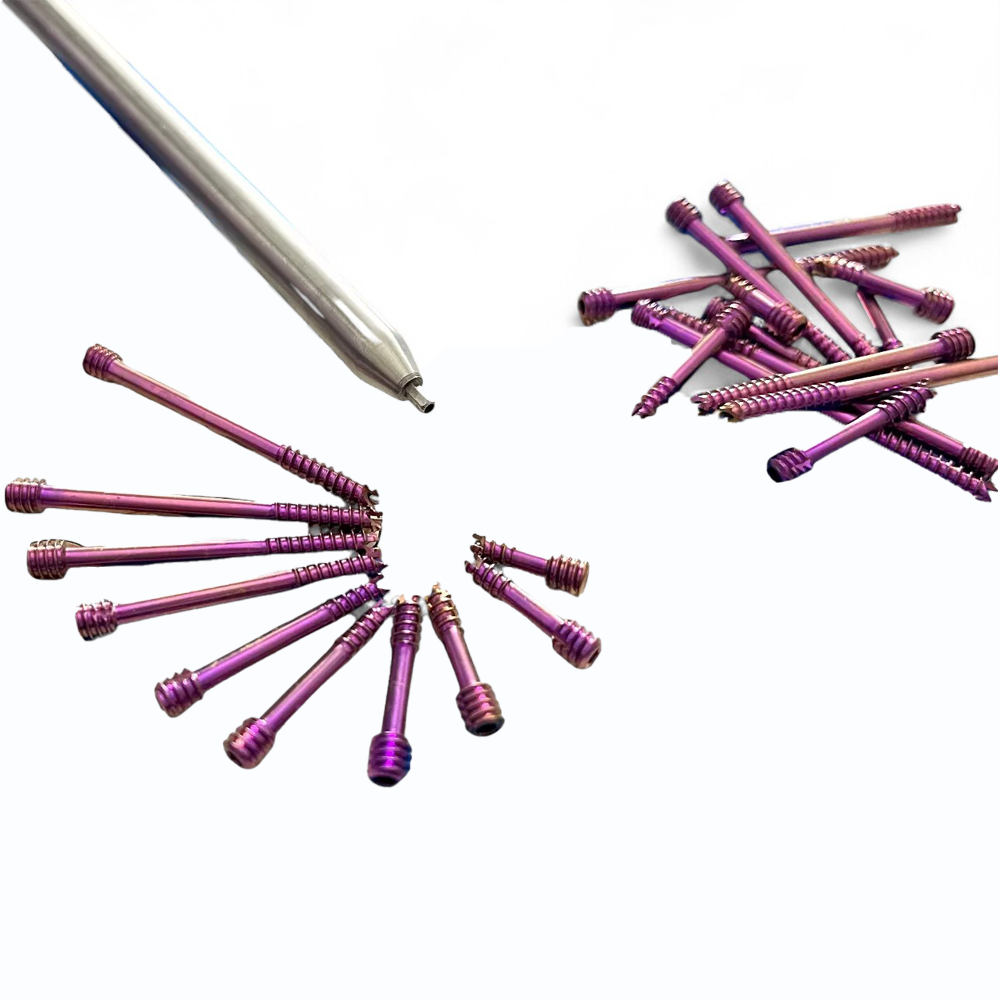

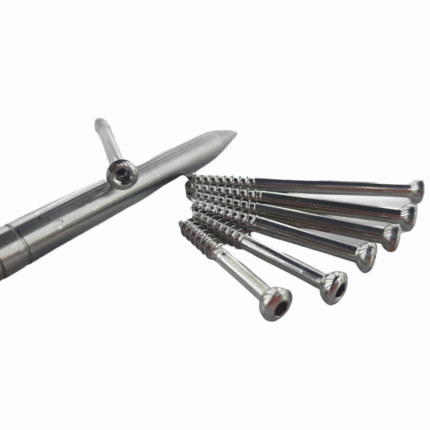
The Herbert Screws 3.5mm Titanium 14 50mm with Screwdriverare orthopedic headless compression screws designed for fixation of appropriately selected fractures and osteotomies where interfragmentary compression and a low-profile implant are clinically desirable. The Herbert screw concept uses a headless design and differential thread characteristics to facilitate compression across selected fracture sites while allowing the implant to be countersunk beneath the bone surface.
Unlike conventional screws with a prominent screw head, a headless compression screw can be positioned below the cortical or articular surface when appropriate. This design can be particularly useful in anatomical regions where implant prominence may interfere with joint motion or surrounding soft tissues. The exact indications depend on the screw design, manufacturer specifications, fracture pattern, and surgeon assessment.
The 3.5 mm screw diameter provides a compact fixation option for appropriately selected orthopedic applications. The system includes multiple lengths from 14 mm through 50 mm, allowing the surgical team to select a screw length appropriate for the patient’s anatomy, fracture location, and required bone purchase. Accurate measurement of the intended screw path is essential before selecting the final implant length.
Herbert-style screws are commonly associated with interfragmentary compression. Their differential thread design can allow the screw to draw appropriately selected fracture fragments together as the screw is advanced. The degree of compression depends on screw design, bone quality, fracture preparation, insertion technique, and the surgeon’s reduction and fixation strategy.
The headless configuration allows the screw to be recessed beneath the bone surface when clinically appropriate. This may be advantageous in selected articular or periarticular applications where minimizing implant prominence is important. However, screw placement must be carefully planned to avoid inappropriate penetration into the joint or surrounding anatomical structures.
The screws are manufactured from titanium, a material widely used in orthopedic implant applications because of its favorable strength-to-weight characteristics, corrosion resistance, and established biocompatibility. The exact titanium grade, mechanical properties, thread geometry, surface treatment, and dimensional tolerances should be verified through the manufacturer’s technical documentation.
The included screwdriver is intended to facilitate insertion of the compatible Herbert screws. Using the appropriate driver interface is important for maintaining proper engagement with the screw during insertion and reducing the risk of damage to the implant or instrumentation. The screwdriver should be used according to the applicable surgical technique.
The 14–50 mm length range provides multiple options for different bone dimensions and fixation requirements. Screw selection should be based on accurate measurement, fracture reduction, desired compression, and adequate purchase in the appropriate bone segment. The screw should be long enough to achieve the intended fixation but should not extend beyond the intended anatomical boundaries.
Herbert screws may be considered for selected fractures involving small bones, periarticular regions, and other anatomical sites where headless compression fixation is appropriate. Potential applications can include selected scaphoid and other carpal fractures, certain osteochondral or articular fracture fragments, and selected osteotomies, depending on the specific implant design and manufacturer-approved indications.
The 38-piece selection provides multiple screw lengths together with a compatible screwdriver, making the set suitable for orthopedic trauma departments, hand and wrist surgery units, hospitals, surgical centers, and medical implant suppliers. Multiple lengths can help support implant selection across different patient anatomies and fixation requirements.
Accurate fracture reduction, guidewire placement where applicable, drilling, measurement, tapping when required, and screw insertion are essential components of the surgical technique. The surgeon should use system-specific instrumentation and follow the manufacturer’s instructions for the particular Herbert screw design.
The implants should be handled carefully to prevent contamination, deformation, scratching, or damage to the screw threads and driver interface. Implant sterility and packaging requirements depend on the product configuration and manufacturer labeling. Reusable instrumentation should be cleaned, inspected, packaged, and sterilized according to validated healthcare-facility procedures.
With 3.5 mm diameter, 14–50 mm length options, titanium construction, headless compression design, an included screwdriver, and a 38-piece selection, this Herbert screw system provides a versatile fixation option for appropriately selected orthopedic fracture and osteotomy procedures.
Key Features
- 3.5 mm Herbert-style headless compression screws.
- Length options ranging from 14 mm to 50 mm.
- Manufactured from titanium.
- Headless design allows appropriate countersunk placement beneath the bone surface.
- Designed for selected interfragmentary compression applications.
- Differential thread concept supports controlled fragment approximation.
- Includes a compatible screwdriver.
- Multiple screw lengths accommodate different anatomical requirements.
- Suitable for selected fracture and osteotomy fixation procedures.
- Useful for appropriately selected small-bone and periarticular fixation.
- 38-piece selection provides multiple implant options.
- Requires appropriate surgical planning and compatible instrumentation.
Product Specifications
| Specification | Details |
|---|---|
| Product Name | Herbert Screws |
| Screw Type | Headless Compression Screw |
| Diameter | 3.5 mm |
| Length Range | 14–50 mm |
| Material | Titanium |
| Screwdriver | Included |
| Quantity | 38 Pieces |
| Design | Headless / Differential Thread |
| Primary Function | Interfragmentary Compression and Fixation |
| Primary Application | Selected Orthopedic Fracture Fixation |
| Potential Surgical Applications | Small-Bone, Periarticular and Osteotomy Fixation |
| Surgical Specialty | Orthopedic Trauma / Hand & Wrist Surgery |
| Fixation Type | Compression Screw Fixation |
| Intended Use | Professional orthopedic surgical applications |
| Instrument Compatibility | Supplied screwdriver and compatible system instrumentation |
| Sterilization | Follow product-specific manufacturer instructions and validated protocols |
FAQs
1. What are Herbert screws used for?
Herbert screws are headless compression screws designed for selected orthopedic fracture and osteotomy fixation procedures where interfragmentary compression and low-profile implant placement are desirable.
2. What is the diameter of these Herbert screws?
These screws have a specified diameter of 3.5 mm.
3. What lengths are available?
The product includes screw lengths ranging from 14 mm to 50 mm, providing multiple options for different anatomical requirements.
4. What material are the screws made from?
The screws are manufactured from titanium, a material widely used for orthopedic implants due to its corrosion resistance, favorable strength-to-weight characteristics, and biocompatibility.
5. What is the advantage of a headless screw?
A headless screw can be recessed beneath the bone surface when appropriately positioned. This may reduce implant prominence and can be beneficial in selected periarticular or articular fixation procedures.
6. How does a Herbert screw provide compression?
Herbert-style screws commonly use differential thread characteristics to facilitate approximation of selected fracture fragments as the screw is advanced. The amount of compression achieved depends on the implant design and surgical technique.


Reviews
There are no reviews yet.