
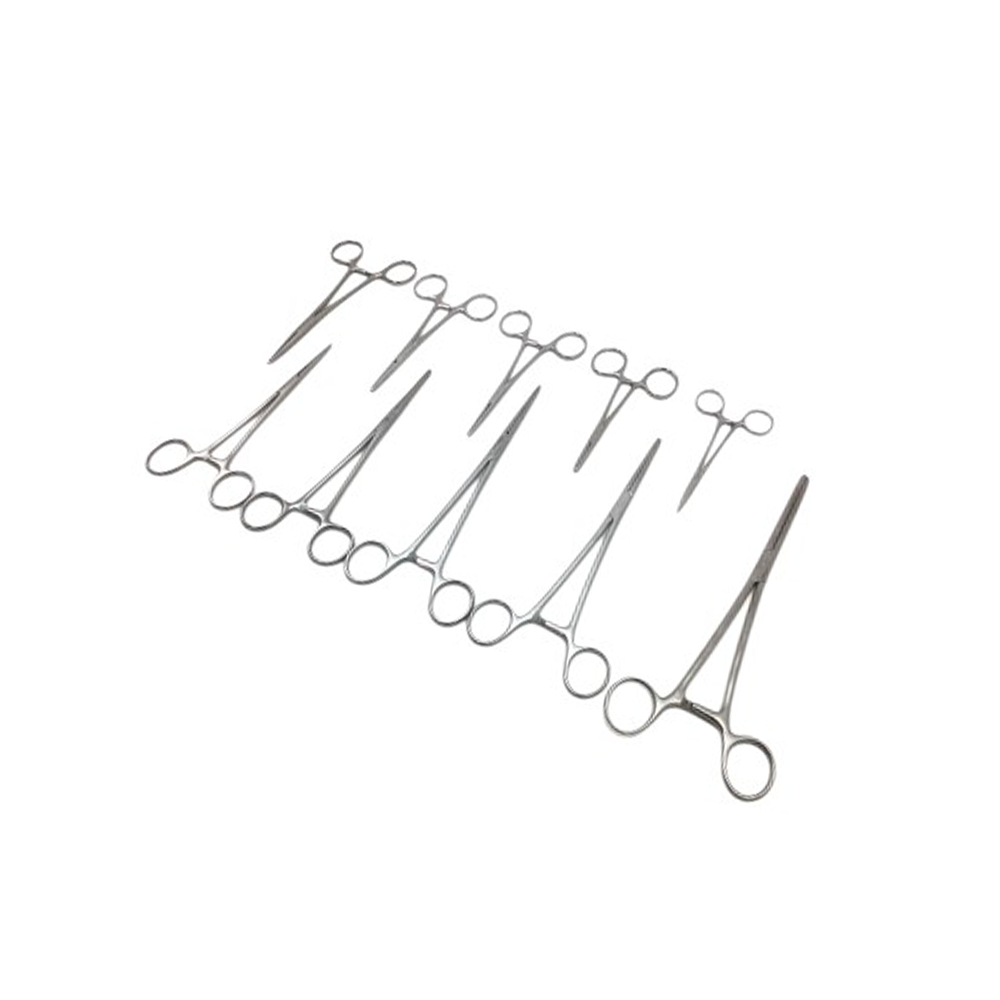

Artery Forceps, also known as hemostatic forceps or artery clamps, are widely used surgical instruments designed to assist qualified healthcare professionals with temporary clamping and control of blood vessels and suitable tissues during surgical procedures. They are fundamental components of many general, emergency, specialty, and minor surgical instrument sets.
An artery forceps typically features two finger rings, a ratchet locking mechanism, elongated shanks, and serrated jaws. The locking mechanism allows the instrument to remain securely engaged when appropriately applied, while the serrated working surfaces are designed to provide controlled gripping. Depending on the model, the jaws may be straight or curved and may have different lengths or patterns of serration.
Straight artery forceps are commonly selected for applications where a direct approach to the surgical field is appropriate. Curved artery forceps can provide access around anatomical structures and may be useful where an angled working end offers improved positioning. The appropriate style and size should be selected according to the procedure and the surgeon’s technique.
Artery forceps can be used in a variety of professional surgical environments, including general surgery, emergency procedures, gynecology, urology, orthopedics, plastic surgery, ENT, and other specialties. They may also be included in basic surgical sets, dressing sets, minor surgery kits, and procedure-specific instrument trays.
Depending on the manufacturer, reusable artery forceps are commonly manufactured from surgical-grade stainless steel. Stainless steel provides strength, durability, corrosion resistance, and compatibility with validated cleaning and sterilization procedures. A smooth or polished surface can facilitate cleaning and visual inspection.
The finger-ring handle and ratchet mechanism are designed to provide controlled operation. Proper jaw alignment is important for reliable performance, and the locking mechanism should engage and release smoothly. Regular inspection should be performed to identify damaged serrations, misalignment, corrosion, loose joints, or ratchet problems.
Reusable artery forceps should be cleaned, inspected, dried, packaged, and sterilized after every clinical procedure according to established sterile-processing protocols and the manufacturer’s validated instructions. Models specifically designated as autoclavable can generally undergo appropriate steam sterilization.
Careful handling and storage can help protect the serrated jaws and locking mechanism from damage. Instruments should be stored in a clean, dry environment and protected from unnecessary impact or contact with other instruments.
The Artery Forceps offers a practical and versatile solution for professional surgical environments requiring dependable hemostatic clamping instruments. Available in different sizes and jaw configurations, they can be selected according to the specific requirements of the surgical procedure.
Exact jaw length, overall length, curvature, serration pattern, material grade, finish, and sterilization compatibility vary by manufacturer. Verify the product specification before ordering.
Key Features
- Professional hemostatic artery forceps
- Designed for controlled vessel and tissue clamping
- Serrated jaws for secure gripping
- Ratchet locking mechanism
- Straight and curved configurations available
- Available in multiple sizes
- Ergonomic finger-ring handles
- Smooth operating joint and locking mechanism
- Surgical stainless-steel construction where specified
- Reusable design where specified
- Autoclave compatible where specified
- Suitable for general and specialty surgical sets
Product Specifications
| Specification | Details |
|---|---|
| Product Type | Artery Forceps / Hemostatic Forceps |
| Application | Hemostasis & Surgical Clamping |
| Material | Surgical-Grade Stainless Steel* |
| Finish | Smooth / Polished Surgical Finish* |
| Sterilization | Autoclave Compatible Where Specified |
| Reusability | Reusable Where Specified |
| Specialty | General & Specialty Surgery |
| Instrument Type | Hemostatic Clamp / Artery Forceps |
| Jaw Design | Straight or Curved – Model Dependent |
| Locking Mechanism | Ratchet |
| Usage | Professional Surgical Use |
| Product Contents | 1 Artery Forceps Unless Otherwise Specified |
*Exact material grade, dimensions, jaw pattern, finish, and sterilization compatibility depend on the manufacturer.
Product Contents
- 1 × Artery Forceps
- Straight or curved configuration according to selected model
- Selected size according to product specification
Note: Sets containing multiple artery forceps may include different sizes and configurations. Confirm the exact quantity before ordering.
Applications
Artery Forceps may support appropriate:
- General surgical procedures
- Hemostasis
- Vessel clamping
- Tissue clamping
- Minor surgical procedures
- Emergency surgery
- Gynecological procedures
- Plastic surgery
- ENT procedures
- Orthopedic surgery
- Urological procedures
- Surgical instrument sets and procedure trays
FAQs
1. What are artery forceps used for?
Artery forceps are designed to assist qualified healthcare professionals with controlled clamping of blood vessels and suitable tissues during surgical procedures.
2. What is the difference between straight and curved artery forceps?
Straight forceps have a direct working axis, while curved forceps provide an angled jaw that can assist with access around anatomical structures. Selection depends on the procedure.
3. Are artery forceps reusable?
Models designated as reusable can be professionally reprocessed after use through appropriate cleaning, inspection, maintenance, and sterilization procedures.
4. Can artery forceps be autoclaved?
If the specific model is designated autoclavable, it can generally undergo validated steam sterilization. Always follow the manufacturer’s instructions.
5. What material are artery forceps made from?
Reusable artery forceps are commonly manufactured from surgical-grade stainless steel, although the exact material grade varies by manufacturer.
6. What is the ratchet mechanism for?
The ratchet allows the jaws to remain locked at a selected position when appropriately applied, providing controlled clamping.
7. Are different sizes available?
Yes. Artery forceps are available in different lengths, jaw configurations, and straight or curved designs depending on the manufacturer.
8. Who should use artery forceps?
They are intended for appropriately trained and qualified healthcare professionals in suitable clinical and surgical environments.


Reviews
There are no reviews yet.