
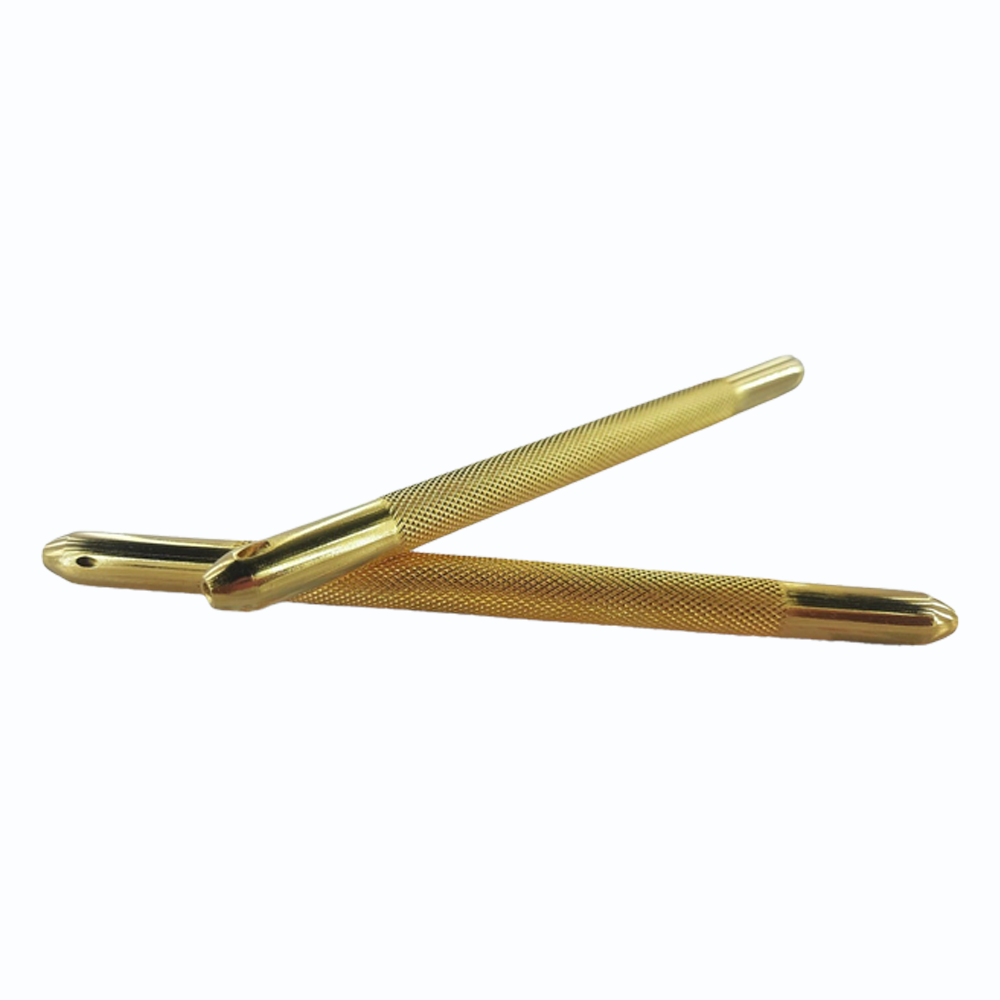

The Double Ended K Wire Bender 1.7mm & 2.5mm 4 Pcs is a specialized orthopedic surgical instrument set designed to assist with the controlled bending and manipulation of Kirschner wires, commonly known as K-wires. The set provides four instruments configured for use with the specified 1.7 mm and 2.5 mm K-wire diameters, giving orthopedic surgical teams dedicated tools for handling different wire sizes.
Kirschner wires are commonly used as temporary or definitive fixation elements in selected orthopedic and trauma procedures. Depending on the surgical technique, K-wires may be used for fracture stabilization, fragment fixation, temporary reduction, guiding other implants, or maintaining alignment during orthopedic procedures. The exact role of a K-wire depends on the anatomical site, fracture pattern, wire diameter, bone quality, and surgeon’s selected fixation method.
A dedicated K-wire bender provides mechanical leverage for forming a wire into the required configuration. Controlled bending may be necessary when the exposed portion of a K-wire must be shaped, when the wire needs to conform to a particular fixation strategy, or when a bent wire configuration is required to assist with secure positioning. Bending should be performed using appropriate technique and only when permitted by the specific implant or wire manufacturer’s instructions.
The double-ended design provides added versatility by incorporating working profiles intended for different K-wire diameters. This allows the surgical team to use a suitable end according to the wire being handled rather than relying on a single generic bending interface. The product is specified for 1.7 mm and 2.5 mm K-wire diameters, and the correct working end should always be matched to the corresponding wire size.
The four-piece configuration can provide practical redundancy and workflow flexibility in the operating room. Having multiple K-wire benders available can be useful when several wire sizes or fixation steps are involved during the same procedure. The exact distribution of the four instruments between the two diameter configurations should be confirmed from the supplier’s current product specification.
The bender should provide controlled contact with the wire while minimizing unnecessary deformation or surface damage. Excessive force, repeated bending at the same location, or use of an inappropriate instrument may weaken a K-wire. The surgeon and surgical team should follow the implant manufacturer’s instructions regarding permissible bending, bending location, and reuse of fixation wires.
The Double-Ended K-Wire Bender is relevant to orthopedic trauma, hand surgery, foot and ankle surgery, pediatric orthopedics, and other procedures where compatible Kirschner wires are used. The instrument itself does not determine the clinical indication; the appropriate K-wire diameter and fixation technique are selected according to the patient’s anatomy, implant system, and surgical requirements.
Professional orthopedic instruments require appropriate construction and finishing to withstand repeated mechanical use. Surgical stainless steel is commonly used for reusable orthopedic hand instruments because of its strength, corrosion resistance, durability, and compatibility with validated cleaning and sterilization processes. The precise material grade for this product should be confirmed against the manufacturer’s technical documentation.
Before each procedure, the K-wire bender should be inspected for deformation, cracks, corrosion, damaged working surfaces, or other signs of wear. The bending profiles should remain properly formed and free of defects that could interfere with controlled wire manipulation. Damaged instruments should be removed from service.
Following use, reusable K-wire benders should be cleaned promptly using a validated instrument-cleaning procedure. Particular attention should be given to the working surfaces where metallic debris or biological material may accumulate. After cleaning, the instruments should be inspected and sterilized according to validated manufacturer instructions and the healthcare facility’s infection-control protocols.
The Double-Ended K-Wire Bender (1.7 mm & 2.5 mm Diameter) – 4 Pcs provides orthopedic professionals with a focused solution for controlled K-wire manipulation. Its specified diameter compatibility, double-ended configuration, and four-piece set format make it a practical addition to orthopedic trauma and fracture-fixation instrument inventories.
Key Features
- Professional double-ended K-wire bender set
- Four-piece configuration
- Designed for compatible 1.7 mm and 2.5 mm K-wires
- Double-ended working configuration for versatile wire handling
- Supports controlled Kirschner wire bending and manipulation
- Suitable for orthopedic fracture fixation procedures
- Useful for temporary and selected definitive K-wire fixation techniques
- Provides dedicated instrument options for different wire diameters
- Durable construction for professional surgical use
- Reusable where supplied as a reusable surgical instrument
- Designed for controlled mechanical handling of K-wires
- Requires inspection, cleaning, and sterilization after use
Product Specifications
| Specification | Details |
|---|---|
| Product Name | Double-Ended K-Wire Bender (1.7 mm & 2.5 mm Diameter) |
| Set Quantity | 4 Pieces |
| Instrument Type | K-Wire Bender |
| Design | Double-Ended |
| Compatible K-Wire Diameter | 1.7 mm |
| Additional Compatible Diameter | 2.5 mm |
| Primary Function | K-Wire Bending and Manipulation |
| Wire Type | Kirschner Wire / K-Wire |
| Surgical Specialty | Orthopedic / Trauma Surgery |
| Applications | Orthopedic Fixation and Wire Management |
| Material | Surgical Instrument-Grade Metal; verify manufacturer specification |
| Reusable | Where supplied as reusable instruments |
| Sterilization | According to validated manufacturer and facility protocols |
| Intended Users | Orthopedic and Trauma Surgeons |
| Clinical Environment | Hospitals, Trauma Centers, Surgical Centers |
FAQs
1. What is a K-wire bender used for?
A K-wire bender is used to apply controlled bends to compatible Kirschner wires during orthopedic procedures. It helps surgeons manipulate the exposed portion of a wire according to the selected fixation technique.
2. What K-wire sizes are supported by this set?
The product is specified for 1.7 mm and 2.5 mm diameter K-wires.
3. How many K-wire benders are included?
The product is supplied as a 4-piece set. The exact distribution between the 1.7 mm and 2.5 mm configurations should be confirmed from the supplier’s product specification.
4. What is the advantage of a double-ended K-wire bender?
A double-ended design provides different working profiles within the same instrument, allowing the appropriate end to be selected for the corresponding K-wire diameter and bending requirement.
5. Can K-wire benders be used for any Kirschner wire?
No. The bender should only be used with wire diameters and wire materials for which it is designed. This product is specified for 1.7 mm and 2.5 mm K-wires.
6. Where are K-wires commonly used?
Kirschner wires are used in various orthopedic procedures for fracture fixation, temporary stabilization, fragment fixation, reduction assistance, and other applications determined by the surgeon.
7. Can a K-wire be bent multiple times?
Repeated or excessive bending can affect the mechanical integrity of a wire. K-wire bending should follow the wire manufacturer’s instructions and the surgical technique appropriate for the specific implant.
8. Are K-wire benders reusable?
Where supplied as reusable surgical instruments, K-wire benders should be appropriately cleaned, inspected, and sterilized according to validated manufacturer instructions and healthcare-facility protocols.
Reviews
There are no reviews yet.