
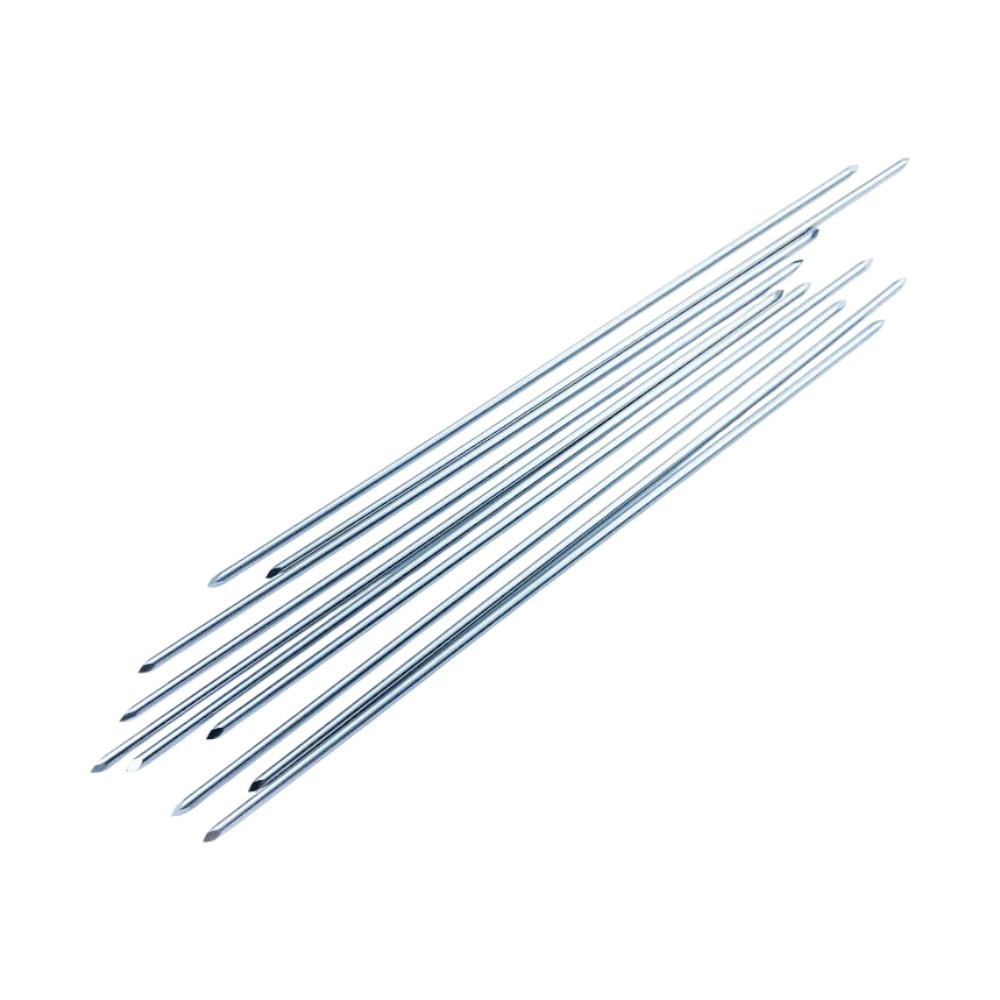

The Double-Ended Kirschner Wires Set Stainless Steel Pin Nails for Veterinary Orthopedics is a specialized veterinary orthopedic fixation product designed for selected fracture management, bone stabilization, and orthopedic procedures. Commonly referred to as K-wires or Kirschner wires, these slender orthopedic pins are used as fixation or stabilization components when appropriate for the patient’s anatomy and the selected surgical technique.
Manufactured from stainless steel, the wires are designed to provide a rigid and consistent pin structure for compatible veterinary orthopedic applications. The double-ended configuration provides two usable ends, which can offer practical flexibility during surgical preparation and instrument handling. Exact wire dimensions, tip configuration, and compatibility depend on the supplied set specifications.
Kirschner wires can be incorporated into selected orthopedic fixation constructs for veterinary patients, including procedures involving fracture stabilization, temporary fixation, alignment, or support of bone fragments. Their use depends on the animal’s size, bone anatomy, fracture characteristics, implant requirements, and the veterinary surgeon’s treatment plan.
The slender profile of K-wires allows them to be used in applications where a relatively small fixation element is appropriate. They may also be used alongside other orthopedic implants and instruments as part of a broader fixation strategy. The appropriate wire diameter and length should be selected according to the anatomical and mechanical requirements of the intended application.
The set format provides a convenient selection of wires for veterinary orthopedic instrument inventories. It can be useful for veterinary hospitals, specialty clinics, orthopedic practices, and surgical facilities that maintain dedicated fracture-fixation supplies.
The stainless steel construction is intended to provide durability and resistance to corrosion when properly handled and maintained. As with other orthopedic fixation components, wires should be inspected before use for bending, surface damage, corrosion, deformation, or other defects that could affect their intended function.
The term Kirschner wire describes the established orthopedic pin design and should not be interpreted as indicating affiliation with a specific manufacturer. Compatibility with a particular orthopedic fixation system should be confirmed based on wire dimensions, material specifications, instrumentation, and the manufacturer’s applicable requirements.
Because these products are used in veterinary orthopedic procedures, selection and application should be performed by a qualified veterinary surgeon or appropriately trained veterinary professional. The correct wire size, configuration, and fixation method should be determined according to the animal’s anatomy and clinical requirements.
If the wires are supplied as reusable instruments or components, cleaning, inspection, and sterilization should follow the manufacturer’s validated instructions and applicable veterinary infection-control protocols. If supplied as implantable or single-use fixation components, they should be handled according to the applicable product labeling and clinical protocol.
Overall, the Double-Ended Kirschner Wires Set provides stainless steel pin-style orthopedic components for selected veterinary fracture fixation and stabilization applications. Its double-ended design and set configuration make it a practical addition to veterinary orthopedic surgical inventories.
Key Features
- Double-ended Kirschner wire set
- Stainless steel orthopedic pin construction
- Designed for veterinary orthopedic applications
- Suitable for selected fracture fixation procedures
- Useful for bone stabilization and temporary fixation
- Double-ended configuration provides two working ends
- Slender pin profile for compatible orthopedic applications
- Suitable for veterinary hospitals and orthopedic clinics
- Can be used with compatible fixation instruments and systems
- Multiple wires provide practical procedure selection
- Durable stainless steel construction
- Wire dimensions should be verified before clinical use
Product Specifications
| Specification | Details |
|---|---|
| Product Name | Double-Ended Kirschner Wires Set |
| Common Name | K-Wires / Kirschner Pins |
| Instrument Type | Veterinary Orthopedic Fixation Pins |
| Design | Double-Ended |
| Material | Stainless Steel |
| Application | Veterinary Orthopedic Surgery |
| Primary Use | Selected Fracture Fixation & Bone Stabilization |
| Configuration | Set |
| Compatibility | Compatible Veterinary Orthopedic Systems |
| Condition | New, unless otherwise specified |
| Sterilization | Follow manufacturer instructions |
| Intended Patients | Veterinary Patients |
| Intended Users | Qualified Veterinary Surgical Professionals |
FAQs
What are double-ended Kirschner wires?
Double-ended Kirschner wires, commonly called K-wires, are slender orthopedic pin-style fixation components designed for selected bone stabilization and fracture fixation applications.
What are K-wires used for in veterinary orthopedics?
They may be used for selected fracture stabilization, temporary fixation, alignment, and other orthopedic applications depending on the animal’s anatomy and surgical requirements.
What material are these Kirschner wires made from?
The product is specified as being made from stainless steel.
What does double-ended mean?
A double-ended Kirschner wire has usable working ends on both sides of the wire, providing flexibility when selecting the appropriate end for a compatible application.
Can these K-wires be used for all animals?
Not necessarily. Wire selection depends on the animal’s species, size, bone anatomy, fracture characteristics, and the veterinary surgeon’s treatment plan.
Are these Kirschner wires suitable for fracture fixation?
Yes. They are designed for selected veterinary orthopedic fracture fixation and bone stabilization applications when the appropriate wire size and technique are selected.
Are the wires reusable?
The reuse status depends on the specific product configuration and labeling. Reusable components should be processed according to validated manufacturer instructions, while implantable or single-use products should follow their applicable labeling.
Are these wires compatible with every orthopedic fixation system?
No. Compatibility depends on wire diameter, length, material, instrument interface, and the requirements of the fixation system. Specifications should be verified before use.
Who should use veterinary Kirschner wires?
They are intended for use by qualified veterinary surgeons and appropriately trained veterinary surgical professionals.




Reviews
There are no reviews yet.