
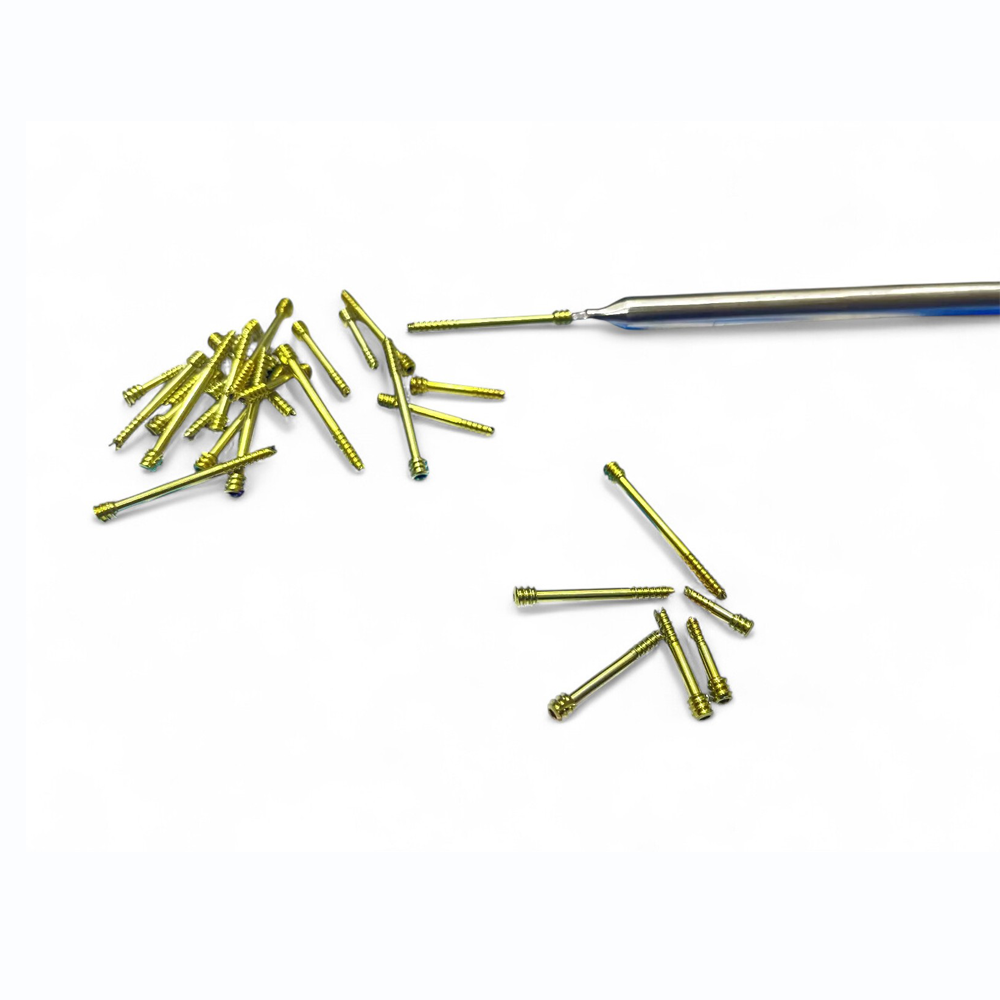


The Herbert Screws 2.5mm Titanium 14 30mm with Screwdriver are specialized orthopedic fixation screws designed for compression and stabilization of appropriately selected small-bone fractures. The Herbert screw concept is characterized by a headless design and differential thread geometry, allowing the screw to be positioned below the bone surface while generating compression between fracture fragments when inserted according to the appropriate surgical technique.
These 2.5 mm Herbert screws are intended for applications where a compact fixation implant is required. Their small diameter makes them suitable for selected fractures involving smaller bones and other orthopedic procedures where a conventional larger screw may not be appropriate. The exact clinical indication depends on the anatomical site, fracture pattern, bone quality, implant dimensions, and the surgeon’s preferred fixation technique.
The screw’s differential thread design is an important feature of the Herbert screw principle. Different thread pitches at the two ends of the screw can create relative advancement between the screw sections as the implant is inserted. When appropriately positioned across a fracture, this differential advancement can generate compression between the fracture fragments. The actual compression characteristics depend on screw geometry, bone quality, insertion technique, fracture reduction, and implant positioning.
The headless configuration allows the screw to be countersunk beneath the bone surface. This can be beneficial in areas where a prominent screw head could interfere with surrounding soft tissue or joint movement. Proper countersinking and screw placement are essential, particularly when the implant is positioned near an articular surface. The surgeon should follow the applicable surgical technique and ensure that the implant is placed at an appropriate depth.
The screws are manufactured from titanium, a material widely used in orthopedic implant applications. Titanium provides favorable strength-to-weight characteristics, corrosion resistance, and established biocompatibility properties. The exact titanium grade and mechanical specifications should be confirmed against the manufacturer’s product documentation.
The available 14–30 mm length range provides multiple sizing options for different anatomical requirements and fracture configurations. Appropriate screw length should be determined through preoperative planning and intraoperative assessment. The selected screw should provide adequate purchase across the intended fracture while avoiding excessive penetration into adjacent anatomical structures.
The product is supplied as a 46-piece selection together with a compatible screwdriver, providing a practical solution for orthopedic surgical facilities requiring multiple screw sizes and the appropriate insertion instrument. The exact quantity of each screw length should be verified against the manufacturer’s set configuration.
The screwdriver should be compatible with the screw drive interface and used according to the manufacturer’s recommended insertion technique. Appropriate driver engagement is important to reduce the risk of damage to the screw recess or instrument during insertion.
Herbert screws may be considered for selected fractures of the scaphoid, carpal bones, metacarpals, phalanges, and other small bones, depending on the specific implant design and approved indications. The surgeon must determine whether Herbert screw fixation is appropriate based on the patient’s anatomy, fracture morphology, bone quality, and treatment objectives.
The screws and associated screwdriver should be handled carefully to prevent contamination, deformation, or damage to the screw threads and driver interface. Reusable instruments should be cleaned, inspected, packaged, and sterilized according to validated healthcare-facility procedures and the manufacturer’s instructions.
With their 2.5 mm diameter, 14–30 mm length range, titanium construction, headless compression design, compatible screwdriver, and 46-piece selection, these Herbert Screws provide a versatile fixation option for appropriately selected small-bone orthopedic procedures.
Key Features
- 2.5 mm diameter Herbert screw configuration.
- Available in 14–30 mm lengths.
- Headless screw design for sub-surface placement.
- Differential thread geometry supports compression across appropriately reduced fractures.
- Manufactured from titanium.
- Supplied with a compatible screwdriver.
- 46-piece selection provides multiple screw sizing options.
- Designed for selected small-bone fracture fixation applications.
- Suitable for professional orthopedic and hand surgery procedures.
- Compact implant profile can reduce prominence above the bone surface.
- Screw length should be selected according to anatomy and surgical requirements.
- Requires appropriate reduction, insertion technique, and compatible instrumentation.
Product Specifications
| Specification | Details |
|---|---|
| Product Name | Herbert Screws |
| Screw Type | Headless Compression / Herbert Screw |
| Diameter | 2.5 mm |
| Length Range | 14–30 mm |
| Material | Titanium |
| Screw Design | Headless Differential-Thread |
| Screwdriver | Included |
| Quantity | 46 Pieces |
| Primary Application | Small-Bone Fracture Fixation |
| Surgical Specialty | Orthopedic / Hand Surgery |
| Fixation Principle | Compression Fixation |
| Intended Use | Professional orthopedic surgical applications |
| Instrument Compatibility | Compatible Screwdriver Included |
| Sterilization | Follow product-specific manufacturer instructions and validated protocols |
FAQs
1. What are Herbert Screws used for?
Herbert Screws are headless compression screws designed for fixation of appropriately selected fractures, particularly involving small bones. They may be used in selected hand, wrist, and other orthopedic fixation procedures.
2. What is the diameter of these Herbert Screws?
These Herbert Screws have a 2.5 mm diameter and are available in multiple lengths from 14 mm to 30 mm.
3. What is the advantage of a headless Herbert Screw?
The headless design allows the screw to be positioned below the bone surface. This can help minimize implant prominence in anatomical areas where a conventional screw head could interfere with soft tissue or joint movement.
4. How does a Herbert Screw provide compression?
Herbert screws use differential thread geometry. When properly inserted across a reduced fracture, differences in thread pitch can cause relative movement between the screw sections and generate compression between the fracture fragments.
5. What material are these Herbert Screws made from?
The screws are manufactured from titanium, a material commonly used for orthopedic implants because of its corrosion resistance, favorable strength-to-weight characteristics, and biocompatibility.
6. What lengths are available?
The available length range is 14–30 mm. The appropriate length should be selected based on the anatomical site, fracture characteristics, bone dimensions, and surgical technique.
7. Is a screwdriver included?
Yes. The product includes a compatible screwdriver for screw insertion.
8. How many pieces are included?
The product is supplied as a 46-piece selection, including the specified Herbert screws and screwdriver. The exact distribution of screw lengths should be confirmed from the detailed set specification.
9. Can Herbert Screws be used for scaphoid fractures?
Herbert-type headless compression screws are commonly associated with selected scaphoid fracture fixation, but suitability depends on fracture location, morphology, bone quality, implant dimensions, and the surgeon’s clinical judgment.
Reviews
There are no reviews yet.