
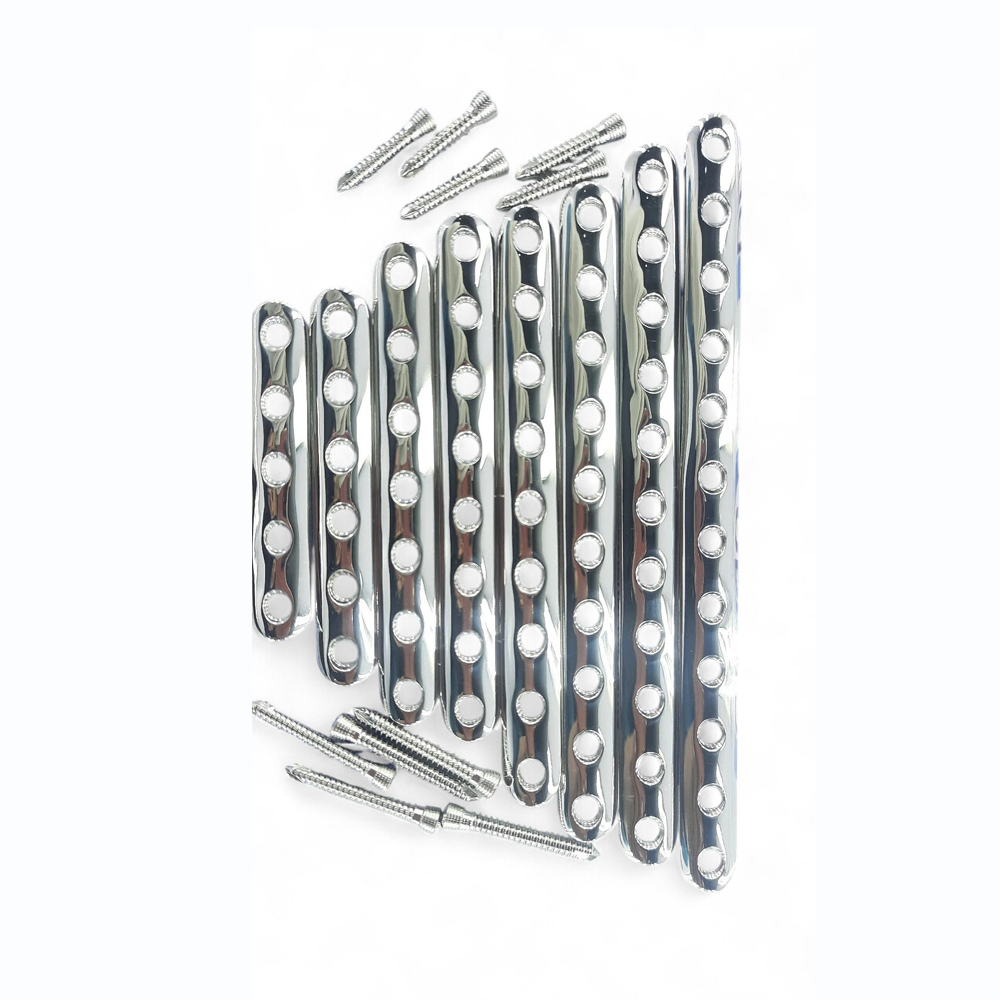

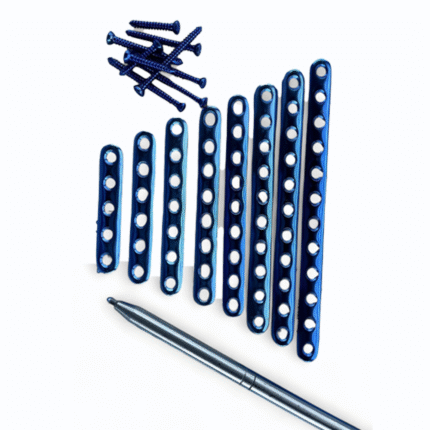
The Locking One Third Tubular Plate 3.5mm LCP Set is a specialized orthopedic trauma fixation system designed for the stabilization of fractures and other conditions requiring plate-and-screw fixation. The set incorporates 3.5mm locking one-third tubular plates and compatible locking compression plate (LCP) technology to provide orthopedic surgeons with a practical solution for selected fracture fixation procedures.
A one-third tubular plate has a relatively low-profile design that can be useful when soft-tissue coverage and implant profile are important considerations. The tubular configuration provides structural support while maintaining a compact plate shape. The 3.5mm locking platform is commonly used in orthopedic trauma applications involving smaller bones and selected fracture patterns.
The locking feature allows compatible screws to engage with threaded plate holes, creating a fixed-angle relationship between the screw and plate. This can provide angular stability within the fixation construct when the system is used according to the manufacturer’s specifications and appropriate surgical technique. The locking mechanism is particularly useful in situations where maintaining stable fixation is important.
The LCP plate design can support different fixation strategies depending on the specific plate configuration and compatible screw system. Surgeons may select appropriate locking or conventional fixation techniques based on fracture characteristics, bone quality, anatomical location, and the desired mechanical construct. Implant selection should always be based on professional orthopedic assessment.
The Locking One-Third Tubular Plate 3.5mm can be considered for selected fracture fixation applications involving areas such as the fibula, ankle, forearm, hand, foot, and other suitable anatomical locations. The actual indication depends on the specific plate geometry, available hole configuration, implant dimensions, and the surgeon’s clinical judgment.
The set format provides an organized solution for orthopedic surgical environments. Depending on the supplied configuration, the set may contain plates in different lengths and hole counts to accommodate different fracture patterns and anatomical requirements. Exact plate sizes, screw quantities, and accompanying instrumentation should be confirmed from the manufacturer’s supplied configuration.
Professional orthopedic fixation plates are manufactured from materials selected for implant use, while reusable instruments associated with the system may be manufactured from surgical-grade stainless steel or another suitable medical-grade material. The exact alloy and material specifications should be verified against the manufacturer’s documentation for the particular set.
Correct handling and storage are important for maintaining the integrity of orthopedic implants and instruments. Implant plates should be protected from unnecessary scratching, bending, contamination, or other damage. Locking interfaces should remain free from damage or contamination to support proper screw engagement.
If the set includes reusable surgical instruments, they should be cleaned, inspected, and sterilized according to the manufacturer’s validated instructions. Instruments should be checked for corrosion, deformation, damaged threads, worn surfaces, or other abnormalities before use.
Implant components should be used only as intended by the manufacturer. Locking screws should be selected for compatibility with the specific plate system, and the appropriate drill guides, drill bits, and screwdrivers should be used according to the corresponding surgical technique.
The Locking One-Third Tubular Plate 3.5mm LCP Set provides a specialized solution for professional orthopedic fracture fixation. Its low-profile one-third tubular plate design and 3.5mm locking technology make it suitable for selected trauma applications where controlled fixation, angular stability, and anatomical adaptability are required.
Key Features
- 3.5mm locking one-third tubular plate system
- LCP-compatible locking plate technology
- Designed for orthopedic fracture fixation
- Relatively low-profile tubular plate configuration
- Supports fixed-angle plate-and-screw constructs
- Suitable for selected small-bone and orthopedic trauma applications
- Available in procedure-specific plate configurations
- Designed for controlled locking screw fixation
- Useful for professional orthopedic surgical sets
- Suitable for selected ankle, fibula, forearm, hand, and foot fixation applications
- Implant components should be used with compatible system instrumentation
- Supports established orthopedic trauma fixation techniques
Product Specifications
| Specification | Details |
|---|---|
| Product Name | Locking One-Third Tubular Plate 3.5mm LCP Set |
| Instrument Category | Orthopedic Trauma Fixation |
| Plate Type | Locking One-Third Tubular Plate |
| Plate System | 3.5mm |
| Technology | LCP / Locking Fixation |
| Primary Function | Fracture Stabilization |
| Fixation Type | Locking Plate and Screw Fixation |
| Specialty | Orthopedic Surgery |
| Potential Applications | Selected Small-Bone & Trauma Fixation |
| Plate Profile | One-Third Tubular |
| Plate Lengths | Configuration Dependent |
| Hole Count | Configuration Dependent |
| Screw Compatibility | Compatible 3.5mm Locking Screws |
| Material | Implant-Grade Material |
| Set Configuration | Manufacturer Dependent |
| Sterilization | Follow Manufacturer’s Validated Protocol |
FAQs
1. What is a 3.5mm locking one-third tubular plate used for?
A 3.5mm locking one-third tubular plate is designed for selected orthopedic fracture fixation applications where a relatively low-profile locking plate is appropriate.
2. What does LCP mean in orthopedic plates?
LCP stands for Locking Compression Plate. The system uses compatible screw and plate technology to provide options for stable fixation and, depending on the configuration, compression or locking constructs.
3. What is the advantage of a locking one-third tubular plate?
The locking design allows compatible screws to engage threaded plate holes, creating a fixed-angle relationship that can provide angular stability within the fixation construct.
4. Where can a 3.5mm one-third tubular plate be used?
Depending on the specific plate design, it may be used for selected fractures involving areas such as the fibula, ankle, forearm, hand, or foot. The appropriate application must be determined by the orthopedic surgeon.
5. Are all 3.5mm LCP screws compatible with this plate?
Compatibility should be confirmed with the manufacturer. Only screws and instruments specifically designed for the particular plate system should be used.
6. Does the set include different plate sizes?
The exact plate lengths and hole configurations depend on the supplied set. Product-specific sizing should be verified before ordering or surgical use.
7. Are orthopedic locking plates reusable?
Implant plates are intended for their labeled clinical use and should be handled according to the manufacturer’s instructions. Reusable surgical instruments, if included, require validated cleaning, inspection, and sterilization procedures.

Reviews
There are no reviews yet.