

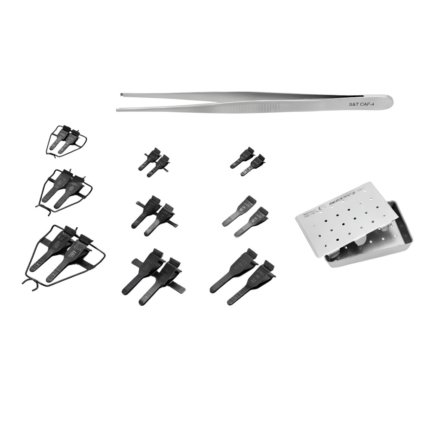

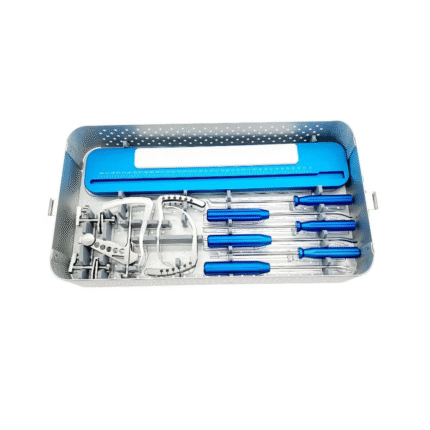
The Phantom CS Essentials Retractor System Set is a specialized surgical retraction system designed to assist with controlled tissue management and operative exposure. Retractor systems are commonly used when surgeons require stable access to an anatomical area while keeping selected soft tissues away from the surgical field.
Unlike a single handheld retractor, a system set brings multiple compatible retraction components together to support different exposure requirements. The exact configuration of the Phantom CS Essentials system may vary, and the individual components should be confirmed from the supplier’s current instrument list before purchase or clinical use.
Retractor systems can be particularly useful when consistent exposure is required throughout a procedure. Depending on the available components, the system may provide options for positioning retractors at different locations around the operative field. Proper placement is important because retractors should provide the required exposure without applying unnecessary pressure to surrounding tissues.
The Phantom CS Essentials system may be suitable for selected orthopedic and surgical procedures requiring controlled exposure. The appropriate application depends on the individual retractor design, blade dimensions, surgical approach, patient anatomy, and procedure being performed. Surgeons should select and position the components according to established surgical technique and the intended clinical application.
A coordinated retractor system can also improve operating-room organization. Keeping compatible components together makes instrument preparation more straightforward and helps the surgical team identify the required retraction tools before a procedure. Each component should be inspected before use to confirm that working surfaces, handles, joints, locking mechanisms, and attachment points are in proper condition.
The instruments are intended for controlled manual handling. Retractor blades and other working elements should be positioned carefully and adjusted gradually to obtain the required exposure. Excessive force or inappropriate positioning can potentially cause unwanted tissue pressure, so the system should always be used by appropriately trained surgical personnel following the applicable procedure and manufacturer’s instructions.
For reusable components, proper cleaning and sterilization are essential. After surgery, retractors should be thoroughly cleaned to remove blood, tissue, and other contaminants. Hinges, joints, attachment interfaces, serrations, and recessed areas should receive particular attention because retained material can interfere with effective processing.
Before sterilization, each instrument should be inspected for deformation, cracks, corrosion, damaged working surfaces, or malfunctioning mechanisms. Components should be disassembled where required by the manufacturer’s validated processing instructions. Sterilization should then be performed using a validated method appropriate for the specific materials and configuration.
The Phantom CS Essentials Retractor System Set provides a practical solution for hospitals, orthopedic operating rooms, surgical centers, and other healthcare facilities requiring a coordinated retraction system for compatible procedures. Its system-based design supports organized preparation and controlled surgical exposure.
Key Features
- Coordinated surgical retractor system set
- Designed for controlled surgical exposure
- Supports soft-tissue retraction during compatible procedures
- Helps maintain access and visualization of the operative field
- Suitable for selected orthopedic and surgical applications
- System-based configuration for organized instrument handling
- Designed for controlled manual positioning
- Components can support different exposure requirements depending on configuration
- Suitable for operating-room surgical instrument sets
- Reusable where individual components are designed for repeated use
- Requires inspection before each surgical procedure
- Exact components and configuration may vary
Product Specifications
| Specification | Details |
|---|---|
| Product Name | Phantom CS Essentials Retractor System Set |
| Instrument Category | Surgical Retractor System |
| System Type | Essentials Retractor Set |
| Primary Function | Surgical Exposure & Tissue Retraction |
| Surgical Application | Orthopedic & Compatible Surgical Procedures |
| Operation | Manual Retraction |
| Construction | Surgical Instrument-Grade Material |
| Configuration | System Set; exact contents may vary |
| Reusable | Yes, where applicable |
| Sterilization | Follow validated manufacturer/facility processing instructions |
| Component Compatibility | Verify Within the Specific System |
FAQs
What is the Phantom CS Essentials Retractor System Set?
The Phantom CS Essentials Retractor System Set is a coordinated collection of surgical retraction components designed to assist with controlled tissue retraction and operative exposure.
What is a surgical retractor system used for?
A surgical retractor system is used to hold selected tissues or anatomical structures away from the operative area, helping provide access and visualization during appropriate procedures.
Can the Phantom CS Essentials system be used for orthopedic surgery?
It may be suitable for selected orthopedic procedures requiring controlled surgical exposure. The exact application depends on the system configuration and surgical approach.
What components are included in the Essentials Retractor System?
The exact components can vary by configuration. Users should confirm the current instrument list for the specific Phantom CS Essentials set before purchase.
How does a retractor system differ from a handheld retractor?
A handheld retractor is generally manipulated manually throughout the procedure, while a coordinated retractor system may include multiple components designed to provide more structured or sustained exposure.
Is the Phantom CS Essentials Retractor System reusable?
Where the individual components are manufactured as reusable surgical instruments, they can be reprocessed according to validated manufacturer instructions and facility protocols.
How should retractors be cleaned?
Retractors should be cleaned promptly after use, with particular attention to joints, attachment areas, serrations, locking mechanisms, and other surfaces where biological material may accumulate.
How should the retractor system be sterilized?
Reusable components should be cleaned, inspected, and sterilized using a validated process appropriate for their materials and design. Manufacturer processing instructions should always be followed.
Can components of the system be replaced?
Replacement depends on the specific system and component design. Compatibility should be confirmed with the appropriate manufacturer or supplier before replacing or adding components.




Reviews
There are no reviews yet.