

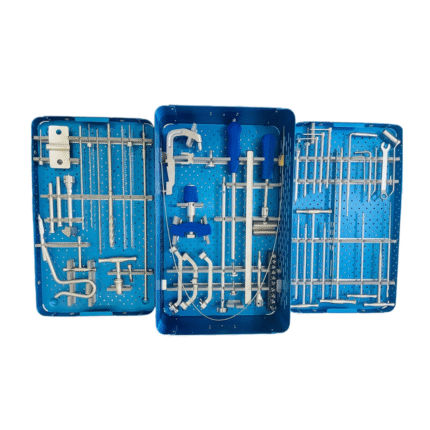

The Proximal Lateral Tibial LCP Plate 6, 8, 10 & 12 Holes Left & Right with 5mm Titanium Screws – 85 Pieces is an orthopedic locking plate and screw system designed for fixation of suitable proximal tibial fractures. The system provides multiple plate lengths and anatomical orientations to help accommodate different fracture patterns, bone anatomy, and surgical requirements.
The plates are available in left- and right-sided configurations, allowing selection according to the anatomical side being treated. The 6-hole, 8-hole, 10-hole, and 12-hole options provide different plate lengths and fixation zones. This range can help surgeons select an appropriate construct based on fracture extent, available bone stock, and the desired distribution of fixation points.
The LCP (Locking Compression Plate) design incorporates locking screw technology. When compatible locking screws are correctly seated within the threaded plate holes, the screw head engages with the plate to create a fixed-angle relationship. This can provide angular stability within the fixation construct and reduce dependence on intimate plate-to-bone contact compared with conventional compression plating techniques.
The included 5mm titanium screws are designed for use with the corresponding plate system. Titanium provides a favorable combination of strength, corrosion resistance, and relatively low density and is widely used in orthopedic implant applications. The exact titanium grade and mechanical specifications should be verified against the manufacturer’s documentation before clinical use.
A proximal lateral tibial plate is shaped to accommodate the lateral proximal tibia when used for an indicated fixation procedure. Proper positioning is essential to achieve appropriate fracture alignment and fixation. The surgeon must consider the fracture configuration, soft-tissue condition, bone quality, anatomical dimensions, and implant selection when planning the procedure.
The 85-piece configuration provides multiple plate sizes and associated screws in one consolidated set. This can be useful for orthopedic hospitals, trauma centers, surgical departments, medical distributors, and healthcare procurement teams that require a range of proximal tibial fixation components.
The system should only be used with compatible screws and instrumentation. Plate contour, screw trajectory, screw length, number of fixation points, and final construct should be determined by a qualified orthopedic surgeon according to the specific patient and surgical technique.
All implant components should be handled according to applicable medical-device requirements. Sterility depends on the supplied product configuration. If supplied non-sterile, processing must follow validated manufacturer instructions and institutional protocols. Implantable components should not be treated as reusable unless explicitly designated and validated for such use.
Key Features
- Proximal lateral tibial LCP plate system
- Left and right anatomical configurations
- Available in 6, 8, 10, and 12-hole plate options
- Designed for compatible 5mm screws
- Titanium screw construction as specified
- Locking plate design for fixed-angle fixation
- Designed for suitable proximal tibial fracture fixation
- Multiple plate lengths for surgical flexibility
- 85-piece comprehensive configuration
- Suitable for orthopedic trauma surgery
- Supports professional fracture stabilization procedures
- Compatible surgical instrumentation required for implantation
Product Specifications
| Specification | Details |
|---|---|
| Product Type | Proximal Lateral Tibial LCP Plate & Screw Set |
| Plate Type | Proximal Lateral Tibial Locking Plate |
| Plate Holes | 6, 8, 10 & 12 Holes |
| Orientation | Left & Right |
| Screw Diameter | 5mm |
| Screw Type | Locking / LCP Screws |
| Material | Titanium* |
| Total Pieces | 85 Pieces |
| Application | Proximal Tibial Fracture Fixation |
| Specialty | Orthopedic & Trauma Surgery |
| Finish | Medical-Grade Implant Finish |
| Sterilization | Follow manufacturer-validated protocol |
| Reusability | Implant components according to manufacturer instructions |
| Usage | Internal Bone Fixation |
| System | Proximal Tibial LCP |
*Exact titanium grade should be confirmed from the manufacturer’s product documentation.
Product Contents
- Proximal Lateral Tibial LCP Plates:
- 6-hole
- 8-hole
- 10-hole
- 12-hole
- Left and right plate configurations
- Compatible 5mm titanium screws
- Total: 85 Pieces
Exact plate-to-screw quantity distribution and screw lengths should be confirmed against the manufacturer’s packing list.
Applications
The proximal lateral tibial LCP system may be used for:
- Proximal tibial fracture fixation
- Lateral tibial plateau fracture fixation
- Selected periarticular tibial fractures
- Tibial trauma surgery
- Internal fixation of suitable proximal tibial fractures
- Complex fracture stabilization
- Orthopedic reconstructive procedures
- Bone fixation requiring a compatible proximal tibial locking plate
The specific clinical indication and surgical technique must be determined by a qualified orthopedic surgeon.
FAQs
1. What is a proximal lateral tibial LCP plate?
It is a locking orthopedic plate specifically shaped for fixation of suitable fractures involving the proximal lateral tibia.
2. What plate sizes are included?
The system includes 6-hole, 8-hole, 10-hole, and 12-hole plate configurations, with both left and right options.
3. What size screws are included?
The product is specified with 5mm screws made from titanium as stated in the product title.
4. How many pieces are in the set?
The stated configuration contains 85 pieces, including the plates and compatible screws.
5. What does LCP mean?
LCP stands for Locking Compression Plate. Its threaded holes allow compatible locking screws to form a fixed-angle connection with the plate.
6. Are left and right plates available?
Yes. The product includes left and right configurations for anatomical side-specific fixation.
7. Can these plates be used for every tibial fracture?
No. Implant selection depends on fracture pattern, anatomy, bone quality, and other clinical factors. A qualified orthopedic surgeon must determine suitability.
8. Are the implants sterile?
Sterility depends on the supplied product and packaging. Always verify the manufacturer’s stated sterility status and follow applicable processing requirements before clinical use.
Reviews
There are no reviews yet.