

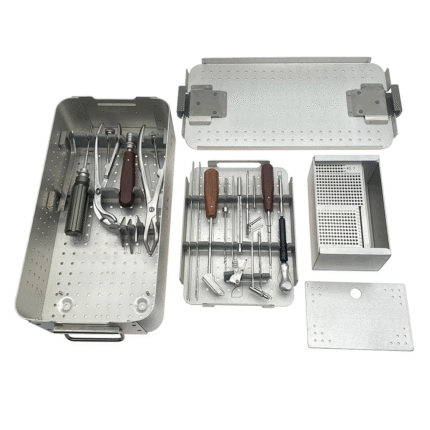

The 3.5 mm Titanium Locking Plate – Veterinary Orthopedic Implants for Dogs is a veterinary orthopedic implant designed for surgical fracture stabilization in dogs. It is intended for use by qualified veterinary surgeons as part of an appropriate orthopedic fixation system. The plate provides a stable platform for fixation when used with compatible 3.5 mm locking screws and selected according to the patient’s anatomy, fracture pattern, and surgical requirements.
Constructed from titanium, this veterinary locking plate combines low weight with corrosion resistance and good mechanical performance. Titanium is widely used in orthopedic implant applications because of its favorable strength-to-weight characteristics and compatibility with implant environments. The material also makes the plate suitable for procedures where minimizing unnecessary implant weight is desirable.
The locking plate design allows compatible locking screws to engage with the threaded plate holes, creating a fixed-angle relationship between the screws and the plate. This can help maintain the intended screw trajectory and construct stability without relying entirely on compression between the plate and bone. Depending on the plate configuration and surgical technique, locking fixation can be useful in managing complex fractures, metaphyseal regions, comminuted fractures, and situations where preservation of local blood supply is an important consideration.
The 3.5 mm system size is commonly associated with small- to medium-sized veterinary orthopedic fixation applications, although final implant selection should always be based on the patient’s body size, bone dimensions, fracture characteristics, and the veterinarian’s clinical assessment. The plate may be incorporated into procedures involving long-bone fractures and other orthopedic indications where a compatible locking plate system is appropriate.
The plate’s contoured profile is designed to support positioning along the selected bone surface while maintaining access for compatible screws. Proper plate length, width, screw selection, contouring requirements, and fixation technique should be determined before surgery. Veterinary surgeons should also evaluate radiographs or other appropriate diagnostic imaging to select an implant configuration suitable for the individual animal.
For surgical handling, the titanium construction provides a practical balance between durability and reduced implant weight. The plate should be handled using appropriate orthopedic instrumentation to avoid unnecessary scratching, bending, or deformation. Any required contouring should be performed only when permitted by the specific implant design and according to established veterinary orthopedic techniques.
Before clinical use, reusable surgical instruments used during implantation should be cleaned and sterilized according to the instrument manufacturer’s validated instructions and the veterinary facility’s infection-control procedures. The implant itself should be supplied, prepared, and processed according to its intended regulatory and manufacturer instructions. Proper sterilization, aseptic handling, surgical preparation, and postoperative monitoring are essential components of orthopedic implant procedures.
The 3.5 mm Titanium Locking Plate provides veterinary professionals with a specialized option for canine fracture fixation where a compatible titanium locking plate system is required. Its combination of titanium construction, locking-hole design, lightweight characteristics, and orthopedic application makes it suitable for use within a properly selected veterinary fracture fixation system.
Key Features
- 3.5 mm locking plate system for veterinary orthopedic applications
- Designed for fracture fixation in dogs
- Manufactured from lightweight titanium
- Corrosion-resistant implant material
- Compatible with appropriate 3.5 mm locking screws
- Fixed-angle screw fixation through threaded locking holes
- Suitable for selected canine orthopedic fracture procedures
- Supports stable fixation when properly selected and applied
- Designed for use by qualified veterinary orthopedic professionals
- Durable construction for demanding surgical applications
- Suitable for use with compatible veterinary orthopedic instrumentation
- Implant selection should be based on patient anatomy and fracture characteristics
Product Specifications
| Specification | Details |
|---|---|
| Product Type | Veterinary Orthopedic Locking Plate |
| Application | Canine Orthopedic Surgery |
| Plate Size | 3.5 mm System |
| Material | Titanium |
| Implant Type | Locking Bone Plate |
| Intended Use | Fracture Fixation |
| Compatible Screws | Compatible 3.5 mm Locking Screws |
| Primary Patient | Dogs |
| Surgical Specialty | Veterinary Orthopedics |
| Design | Threaded Locking Plate |
| Material Benefits | Lightweight and Corrosion Resistant |
| Sterilization | Follow Manufacturer/Facility Validated Protocols |
FAQs
What is a 3.5 mm Titanium Locking Plate used for?
A 3.5 mm Titanium Locking Plate is used for selected orthopedic fracture fixation procedures in dogs. It is designed to work with compatible 3.5 mm locking screws.
What material is this veterinary locking plate made from?
This veterinary orthopedic plate is made from titanium, a lightweight and corrosion-resistant material commonly used in orthopedic implant applications.
What size screws are compatible with the plate?
The plate is designed for use within a compatible 3.5 mm locking screw system. Screw diameter, length, and configuration should be selected according to the specific implant system and patient’s anatomy.
Can this locking plate be used for all dog fractures?
No. Implant selection depends on the dog’s size, bone anatomy, fracture location, fracture pattern, bone quality, and the veterinary surgeon’s treatment plan.
What are the benefits of a titanium veterinary orthopedic plate?
Titanium provides a favorable strength-to-weight ratio and corrosion resistance, making it useful for selected veterinary orthopedic implant applications.
Is the 3.5 mm locking plate suitable for veterinary orthopedic surgery?
Yes, it is designed as a veterinary orthopedic implant for canine fracture fixation when used with a compatible locking screw system and appropriate surgical technique.
How should surgical instruments used with the plate be sterilized?
Reusable surgical instruments should be cleaned and sterilized according to their validated manufacturer instructions and the veterinary facility’s established sterilization procedures.





Reviews
There are no reviews yet.