

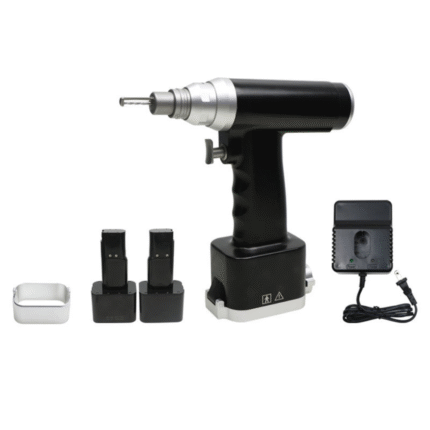

The High Speed Craniotomy Drill – Cranial Mill for Neurosurgery is a specialized powered instrument designed to support controlled cranial bone preparation during neurosurgical procedures. High-speed drilling technology allows the surgeon to perform precise cutting, milling, and shaping of bone when establishing access to the intracranial operative field. Its primary role is to assist with efficient cranial exposure while maintaining controlled instrument handling.
A cranial drill system is commonly used during craniotomy, burr-hole creation, bone flap preparation, cranial decompression, and other neurosurgical procedures requiring controlled removal or modification of skull bone. The appropriate drill attachment, cutting burr, or cranial milling accessory is selected according to the surgical task, bone thickness, operative approach, and surgeon preference.
The high-speed mechanism is intended to provide rapid rotational movement for efficient bone cutting. Compared with manually operated drilling instruments, powered systems can support more consistent rotational performance and may reduce the physical effort required for extended cranial bone preparation. Exact operating speed, power source, handpiece compatibility, and control features vary by system and should be confirmed for the specific model.
The cranial mill configuration is particularly relevant to bone-flap procedures in which controlled milling or cutting is required. Depending on the compatible attachments, the system may support straight cuts, curved cuts, burr-hole preparation, bone edge refinement, or other cranial shaping tasks. Instrument selection should always correspond to the intended procedure and the manufacturer’s applicable instructions.
Ergonomic handling is important in neurosurgical drilling because the surgeon must maintain precise control over the working end while operating close to delicate anatomical structures. The handpiece and attached cutting instrument should be manipulated with appropriate pressure and trajectory. Excessive force, inappropriate attachments, or incorrect operating parameters can affect cutting performance and may increase procedural risk.
High-speed cranial drills are used in a variety of neurosurgical and cranial procedures, including tumor surgery, traumatic brain surgery, skull-base approaches, vascular procedures, decompressive craniectomy, and other operations requiring cranial access. The actual clinical application depends on the drill configuration, available accessories, and the specific surgical technique.
Compatible burrs and cutting accessories are important components of a cranial drilling system. Different burr geometries can be selected for drilling, cutting, shaping, or finishing the bone. Because accessory interfaces are not universally interchangeable, users should confirm compatibility between the drill handpiece, milling attachment, burr, and associated drive system before use.
Maintenance and inspection are particularly important for powered surgical drills. Before each procedure, the drill, handpiece, connections, control components, and cutting accessories should be examined for damage, wear, contamination, or abnormal operation. Cutting instruments should be replaced when they become excessively worn or otherwise unsuitable for clinical use.
Cleaning and sterilization should be performed strictly according to the validated reprocessing instructions for the specific drill, handpiece, burrs, and accessories. Powered surgical equipment may contain components that require specialized cleaning methods or restrictions on immersion and sterilization. Not every component should automatically be processed using the same method.
The High Speed Craniotomy Drill – Cranial Mill for Neurosurgery provides a practical powered solution for surgical teams performing cranial bone work. Its combination of high-speed rotation and compatible cranial cutting accessories is intended to support controlled bone preparation across a range of neurosurgical procedures.
Key Features
- High-speed powered cranial drilling system
- Designed for neurosurgical bone preparation
- Suitable for craniotomy and cranial access procedures
- Supports controlled drilling and cranial milling
- Useful for burr-hole and bone-flap procedures
- High rotational speed for efficient bone cutting
- Compatible accessories available depending on system configuration
- Supports controlled shaping and preparation of cranial bone
- Suitable for selected trauma, tumor, vascular, and skull-base procedures
- Requires appropriate handpiece and accessory compatibility
- Designed for professional neurosurgical operating environments
- Reprocessing must follow the specific manufacturer’s validated instructions
Product Specifications
| Specification | Details |
|---|---|
| Product Name | High Speed Craniotomy Drill |
| Alternate Description | Cranial Mill |
| Instrument Type | Powered Neurosurgical Bone Drill |
| Primary Specialty | Neurosurgery |
| Primary Function | Cranial Bone Cutting and Drilling |
| Applications | Craniotomy, Burr Holes, Bone Flap Preparation |
| Drive Type | Powered |
| Operating Speed | High Speed, Model Dependent |
| Cutting Accessories | Burrs / Milling Attachments, Configuration Dependent |
| Handpiece | System Dependent |
| Control System | Model Dependent |
| Material | Surgical-Grade Construction, Configuration Dependent |
| Power Source | System Dependent |
| Reusable | Depending on Specific Components |
| Sterilization | Follow Validated Manufacturer Instructions |
| Compatibility | Verify Handpiece, Burr, and Accessory Compatibility |
FAQs
What is a high speed craniotomy drill used for?
A high-speed craniotomy drill is used to cut, drill, and shape cranial bone during neurosurgical procedures. It can assist with craniotomy, burr-hole creation, and bone-flap preparation.
What is a cranial mill?
A cranial mill is a surgical drilling or milling system used for controlled removal and shaping of skull bone. Depending on the configuration, it can support different cranial cutting techniques.
Can this drill be used for craniotomy?
Yes. A compatible high-speed cranial drill can be used for craniotomy procedures when properly configured with the appropriate handpiece and cutting accessory.
What types of procedures use a cranial drill?
Cranial drills may be used during craniotomy, decompressive procedures, traumatic brain surgery, tumor procedures, vascular neurosurgery, skull-base surgery, and other operations requiring cranial access.
What is the advantage of a high-speed surgical drill?
High-speed rotation allows efficient cutting of bone while providing controlled drilling performance. It can reduce the physical effort associated with manual drilling and support precise cranial preparation.
Are all cranial drill burrs compatible with every handpiece?
No. Burr and attachment interfaces can differ between systems. Compatibility should always be verified between the specific drill handpiece, burr, milling attachment, and drive system.
Can the drill be used for burr-hole creation?
A compatible cranial drill system can be used for burr-hole preparation when the appropriate burr or accessory is selected for the procedure.
How should a high-speed craniotomy drill be cleaned?
Cleaning should follow the validated manufacturer’s instructions for the exact drill and handpiece. Powered components may have specific requirements regarding immersion, flushing, lubrication, or other processing steps.
Can the entire cranial drill be sterilized?
Sterilization requirements vary by component. Some reusable handpieces and attachments may be sterilizable using approved methods, while other system components may require specific processing or may not be sterilizable.
What should be inspected before using a cranial drill?
The surgical team should inspect the handpiece, attachments, connections, cutting burrs, and control components for wear, damage, corrosion, contamination, or abnormal mechanical operation before use.




Reviews
There are no reviews yet.