

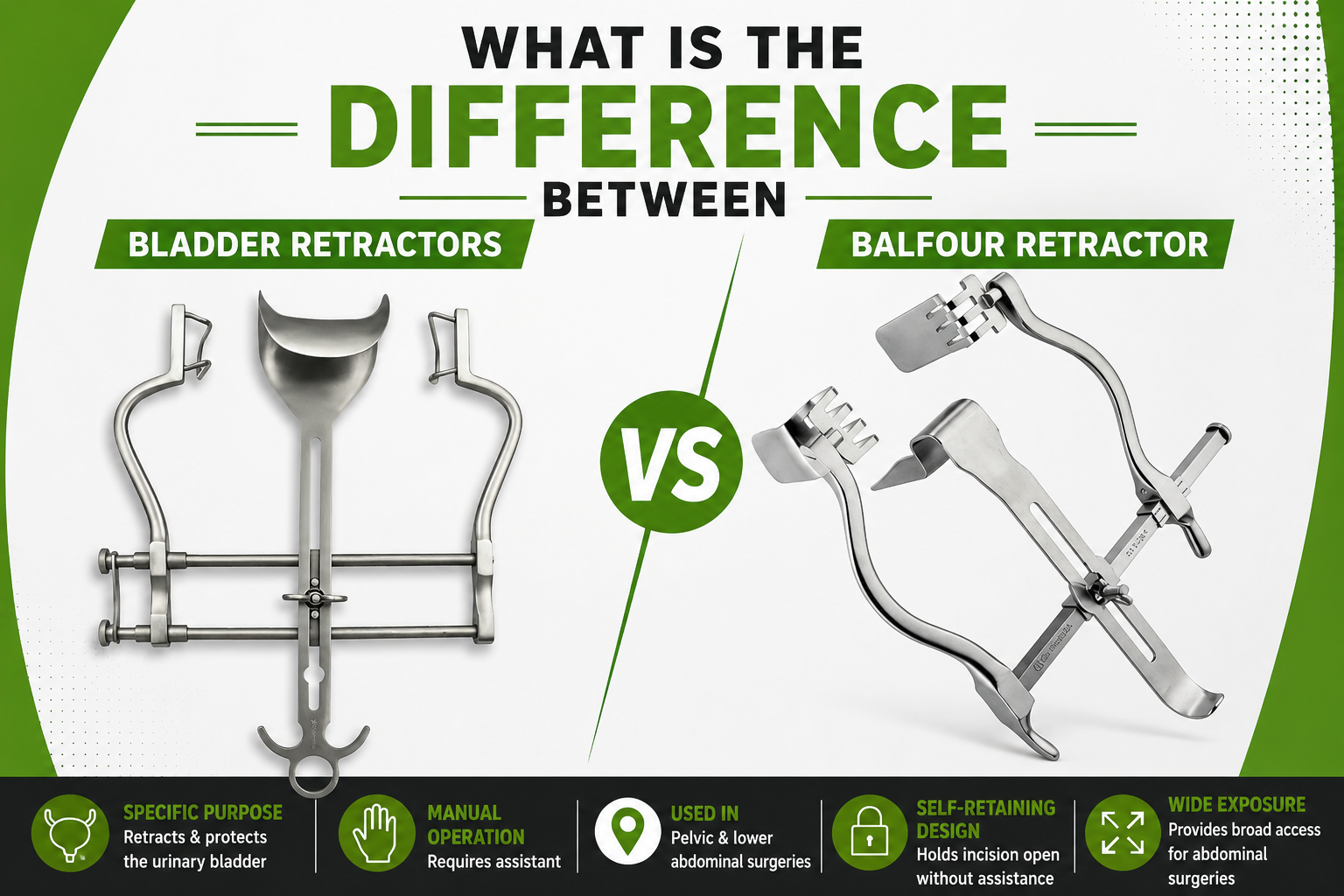
Although Bladder Retractors and Balfour Retractors are both used to improve surgical exposure during abdominal and pelvic procedures, they are designed for different clinical purposes. A bladder retractor is a specialized instrument used to protect and retract the urinary bladder during pelvic surgery, whereas a Balfour retractor is a self-retaining abdominal retractor designed to hold open large surgical incisions, providing continuous exposure without requiring an assistant.
Understanding the differences between these two retractors helps surgeons, surgical residents, operating room staff, and healthcare facilities choose the appropriate instrument for each procedure.
Quick Comparison Between Bladder Retractor and Balfour Retractor
| Feature | Bladder Retractor | Balfour Retractor |
|---|---|---|
| Primary Purpose | Retracting and protecting the urinary bladder | Maintaining abdominal incision exposure |
| Retraction Type | Manual | Self-retaining |
| Surgical Area | Pelvis and lower abdomen | Abdomen |
| Blade Design | Smooth curved blade | Two lateral blades with a central bladder blade |
| Requires Assistant | Yes | No |
| Exposure | Localized | Wide operative field |
| Common Procedures | Gynecology, Urology, Cesarean Section | General Surgery, Colorectal Surgery, Urology |
What Is a Bladder Retractor?
A bladder retractor is a handheld surgical instrument designed to gently retract the urinary bladder away from the operative field. It protects the bladder from accidental injury while providing improved visualization of nearby anatomical structures.
These retractors usually feature a broad, smooth, curved blade that distributes pressure evenly across the bladder wall, reducing tissue trauma during prolonged procedures.
Bladder retractors are commonly used during pelvic operations where the bladder must be displaced to safely access deeper organs.
What Is a Balfour Retractor?
A Balfour retractor is a self-retaining abdominal retractor widely used in open abdominal surgery. It consists of a central frame with two adjustable lateral blades and, in many configurations, a removable central bladder blade.
Once positioned inside the surgical incision, the retractor remains open without manual assistance, providing continuous exposure throughout the procedure.
Its self-retaining mechanism reduces surgeon fatigue and allows the surgical team to work more efficiently.
Main Difference Between Bladder Retractor and Balfour Retractor
The primary difference is their function.
A bladder retractor is specifically designed to move and protect the urinary bladder during pelvic surgery.
A Balfour retractor is designed to hold an abdominal incision open, creating a stable and unobstructed surgical field for extended procedures.
Although some Balfour retractors include a central bladder blade, the instrument itself is not considered a bladder retractor. The bladder blade is simply one component that helps improve exposure during lower abdominal surgery.
Design Differences
Bladder Retractor Design
Bladder retractors typically feature:
Smooth curved blade
Broad tissue-contact surface
Rounded atraumatic edges
Comfortable ergonomic handle
Manual operation
The design minimizes pressure points and protects delicate pelvic organs.
Balfour Retractor Design
A Balfour retractor includes:
Self-retaining frame
Two adjustable lateral blades
Ratchet locking mechanism
Optional removable bladder blade
Heavy-duty stainless steel construction
This configuration provides stable, hands-free abdominal exposure throughout the operation.
Surgical Applications
Bladder Retractor
Bladder retractors are frequently used during:
Cesarean sections
Radical hysterectomy
Pelvic reconstructive surgery
Prostate surgery
Bladder surgery
Gynecologic oncology procedures
Urologic operations
Any procedure requiring protection of the bladder
Balfour Retractor
Balfour retractors are commonly used during:
Exploratory laparotomy
Colon surgery
Small bowel surgery
Gastrectomy
Open appendectomy
Radical cystectomy
Major gynecologic surgery
Open urologic procedures
General abdominal surgery
Retraction Method
The method of retraction is another important distinction.
A bladder retractor requires continuous manual control by a surgeon or surgical assistant. This allows frequent adjustments while working around delicate pelvic structures.
A Balfour retractor locks into position using its ratchet mechanism, maintaining consistent retraction without requiring additional personnel.
For long abdominal procedures, this self-retaining feature significantly improves operating room efficiency.
Advantages of a Bladder Retractor
Bladder retractors offer several important benefits. They provide gentle handling of delicate bladder tissue, reduce the risk of accidental injury, improve visualization during pelvic surgery, allow precise manual control, and are available in multiple blade sizes to accommodate different procedures.
Advantages of a Balfour Retractor
Balfour retractors provide wide surgical exposure during open abdominal procedures while remaining securely in position throughout the operation. Their self-retaining design reduces the need for continuous manual assistance, helps decrease surgeon fatigue, allows adjustable blade positioning, and maintains a stable operative field during lengthy surgeries.
Which Retractor Should You Choose?
The appropriate retractor depends on the procedure being performed.
A bladder retractor should be selected whenever the urinary bladder must be gently displaced or protected during pelvic surgery.
A Balfour retractor is the preferred choice for open abdominal procedures requiring prolonged, hands-free exposure through a large incision.
In many lower abdominal operations, surgeons use both instruments together. The Balfour retractor maintains the abdominal incision, while a dedicated bladder retractor provides additional protection and precise displacement of the bladder when needed.
Frequently Asked Questions
Is the bladder blade on a Balfour retractor the same as a bladder retractor?
No. The bladder blade is only one attachment of the Balfour retractor. A dedicated bladder retractor is a separate handheld instrument specifically designed for manual bladder retraction and protection.
Which retractor provides wider exposure?
The Balfour retractor provides significantly wider exposure because it retracts the entire abdominal incision rather than a single organ.
Which retractor requires an assistant?
A bladder retractor is manually held and generally requires an assistant or surgeon to maintain retraction. A Balfour retractor is self-retaining and remains in place once adjusted.
Can both retractors be used during the same procedure?
Yes. During many gynecologic, urologic, and lower abdominal surgeries, a Balfour retractor is used to maintain the abdominal incision while a bladder retractor is employed to protect and reposition the bladder, providing safer access to deeper pelvic structures.
Final Thoughts
Although Bladder Retractors and Balfour Retractors are both essential surgical retractors, they serve different purposes. A bladder retractor is a specialized handheld instrument designed to gently protect and retract the urinary bladder during pelvic procedures, while a Balfour retractor is a self-retaining abdominal retractor that maintains a wide operative field throughout open surgery.
Understanding these differences allows surgeons and healthcare professionals to select the most appropriate instrument for each procedure, improving surgical exposure, protecting delicate tissues, enhancing operative efficiency, and contributing to better patient outcomes.