
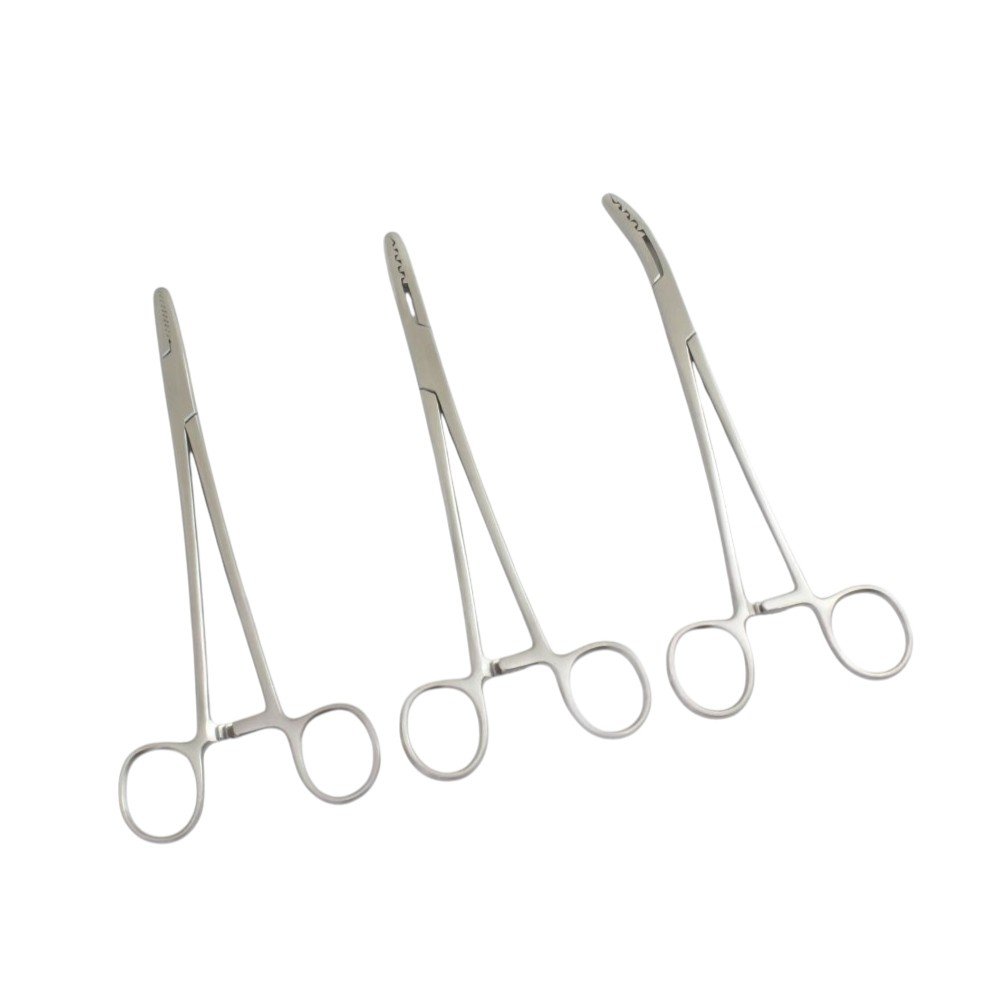
The Cartilage Seizing Forceps & Meniscus Forceps – Bone Holding, 3 PCs Set, Orthopedic is designed for orthopedic procedures requiring controlled grasping, holding, and manipulation of cartilage, meniscal tissue, and selected surgical structures. A dedicated forceps set can provide different jaw configurations to accommodate variations in tissue thickness, anatomy, and operative access.
Cartilage seizing forceps are designed to provide a secure grip on cartilage or other firm tissue during selected orthopedic procedures. Their working jaws are intended to engage the target structure while allowing the surgeon to maintain controlled manipulation. The precise jaw pattern and size determine the appropriate application.
Meniscus forceps are specialized instruments used for handling and manipulating meniscal tissue during selected knee procedures. Their working ends can provide access within the joint or through an operative incision, depending on the instrument design. The exact clinical application depends on the forceps geometry and the surgical technique.
This 3-piece configuration provides multiple forceps options within one coordinated set. Different jaw profiles or lengths can allow the surgical team to select an instrument appropriate for the anatomical location and procedural requirement. Exact jaw dimensions, tip patterns, shaft lengths, and individual instrument designs should be verified against the supplied set configuration.
The instruments may support selected orthopedic, sports medicine, arthroscopy, and joint surgery procedures. In knee surgery, appropriately designed meniscus forceps may assist with controlled manipulation of meniscal tissue during procedures where tissue handling is required. Cartilage seizing forceps may also be useful in selected procedures involving cartilage or other firm tissue structures.
The term bone holding in the product description can refer to the ability of certain forceps designs to securely grasp selected firm structures. However, not every cartilage or meniscus forceps is intended to function as a heavy-duty bone-holding clamp. The instrument should only be used for the purpose specified by its design and applicable manufacturer instructions.
The specialized working jaws are particularly important in orthopedic surgery because controlled tissue handling can help the surgeon maintain access while reducing unnecessary manipulation. Forceps should be applied using appropriate technique and should not be overloaded beyond their intended mechanical capacity.
The three-piece set format can simplify operating-room preparation by keeping related orthopedic forceps together. Having multiple sizes or configurations readily available can help surgical staff prepare for procedures involving cartilage, meniscal tissue, or related joint structures. A defined set also supports postoperative counting, inspection, cleaning, and reassembly.
These forceps may be particularly useful in knee and joint procedures, although exact applications depend on the instrument configuration. Additional instruments such as arthroscopic graspers, punches, scissors, probes, retractors, or other specialty tools may be required depending on the procedure.
Instrument condition is important because forceps rely on precise jaw alignment and controlled mechanical action. Before every use, inspect the jaws for alignment, surface damage, deformation, corrosion, and excessive wear. Hinged components should open and close smoothly and should maintain proper grip throughout the intended range.
The exact material is not specified in the product title. Orthopedic forceps are commonly manufactured from medical-grade stainless steel or other suitable surgical materials, but the precise alloy, finish, hardness, and manufacturing standard should be confirmed from the applicable product documentation.
For reusable instruments, cleaning, disinfection, sterilization, and inspection should follow validated manufacturer instructions. Hinges, serrations, jaw surfaces, and other areas where biological material can accumulate require thorough cleaning. Proper maintenance helps preserve the mechanical performance of the forceps.
The Cartilage & Meniscus Forceps Set 3 Pcs is suitable for orthopedic hospitals, sports medicine centers, arthroscopy units, surgical clinics, and professional operating rooms requiring a focused selection of forceps for cartilage and meniscal tissue handling.
Key Features
- 3-piece orthopedic forceps set
- Includes cartilage seizing and meniscus forceps
- Designed for controlled tissue grasping and manipulation
- Suitable for selected orthopedic procedures
- Useful for meniscal and cartilage tissue handling
- Supports selected knee and joint surgery applications
- Multiple forceps configurations provide procedural flexibility
- Precision jaws for controlled engagement
- Suitable for open or arthroscopic workflows depending on instrument design
- Hinged mechanisms support controlled operation
- Working jaws require careful inspection before use
- Reusable when specifically designed and labeled for repeated clinical use
Product Specifications
| Specification | Details |
|---|---|
| Product Name | Cartilage Seizing Forceps & Meniscus Forceps |
| Set Quantity | 3 Pieces |
| Product Type | Orthopedic Surgical Forceps Set |
| Primary Specialty | Orthopedic Surgery |
| Secondary Applications | Arthroscopy / Sports Medicine |
| Primary Function | Tissue Grasping, Holding and Manipulation |
| Instrument Types | Cartilage Seizing Forceps, Meniscus Forceps |
| Working End | Grasping / Seizing Jaws |
| Jaw Configuration | Model / Instrument Dependent |
| Shaft Length | Configuration Dependent |
| Surgical Applications | Cartilage, Meniscus and Joint Procedures |
| Material | Surgical Instrument Material, Configuration Dependent |
| Reusable | Depending on Product Configuration |
| Sterilization | Follow Validated Reprocessing Instructions |
| Storage | Surgical Tray or Suitable Instrument Container |
| Contents | 3 Orthopedic Forceps |
FAQs
What are cartilage seizing forceps used for?
Cartilage seizing forceps are designed to grasp and manipulate cartilage or other firm tissue structures during selected orthopedic procedures.
What are meniscus forceps used for?
Meniscus forceps are designed for controlled handling and manipulation of meniscal tissue during selected knee and orthopedic procedures.
How many forceps are included in this set?
The set contains 3 orthopedic forceps, with cartilage-seizing and meniscus-handling configurations.
Can these forceps be used in knee surgery?
Appropriately configured meniscus and cartilage forceps can support selected knee procedures where controlled tissue grasping or manipulation is required.
Can these instruments be used for arthroscopy?
Some forceps may be suitable for arthroscopic procedures when their shaft length, diameter, working end, and portal compatibility are appropriate.
What is the difference between cartilage forceps and meniscus forceps?
Cartilage forceps are designed for grasping selected cartilage or firm tissue, while meniscus forceps are specifically configured for handling meniscal tissue. Exact differences depend on the jaw design.
Are these forceps bone-holding instruments?
The product listing includes “bone holding,” but forceps intended specifically for cartilage or meniscus handling should not automatically be treated as heavy-duty bone-holding forceps. The intended function should be confirmed from the individual instrument specifications.
Why are multiple forceps included in the set?
Different jaw shapes, sizes, or shaft configurations provide options for different anatomical locations and tissue-handling requirements.
Are cartilage and meniscus forceps reusable?
They may be reusable when specifically manufactured and labeled for repeated clinical use. Reusable instruments must be properly cleaned, inspected, sterilized, and maintained.
How should orthopedic forceps be sterilized?
Cleaning and sterilization should follow validated manufacturer instructions for the exact instruments and materials. Hinges, jaws, serrations, and other difficult-to-clean areas require careful processing.
What should be inspected before using the forceps?
Check jaw alignment, grip function, hinge movement, shaft integrity, surface condition, corrosion, and signs of deformation or excessive wear before clinical use.
Can these forceps be used for all orthopedic procedures?
No. Instrument selection depends on the anatomy, procedure, tissue type, and forceps design. Additional specialized orthopedic instruments may be required.




Reviews
There are no reviews yet.