
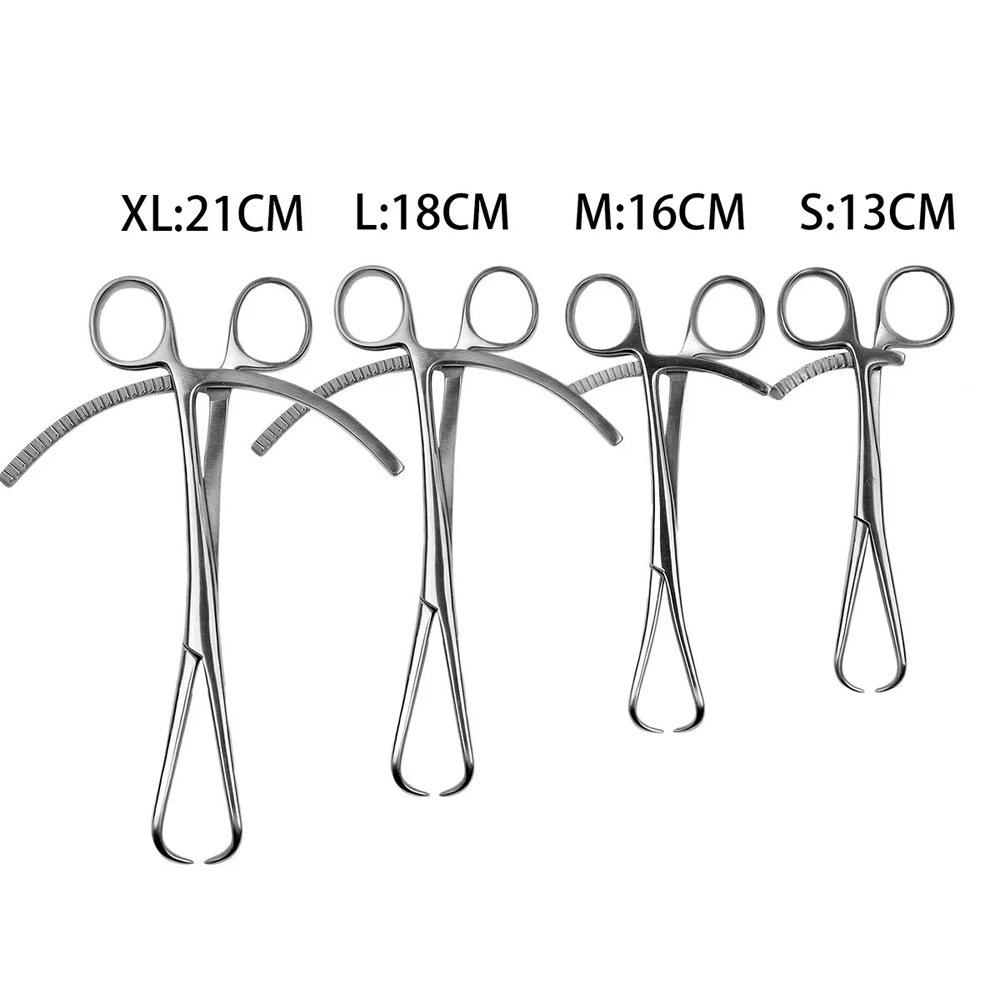
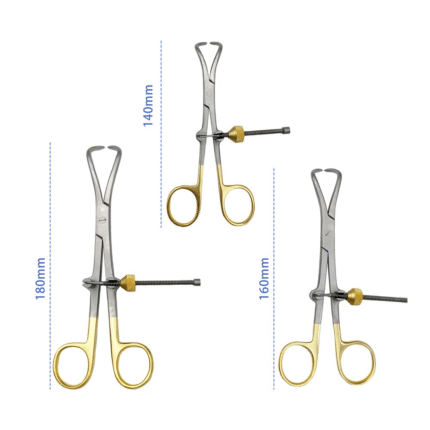
The Pointed Bone Reduction Forceps – Long Ratchet Curved Jaw Orthopedic Surgical Instrument is a specialized orthopedic surgical instrument designed to assist with controlled manipulation, alignment, and temporary stabilization of bone fragments during fracture reduction procedures. Its combination of long handles, curved pointed jaws, and a ratcheting mechanism provides the surgeon with a practical instrument for working around deeper operative sites.
The curved jaws are designed to engage bone with focused contact through their pointed working ends. This configuration can help the surgeon grasp and maintain control of a selected bone fragment while restoring fracture alignment. The curved profile may also provide improved access around anatomical structures compared with a straight-jaw instrument, depending on the surgical approach and operative site.
A built-in ratchet mechanism allows the forceps to maintain a selected grip without requiring continuous hand pressure. This can help support temporary stabilization while the surgeon evaluates alignment or prepares for definitive fixation. The locking action should be applied appropriately and only with the amount of force necessary for the intended reduction task.
The extended design is particularly useful when the operative site requires additional reach. Long reduction forceps can help the surgeon access bone fragments located deeper within the surgical field while keeping the handles positioned outside the immediate working area. Exact suitability depends on the patient’s anatomy, fracture pattern, surgical approach, and instrument dimensions.
Pointed bone reduction forceps are commonly used during orthopedic trauma and reconstructive procedures where accurate fragment positioning is necessary before definitive fixation. They may be used during preparation for plate-and-screw fixation or other orthopedic fixation techniques. The forceps provide temporary control and should not be considered a substitute for definitive fixation unless specifically intended as part of the selected surgical technique.
The ratchet and jaw assembly should operate smoothly and remain properly aligned during use. The pointed tips should be inspected before every procedure for deformation, damage, or excessive wear. Damaged or misaligned forceps should be removed from service because reliable jaw engagement is important for controlled handling of bone fragments.
For reusable surgical instruments, appropriate cleaning and reprocessing are essential. After use, the forceps should be thoroughly cleaned according to the manufacturer’s instructions, with particular attention to the jaw area and ratchet mechanism. The instrument should be rinsed, dried, inspected, lubricated where applicable, packaged appropriately, and sterilized using a validated method compatible with the instrument.
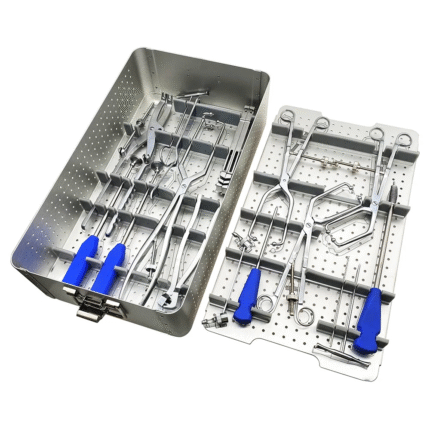
The Long Pointed Bone Reduction Forceps with Curved Jaw and Ratchet is a useful addition to orthopedic trauma instrument trays where extended reach, controlled bone engagement, and temporary fragment stabilization are required. Its specialized working profile makes it suitable for professional orthopedic surgical environments and fracture reduction procedures.
Key Features
- Long pointed bone reduction forceps for orthopedic surgery
- Curved pointed jaws provide focused bone engagement
- Ratchet mechanism helps maintain a controlled grip
- Extended profile provides additional working reach
- Designed for manipulation and alignment of bone fragments
- Useful for temporary stabilization during fracture reduction
- Suitable for orthopedic trauma and reconstructive procedures
- Curved jaw profile can assist access around the operative field
- Manual operation provides tactile control during reduction
- Suitable for use before definitive orthopedic fixation
- Reusable when permitted by manufacturer specifications
- Requires proper cleaning, inspection, and validated sterilization
Product Specifications
| Specification | Details |
|---|---|
| Product Name | Pointed Bone Reduction Forceps |
| Instrument Type | Orthopedic Bone Reduction Forceps |
| Jaw Design | Curved Pointed Jaw |
| Mechanism | Ratchet / Locking Mechanism |
| Profile | Long / Extended |
| Primary Function | Bone Fragment Reduction and Stabilization |
| Application | Orthopedic Trauma and Fracture Surgery |
| Operation | Manual |
| Working End | Pointed Curved Jaws |
| Construction | Surgical Instrument Metal |
| Reusable | Yes, when designated for reusable use |
| Sterilization | According to manufacturer-validated instructions |
| Use | Professional Orthopedic Surgical Procedures |
FAQs
What are long pointed bone reduction forceps used for?
They are used to grasp, manipulate, align, and temporarily stabilize bone fragments during orthopedic fracture reduction and related surgical procedures.
What is the purpose of the curved jaw?
The curved jaw provides a different working angle and can help the surgeon engage bone around deeper or anatomically restricted operative areas.
What does the ratchet mechanism do?
The ratchet mechanism allows the forceps to maintain a selected grip, reducing the need for continuous manual pressure while the bone fragment is being positioned.
Why use a long bone reduction forceps?
The extended length can provide additional reach when the target bone fragment is located deeper within the surgical field or when the surgical approach requires increased working distance.
Can these forceps be used for plate fixation?
They may be used during fracture reduction before or while preparing for definitive plate fixation. Their role is generally temporary reduction and fragment control rather than replacing the fixation implant.
Are pointed bone reduction forceps reusable?
They can be reusable when manufactured and designated for reusable surgical use. Cleaning, inspection, maintenance, and sterilization must follow the manufacturer’s validated instructions.
What should be inspected before surgery?
Check the pointed tips, jaw alignment, ratchet function, handles, surface condition, and overall mechanical operation. Instruments showing damage, excessive wear, or misalignment should not be used.




Reviews
There are no reviews yet.