

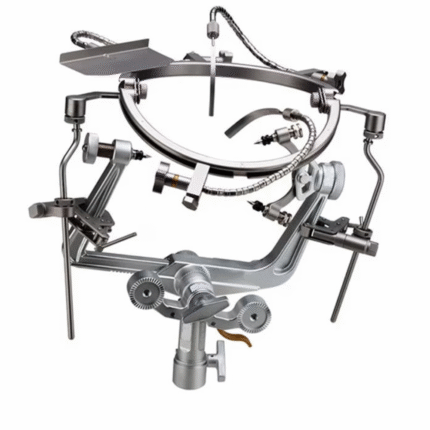
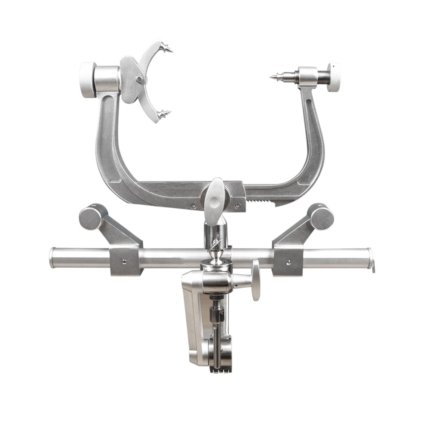
The Surgical Craniotomy Three-Point Support System – Stainless Steel Mayfield Head Clamp Retractor for Neurosurgery is a specialized cranial positioning device designed to stabilize the patient’s head during neurosurgical procedures. Three-point skull fixation provides a rigid support arrangement that helps minimize unintended head movement while allowing the surgical team to position the patient’s head according to the operative approach.
A three-point head clamp generally uses three skull fixation points to secure the head within the support system. This configuration is designed to provide stable immobilization while leaving much of the surgical field accessible. Proper placement and fixation are essential and should be performed by trained surgical personnel according to the applicable device instructions and institutional protocols.
The system is particularly relevant to craniotomy and intracranial neurosurgical procedures, where a stable head position can support controlled surgical access. It may also be applicable to selected tumor, vascular, trauma, skull-base, and other cranial procedures where rigid cranial fixation is required.
The Mayfield-style head clamp design is intended to integrate with a compatible operating-table mounting or neurosurgical support system. The exact mounting interface, adjustment mechanism, skull pins, and accessory components can vary between product configurations. Compatibility with the intended operating table and supporting hardware should therefore be verified before clinical use.
The stainless steel construction provides a durable material for professional surgical handling. Stainless steel is commonly used in reusable surgical equipment because of its resistance to corrosion and ability to withstand appropriate cleaning and sterilization procedures when the specific instrument is designed and validated for reuse. The exact stainless steel grade and surface finish should be confirmed from the applicable product documentation.
Stable cranial positioning can be particularly important during procedures performed with surgical microscopes, navigation systems, or other precision equipment. Unintended movement of the patient’s head can affect the relationship between the patient and surgical field, so the fixation system should be applied and checked carefully before the procedure begins.
Depending on the configuration, the head clamp may allow adjustment of head orientation in multiple directions. This can help the surgical team establish an appropriate operative angle for the intended craniotomy or intracranial approach. The selected position should take into account patient anatomy, surgical access, equipment clearance, and the requirements of the specific procedure.
The three-point fixation design also provides open access around the head compared with positioning methods that rely on larger external supports. This can facilitate surgical preparation and draping while allowing access to the cranial operative area. Exact positioning remains the responsibility of the trained surgical team.
Before each use, the Mayfield head clamp should be inspected for structural integrity, secure fixation mechanisms, properly functioning adjustment components, intact skull pins, and undamaged mounting interfaces. Any component showing deformation, excessive wear, corrosion, or mechanical malfunction should be removed from service and evaluated appropriately.
For reusable components, cleaning and sterilization should follow the validated instructions applicable to the exact model and materials. Skull pins, joints, locking mechanisms, mounting interfaces, and other areas where biological material can accumulate require careful cleaning and inspection. Sterilization should only be performed using a method approved for the specific component.
The Stainless Steel Mayfield Head Clamp Three-Point Support System is suitable for hospitals, neurosurgical operating rooms, cranial surgery centers, and specialty surgical facilities requiring controlled head stabilization during professional neurosurgical procedures. Its rigid fixation design supports consistent cranial positioning while providing access to the operative field.
Key Features
- Three-point cranial fixation system
- Mayfield-style head clamp configuration
- Designed for neurosurgical head stabilization
- Suitable for craniotomy and intracranial procedures
- Stainless steel construction
- Supports controlled and secure head positioning
- Open configuration provides access to the cranial operative field
- Suitable for selected tumor, vascular, trauma, and skull-base procedures
- Adjustable positioning depending on system configuration
- Compatible mounting interface should be verified before use
- Skull pins and fixation components require careful inspection
- Reprocessing must follow validated manufacturer instructions
Product Specifications
| Specification | Details |
|---|---|
| Product Name | Surgical Craniotomy Three-Point Support System |
| Instrument Type | Mayfield-Style Head Clamp / Skull Fixation System |
| Primary Specialty | Neurosurgery |
| Fixation Configuration | Three-Point Cranial Fixation |
| Primary Function | Head Stabilization and Surgical Positioning |
| Applications | Craniotomy, Intracranial, Skull-Base Procedures |
| Construction | Stainless Steel |
| Positioning | Adjustable, System Dependent |
| Patient Interface | Skull Fixation Pins |
| Mounting | Compatible Neurosurgical Table Interface |
| Adjustment Mechanism | Model / Configuration Dependent |
| Reusable | Depending on Product Configuration |
| Sterilization | Follow Validated Manufacturer Instructions |
| Compatibility | Verify Clamp, Pins, Mounting Hardware, and Table Compatibility |
| Intended Setting | Neurosurgical Operating Room |
FAQs
What is a three-point Mayfield head clamp used for?
A three-point Mayfield-style head clamp is used to secure and stabilize the patient’s head during neurosurgical procedures requiring controlled cranial positioning.
Why is three-point skull fixation used in craniotomy?
Three-point fixation provides a rigid support arrangement designed to limit unintended head movement while allowing access to the cranial surgical field.
What procedures use a Mayfield head clamp?
Mayfield-style head clamps may be used during craniotomy, intracranial tumor procedures, vascular neurosurgery, trauma surgery, skull-base procedures, and other operations requiring rigid head stabilization.
Is this Mayfield head clamp made from stainless steel?
Yes. This product is specified as a stainless steel three-point Mayfield-style head clamp system.
Can the head clamp be adjusted?
Mayfield-style systems generally provide positioning adjustments, but the exact range and adjustment mechanisms depend on the specific configuration.
Can this clamp be connected to any operating table?
No. Mounting interfaces vary between neurosurgical systems and tables. Compatibility should be confirmed between the head clamp, mounting hardware, and intended operating table.
What is the purpose of the skull pins?
The skull pins provide the fixation points through which the clamp secures the patient’s head. Their application must follow the appropriate clinical technique and device instructions.
Can a Mayfield head clamp be used with a surgical microscope?
A compatible cranial fixation system can support procedures performed with a surgical microscope by helping maintain a stable patient head position. Compatibility with the complete operating setup should be confirmed.
Is the stainless steel head clamp reusable?
It may be reusable when specifically designed and labeled for repeated clinical use. Reusable components must be appropriately cleaned, inspected, sterilized, and maintained.
How should the Mayfield head clamp be sterilized?
Cleaning and sterilization should follow the validated instructions for the exact clamp, pins, and other components. Different parts may have specific reprocessing requirements.
What should be inspected before using the head clamp?
Inspect the fixation mechanism, skull pins, joints, adjustment components, mounting interfaces, and structural surfaces for damage, corrosion, deformation, excessive wear, or improper operation before clinical use.





Reviews
There are no reviews yet.