
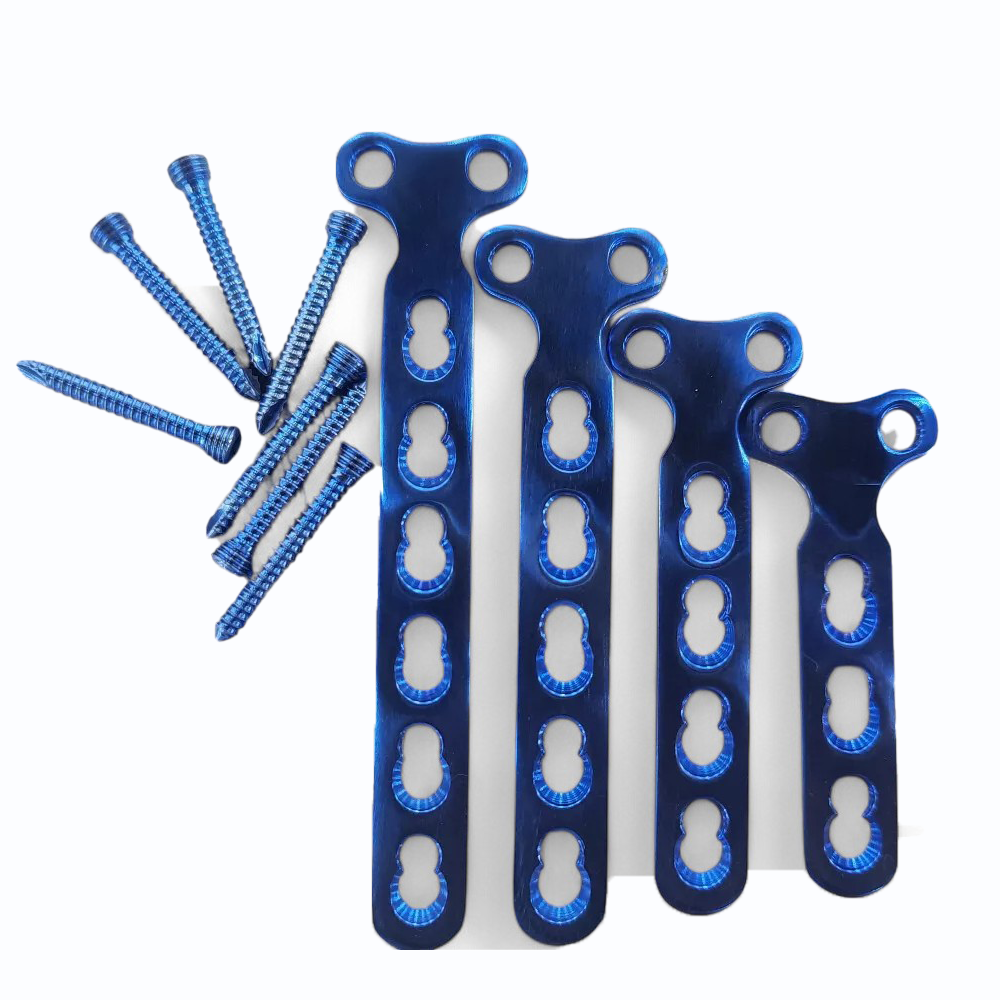
The Titanium T Locking Plates 2.7/2.4mm LCP 30 Pc Set is a specialized orthopedic implant collection designed to support fracture fixation using compatible 2.7 mm and 2.4 mm LCP locking screws. The set contains 30 titanium T-shaped locking plates with configurations ranging from 3 to 6 holes, providing a selection of plate options for different fixation requirements.
Locking plate technology is widely used in modern orthopedic trauma surgery because locking screws can engage threaded plate holes to create a fixed-angle relationship between the screw and plate. This construct can be useful when angular stability is desired and may provide an alternative to traditional compression-based plating techniques depending on the fracture pattern, bone quality, anatomical location, and surgeon’s chosen fixation strategy.
The T-locking plate design provides a specialized geometry that can be useful for selected fracture patterns where a transverse or T-shaped plate configuration is appropriate. The exact anatomical application of each plate should be determined from its specific dimensions, contour, hole arrangement, and validated implant documentation. Because only the hole range is specified in the product title, individual anatomical indications should not be assumed without the manufacturer’s detailed implant specifications.
The 30-piece configuration provides multiple options within the same plate family. Plates with 3, 4, 5, and 6 holes can provide different working lengths and fixation opportunities, allowing the surgical team to select a suitable plate according to the fracture morphology and available bone stock. The exact number of each plate size included in the 30-piece set should be confirmed against the supplier’s implant inventory.
The plates are manufactured from titanium, a material widely used in orthopedic implants because of its favorable strength-to-weight characteristics, corrosion resistance, and established use in implantable orthopedic devices. Titanium can also offer a relatively low-density alternative to stainless steel and is commonly selected for applications where biocompatibility and implant performance are important considerations.
The 2.7/2.4 mm LCP screw compatibility provides the plate system with a small-fragment fixation profile. However, compatibility should always be verified using the exact screw, thread, pitch, hole geometry, and manufacturer specifications. A locking plate should only be used with screws specifically approved or validated for that plate system. Mixing components from unrelated manufacturers or systems without documented compatibility can compromise the intended fixation construct.
The plates are intended to be selected according to the patient’s anatomy and fracture characteristics. Proper plate positioning, contour, screw trajectory, screw length, and fixation sequence are determined by the operating surgeon using the applicable surgical technique. The implant should not be considered a substitute for appropriate fracture assessment, reduction, fixation planning, or surgical expertise.
The T-Locking Plates Set can provide logistical advantages for orthopedic trauma departments and implant distributors. A 30-piece collection consolidates multiple plate configurations into one product family, simplifying implant selection and inventory management. The range of hole counts allows facilities to maintain several fixation options without purchasing each plate configuration individually.
Before clinical use, every implant should be inspected for damage, deformation, contamination, or packaging compromise. Sterile implants must be handled according to the manufacturer’s validated instructions and healthcare-facility protocols. If the supplied plates are non-sterile, they must undergo the validated sterilization process specified by the manufacturer before implantation. Implants intended for single use must not be reused or resterilized unless the manufacturer specifically authorizes such processing.
The T-Locking Plates (3–6 Holes) for 2.7/2.4 mm LCP Screws – Titanium – 30 Pc Set provides orthopedic surgeons and medical facilities with a versatile small-fragment locking plate inventory. Its titanium construction, T-shaped geometry, multiple hole configurations, and compatibility with appropriate 2.7 mm and 2.4 mm LCP screws make it suitable for selected fracture fixation applications where the corresponding implant system is indicated.
Key Features
- Complete 30-piece titanium T-locking plate set
- Plate configurations from 3 to 6 holes
- Designed for compatible 2.7 mm and 2.4 mm LCP screws
- T-shaped locking plate geometry
- Titanium construction for orthopedic implant applications
- Suitable for selected small-fragment fracture fixation
- Locking plate holes designed for compatible fixed-angle screw fixation
- Multiple hole counts provide fixation-length options
- Supports organized orthopedic implant inventory
- Suitable for professional orthopedic trauma applications
- Low-profile small-fragment implant platform
- Exact anatomical indications depend on individual plate specifications
Product Specifications
| Specification | Details |
|---|---|
| Product Name | T-Locking Plates (3–6 Holes) for 2.7/2.4 mm LCP Screws |
| Set Quantity | 30 Pieces |
| Plate Type | T-Locking Plate |
| Hole Configuration | 3–6 Holes |
| Screw Compatibility | 2.7 mm / 2.4 mm LCP Screws |
| Implant Material | Titanium |
| Implant Category | Orthopedic Locking Plates |
| Fixation Type | Locking / Fixed-Angle Fixation |
| Fragment Classification | Small Fragment |
| Plate Geometry | T-Shaped |
| Primary Application | Orthopedic Fracture Fixation |
| Surgical Specialty | Orthopedic Trauma |
| Sterility | Verify supplied product configuration |
| Single/Reusable | Implantable devices are generally intended for single use unless manufacturer documentation states otherwise |
| Intended Users | Orthopedic and Trauma Surgeons |
| Clinical Environment | Hospitals, Trauma Centers, Orthopedic Surgical Facilities |
FAQs
1. What are T-Locking Plates used for?
T-Locking Plates are orthopedic fixation implants designed for selected fracture fixation applications where a T-shaped plate geometry and locking screw construct are appropriate. The exact indication depends on the individual plate design and surgical technique.
2. What screw sizes are compatible with these T-Locking Plates?
The product is specified for compatible 2.7 mm and 2.4 mm LCP screws. Exact screw compatibility must be verified against the manufacturer’s implant system specifications.
3. How many plates are included in this set?
The product title specifies a 30-piece set containing T-locking plates with configurations ranging from 3 to 6 holes.
4. What material are the plates made from?
The plates are specified as titanium. Titanium is widely used for orthopedic implants because of its corrosion resistance, strength-to-weight characteristics, and established use in implantable medical devices.
5. What does 3–6 holes mean?
The 3–6 hole designation indicates that the set contains plate configurations with different numbers of fixation holes, ranging from 3-hole through 6-hole designs. The exact distribution of each configuration should be confirmed from the supplier’s inventory list.
6. Are these plates compatible with any 2.7 mm or 2.4 mm screw?
No. Screw compatibility should not be assumed based solely on diameter. The screw’s thread design, locking interface, pitch, head geometry, and manufacturer-specific specifications must correspond to the plate system.
7. Are titanium locking plates suitable for orthopedic fracture fixation?
Titanium is an established material for orthopedic implants and is used in various fracture fixation systems. Suitability depends on the specific implant design, anatomical indication, fracture characteristics, and manufacturer’s validated instructions.
8. Are these locking plates reusable?
Implantable fixation plates are generally intended for single use. They should not be reused, reprocessed, or resterilized unless the manufacturer specifically provides instructions permitting such treatment.



Reviews
There are no reviews yet.