
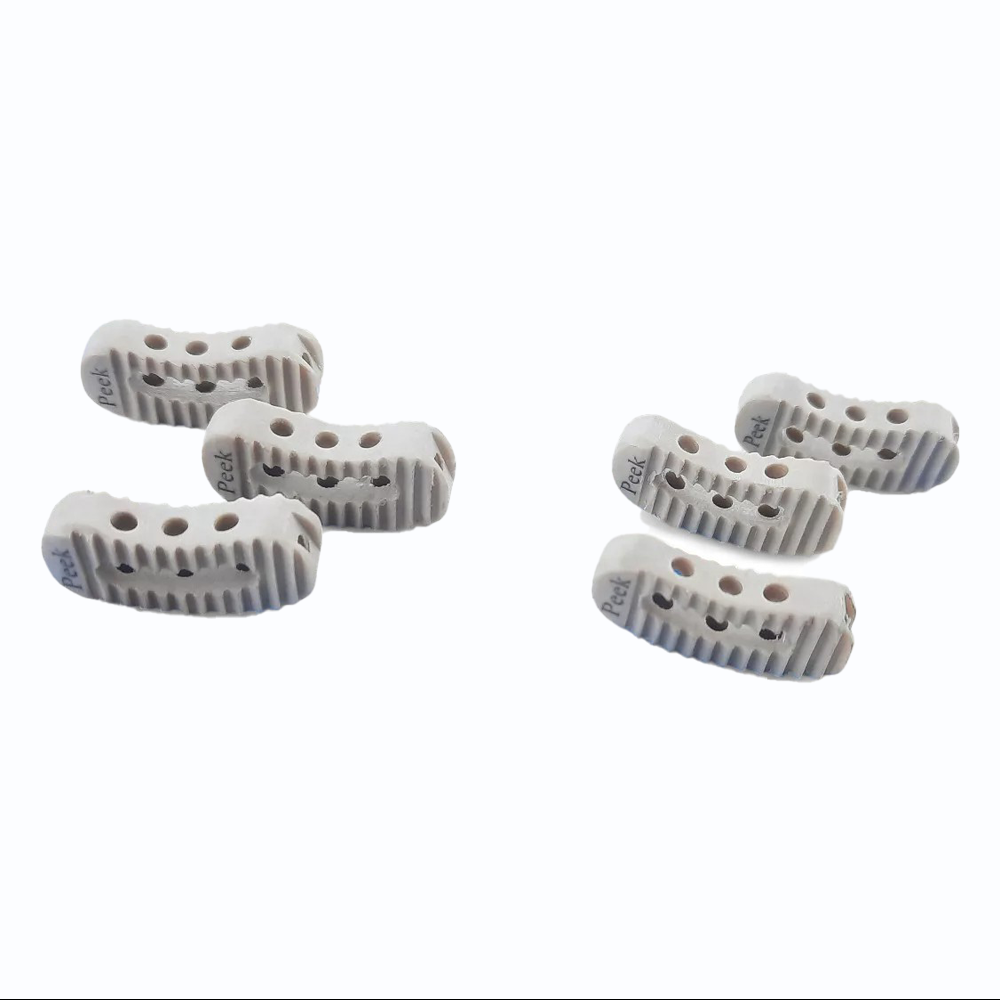
The TLIF Cages PEEK 7×10×28 mm & 8×10×28 mm are spinal interbody fusion implants designed for use in appropriately selected lumbar spine procedures. These cages are intended to be positioned within the intervertebral disc space through a transforaminal approach, providing structural support between adjacent vertebral bodies while creating an environment suitable for bone graft placement and interbody fusion.
TLIF is a commonly used spinal fusion technique in which the surgeon accesses the disc space through a unilateral transforaminal corridor. The approach can provide access to the affected disc while allowing neural decompression and preparation of the intervertebral space according to the patient’s pathology and surgical plan. The exact surgical approach and indications depend on the patient’s anatomy, diagnosis, imaging findings, and surgeon assessment.
The cages are manufactured from PEEK (polyether ether ether ketone), a high-performance polymer widely used in spinal implant applications. PEEK offers radiolucency, allowing postoperative imaging assessment of the surrounding bone and fusion region with reduced implant-related radiographic artifact compared with many metallic materials. The radiolucent nature of PEEK can help clinicians evaluate graft incorporation and fusion progression using appropriate imaging techniques.
The available dimensions are 7×10×28 mm and 8×10×28 mm, providing two cage height options while maintaining a 10 mm width and 28 mm length. Different heights allow the surgical team to select an appropriately sized implant according to the patient’s disc-space anatomy, endplate preparation, desired restoration, and surgical technique. Final cage selection should always be based on direct anatomical assessment and the manufacturer’s sizing guidelines.
An interbody cage serves several important mechanical and biological functions. It can help maintain the desired disc-space geometry, provide anterior-column support, and contain bone graft material intended to facilitate fusion between adjacent vertebral bodies. Proper endplate preparation, cage positioning, graft selection, and postoperative management are important factors influencing fusion outcomes.
The TLIF cage design is intended for insertion into the prepared lumbar intervertebral disc space. The cage should be placed using appropriate system-specific instruments and according to the manufacturer’s surgical technique. Excessive force during insertion should be avoided, and the surgeon should confirm that the cage is appropriately positioned within the disc space.
PEEK’s radiolucent characteristics are particularly useful for postoperative assessment. Because the cage itself produces relatively limited radiographic obstruction, clinicians can use appropriate imaging to evaluate the surrounding vertebral structures and bone graft region. Radiopaque markers may be incorporated into certain PEEK cage designs to assist intraoperative and postoperative localization; the presence, material, and position of markers should be verified from the specific product specification.
These cages may be considered for selected lumbar conditions where interbody fusion is clinically indicated, including certain cases of degenerative disc disease, spondylolisthesis, recurrent disc pathology, foraminal stenosis, spinal instability, and other appropriately selected degenerative or structural conditions. The exact indications, contraindications, levels treated, and surgical technique must be established by the treating spinal surgeon.
Proper implant sizing is essential. A cage that is too small may provide inadequate structural support, while inappropriate oversizing or excessive distraction may affect surrounding anatomy. The surgeon should evaluate disc height, endplate integrity, vertebral anatomy, neural structures, and the desired fusion construct when selecting the implant.
TLIF cages are frequently used as part of a broader spinal fixation construct that may include pedicle screws and rods. Posterior instrumentation can provide additional stabilization when clinically indicated. Whether supplemental fixation is required depends on the surgical plan, spinal level, pathology, bone quality, and implant system.
The implant should be handled carefully to prevent contamination, scratching, deformation, or damage before implantation. Sterility, packaging, storage, and processing requirements depend on the manufacturer’s labeling. Any reusable insertion instruments should be cleaned, inspected, packaged, and sterilized according to validated healthcare-facility procedures.
With PEEK construction, 7×10×28 mm and 8×10×28 mm size options, radiolucent properties, and a design intended for transforaminal lumbar interbody fusion, these cages provide a specialized spinal implant option for appropriately selected lumbar fusion procedures.
Key Features
- Designed for Transforaminal Lumbar Interbody Fusion (TLIF).
- Manufactured from PEEK.
- Radiolucent material supports postoperative imaging assessment.
- Available in 7×10×28 mm size.
- Available in 8×10×28 mm size.
- 10 mm width and 28 mm length across the specified sizes.
- Two height options accommodate different disc-space requirements.
- Provides structural support within the lumbar intervertebral disc space.
- Designed to accommodate bone graft material.
- Suitable for selected lumbar interbody fusion procedures.
- Requires appropriate cage sizing and system-specific insertion instrumentation.
- Intended for professional spinal surgery applications.
Product Specifications
| Specification | Details |
|---|---|
| Product Name | Transforaminal Lumbar Interbody Fusion (TLIF) Cages |
| Implant Type | Lumbar Interbody Fusion Cage |
| Surgical Approach | Transforaminal |
| Material | PEEK |
| Available Size 1 | 7 × 10 × 28 mm |
| Available Size 2 | 8 × 10 × 28 mm |
| Width | 10 mm |
| Length | 28 mm |
| Height Options | 7 mm & 8 mm |
| Primary Application | Lumbar Interbody Fusion |
| Intended Function | Interbody Support and Fusion |
| Graft Compatibility | Designed to accommodate bone graft material |
| Imaging Characteristic | Radiolucent PEEK |
| Surgical Specialty | Spine Surgery / Neurosurgery / Orthopedic Spine |
| Intended Use | Professional spinal surgical applications |
| Instrumentation | Use compatible cage insertion instrumentation |
| Sterilization | Follow product-specific manufacturer instructions and validated protocols |
FAQs
1. What are TLIF cages used for?
TLIF cages are interbody implants designed to provide structural support within the lumbar disc space during transforaminal lumbar interbody fusion procedures and to accommodate bone graft material for spinal fusion.
2. What material are these TLIF cages made from?
These cages are manufactured from PEEK (polyether ether ether ketone), a radiolucent polymer widely used in spinal interbody implants.
3. What sizes are available?
The specified sizes are 7×10×28 mm and 8×10×28 mm.
4. What does 7×10×28 mm mean?
The dimensions represent the cage’s specified height × width × length: 7 mm high, 10 mm wide, and 28 mm long.
5. What does 8×10×28 mm mean?
This configuration has an 8 mm height, 10 mm width, and 28 mm length, providing a taller option than the 7 mm cage.
6. What is the advantage of PEEK for spinal cages?
PEEK is radiolucent, which can reduce radiographic obstruction from the implant and facilitate postoperative assessment of the surrounding bone and fusion region.
7. What is a TLIF procedure?
TLIF, or Transforaminal Lumbar Interbody Fusion, is a spinal fusion technique in which the surgeon accesses the intervertebral disc space through a transforaminal approach and places an interbody cage to support fusion.
Reviews
There are no reviews yet.